


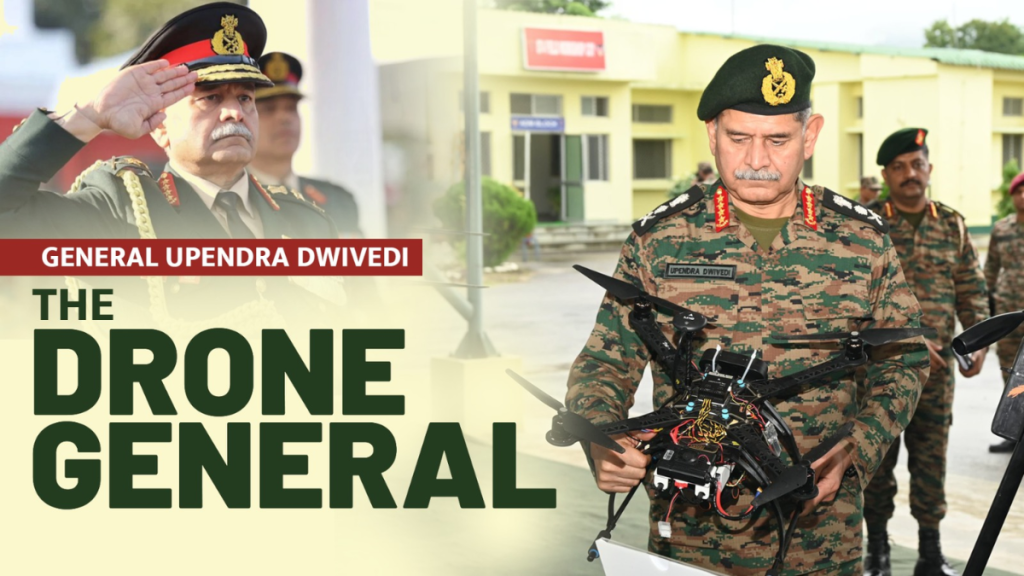
General Upendra Dwivedi will step down as Chief of Army Staff on June 30, 2026, concluding a tenure during which the Indian Army’s drone fleet grew from a few hundred units two years ago to more than 50,000 today — a number expected to double again within the next two to three years.
The scale of that expansion has been matched by infrastructure to support it. More than 25 Drone and Counter-Drone Hubs have been established across military stations nationwide, enabling large-scale induction, training and operational deployment of unmanned systems. Precision engagement capabilities, once largely confined to tactical ranges, have evolved toward strike and surveillance architectures capable of operating at distances approaching 500 kilometres.
The shift has earned General Dwivedi an informal nickname within military circles: “The Drone General.” But officials and analysts say the title understates the breadth of changes made during his tenure, which also restructured how the Army organizes, trains and equips its soldiers.
Under his leadership, the Army stood up new formations including Bhairav Battalions, Ashni Platoons, Rudra All Arms Brigades, Shaktibaan Regiments and Divyastra Batteries, alongside the continued evolution of Integrated Battle Groups. These units reflect a deliberate move away from platform-centric warfare toward what military planners describe as capability-centric, multi-domain operations.
That doctrine was tested operationally during Operation Sindoor, which is increasingly viewed within strategic circles as a template for India’s future approach to conflict. The operation combined integrated planning, real-time intelligence fusion, drones, loitering munitions and electronic warfare in coordinated multi-domain execution.
Along India’s northern borders, the Army simultaneously reinforced surveillance grids, drone deployment, logistics resilience and rapid mobilisation capability, with Eastern Ladakh emerging as a key site for testing new technology and operational concepts. Military planners now widely expect that future conflicts with China or Pakistan would begin in the cyber, information and drone domains before any conventional engagement.
Self-reliance in defence production accelerated alongside the technological shift. Nearly all of the Army’s special clothing requirements and a substantial share of its ammunition needs are now sourced domestically, officials said, the result of expanded partnerships with the Defence Research and Development Organisation, private industry, start-ups, MSMEs and academic institutions.
The Army also deepened its integration with civilian infrastructure during this period. Nearly 100 dual-use infrastructure projects were launched in partnership with various government ministries, while civil aviation resources were increasingly used to support remote deployments — a move officials say preserved military aviation assets for operational contingencies.
International military engagement expanded as well. General Dwivedi presided over forums such as the UNTCC Chiefs Conclave, which drew chiefs and representatives from 32 countries, alongside numerous bilateral meetings with foreign military leadership. A new digital platform, “Friends for Life,” was launched to connect nearly 100,000 alumni of Indian military training institutions across the globe.
Internally, the Army issued close to 25 new doctrines, strategic guidelines, standard operating procedures and policy documents during his tenure, spanning land warfare, strategic security, red teaming, physical fitness standards and emerging domains such as space operations.
Other initiatives launched during this period include an expansion of National Cadet Corps enrollment by nearly 20 percent, the creation of an Indian Army Internship Programme, and the institution of a Veteran Achievers Award. Environmental initiatives included the formation of a Yamuna Task Force, with a similar Aravali Task Force reportedly in planning.
General Dwivedi’s tenure coincided with a broader shift in global military thinking, as conflicts in Ukraine and Gaza demonstrated the growing centrality of drones, artificial intelligence, electronic warfare and precision fires in modern combat. Defence officials say he moved early to align the Indian Army’s modernisation plans with those emerging lessons.
Lieutenant General Dhiraj Seth, currently Vice Chief of the Army Staff, has been named as General Dwivedi’s successor and is set to take over as the 31st Chief of the Army Staff on the afternoon of June 30, bringing nearly four decades of distinguished service across command, staff and strategic appointments. He inherits an institution substantially reshaped in both equipment and doctrine, with the foundations laid over the past two years set to guide the Army’s continued modernisation.
Officials close to the transition describe the changes of the past several years as structural rather than incremental, noting that the formations, doctrines and procurement shifts put in place are built to outlast any single tenure — a marker of the depth of General Dwivedi’s institutional groundwork as he hands over command.