


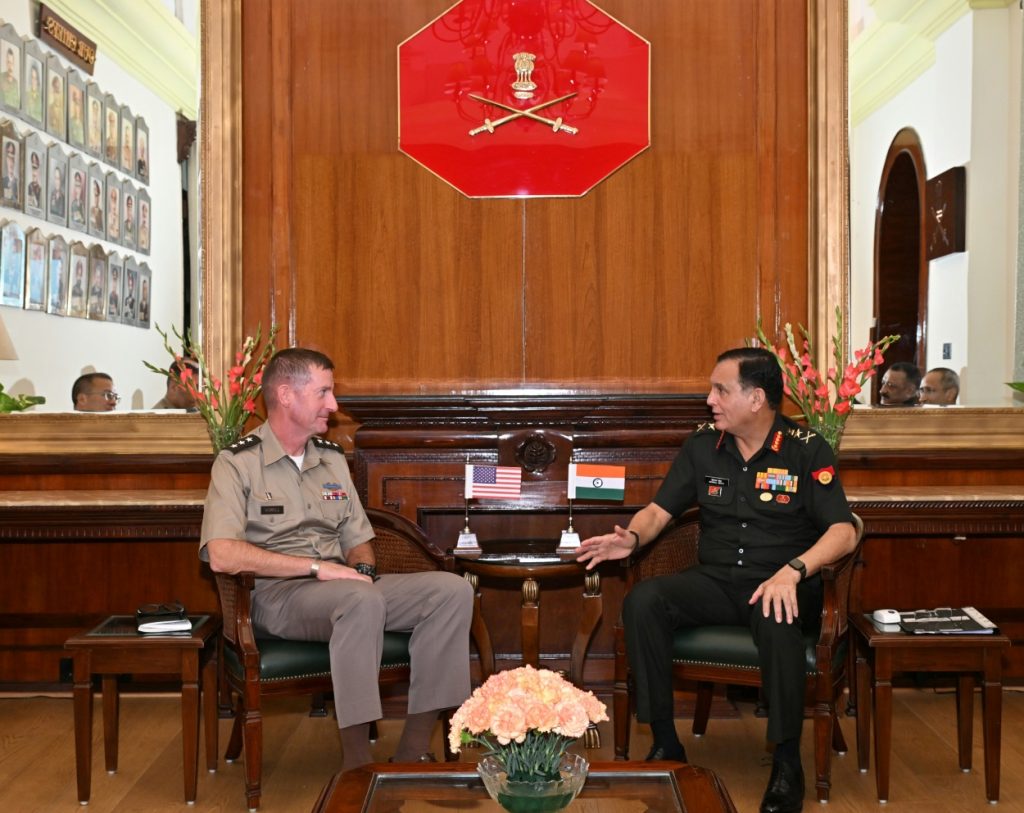
New Delhi: The Indian Army chief, General Dhiraj Seth, and a senior US Army Pacific commander discussed the changing security situation in the Indo-Pacific and ways to deepen military cooperation in New Delhi on Monday. Their meeting followed the Yudh Abhyas 2026 joint exercise that tested how troops from the two countries could plan and operate together in mountain and desert terrain.
The visiting officer, Lieutenant General Joel B Vowell, is the deputy commanding general of US Army Pacific. According to the Army’s account of the talks, the commanders considered cooperation across several operational domains, with particular attention to joint training and exercises.
The talks came immediately after the 22nd edition of Exercise Yudh Abhyas, held at Auli in Uttarakhand and the Mahajan Field Firing Range in Rajasthan. The Ministry of Defence said about 600 personnel from each country took part, practising the employment of integrated battle groups in mountainous and semi-mountainous terrain as well as the use of drones and autonomous systems.
The two locations gave the exercise a broader test than a drill confined to one landscape. In Auli, troops worked on infantry operations, air assaults and the use of each other’s equipment; at Mahajan, they coordinated artillery, aviation and air defence during combined live-fire training.
That practical coordination is what the armies mean by interoperability, which is the ability to understand one another’s procedures, communicate effectively and act together when a task demands it. US and Indian personnel flew drones side by side during the exercise, while the live-fire phase brought Indian systems, including Pinaka rockets and Apache helicopters, into a training event alongside US capabilities such as Himars rockets and counterdrone equipment.
Monday’s meeting did not produce a publicly announced agreement or identify a new joint operation. The Army described the outcome as an exploration of further engagement, linking the commanders’ discussion to lessons from Yudh Abhyas and the continuing programme of military contacts.
Defence cooperation also featured in a separate meeting that day between India’s defence secretary, Rajesh Kumar Singh, and a bipartisan US House of Representatives delegation led by Brian Mast, the chairman of the US house foreign affairs committee. That discussion focused more specifically on defence industry and technology, illustrating how the relationship extends beyond exercises between serving forces.
Both engagements sit within the 10-year framework for the India-US major defence partnership, signed in October 2025 to guide cooperation across the defence relationship. For New Delhi and Washington, the immediate task is to turn that broad commitment into working familiarity between their forces and sustained progress on technology and industrial collaboration.