


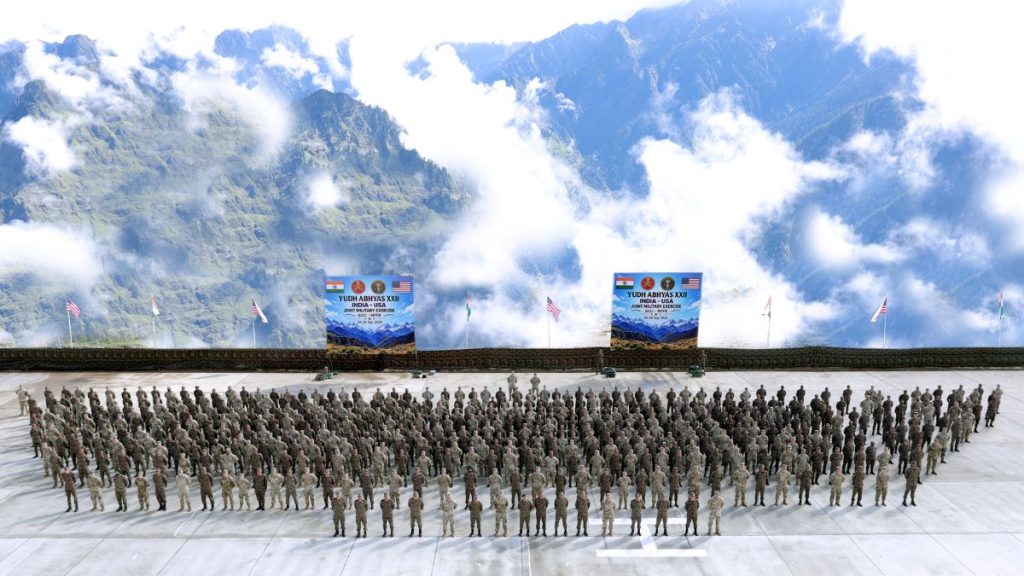
New Delhi: India and the United States are conducting Yudh Abhyas 2026 across desert and high-altitude terrain for the first time. with 600 personnel from each side participating. The 22nd edition, which began on Wednesday and will continue until September 28, is being held at the Mahajan Field Firing Ranges in Rajasthan and Auli in Uttarakhand.
The change is more than geographical. Mahajan offers wide manoeuvre space and long-range firing conditions associated with India’s western desert sector, while Auli, at about 2,500 metres and roughly 95 kilometres from the line of actual control (LAC) with China, brings altitude, difficult logistics and mountain warfare into the same exercise.
This year’s exercise shows how far Yudh Abhyas has moved beyond conventional infantry cooperation. The US Army has deployed Arctic-trained soldiers from its 11th Airborne Division, based in Alaska, while the 3rd Multi-Domain Task Force is bringing long-range precision fires and integrated command and control capabilities into the bilateral framework.
The exercise includes a command-post exercise, field training and a combined live-fire demonstration. The US Army has also brought its mobile low, slow, small unmanned aircraft integrated defeat system, or MLIDS, to India for the first time, strengthening the counterdrone component as unmanned systems and precision strike reshape modern warfare.
New Indian Express reported that the Mahajan phase was expected to bring together India’s Pinaka rocket system and K9 Vajra self-propelled howitzers with the US Himars (high-mobility artillery rocket system). AH-64E Apache attack helicopters were also expected to feature, while the mountain phase at Auli would place greater emphasis on high-altitude manoeuvre, air mobility and lighter artillery such as the M777 ultra-light howitzer.
RNA Media reported earlier, Yudh Abhyas 2026 was planned as a more complex iteration, with Apache attack helicopters, long-range strike capabilities and training at both Auli and Mahajan. The dual-location format had already signalled a shift towards testing interoperability across sharply different operational environments.
Two theatres, two strategic problems
The dual-location format gives Yudh Abhyas added strategic relevance. The Rajasthan phase trains forces in conditions applicable to the western front, where mobility, armour, artillery and long-range fires dominate. The Auli phase shifts the problem to the Himalayas, where altitude, restricted movement and sustainment become decisive.
Officials have not described the exercise as directed against any country, but the geography is difficult to ignore. Training across terrain relevant to India’s western and northern military challenges allows the two armies to test whether procedures, communications and fire-support concepts can move across very different theatres.
It also adds another layer to India’s focus on integrated and multi-domain operations after recent conflicts demonstrated the importance of drones, electronic warfare, precision fires and resilient command networks.
Military ties broaden in 2026
The exercise comes amid sustained bilateral engagement. In March, India and the US held the 18th Defence Policy Group meeting in New Delhi, where the two sides reviewed ongoing initiatives, identified areas for defence co-development and co-production and reaffirmed military-to-military cooperation through exercises and training.
General Upendra Dwivedi, the-then chief of the Army staff, visited the US Army Pacific headquarters in Hawaii in April and held discussions with General Ronald Clark on defence cooperation and Indo-Pacific security. He retired on June 30 and was succeeded by General Dhiraj Seth.
The institutional contact continued in June, when the 29th India-US Army-to-Army Staff Talks in Hawaii focused on interoperability, professional exchanges and military collaboration.
Air and maritime links are also expanding. The Indian Air Force chief, Air Chief Marshal Amar Preet Singh, visited the United States in April and held talks with senior US Air Force leadership on interoperability, modernization and future exercise opportunities. At sea, the Indian and US navies conducted a bilateral Explosive Ordnance Disposal exercise at Kochi in August, while Malabar and the tri-service Tiger Triumph add broader interoperability.