


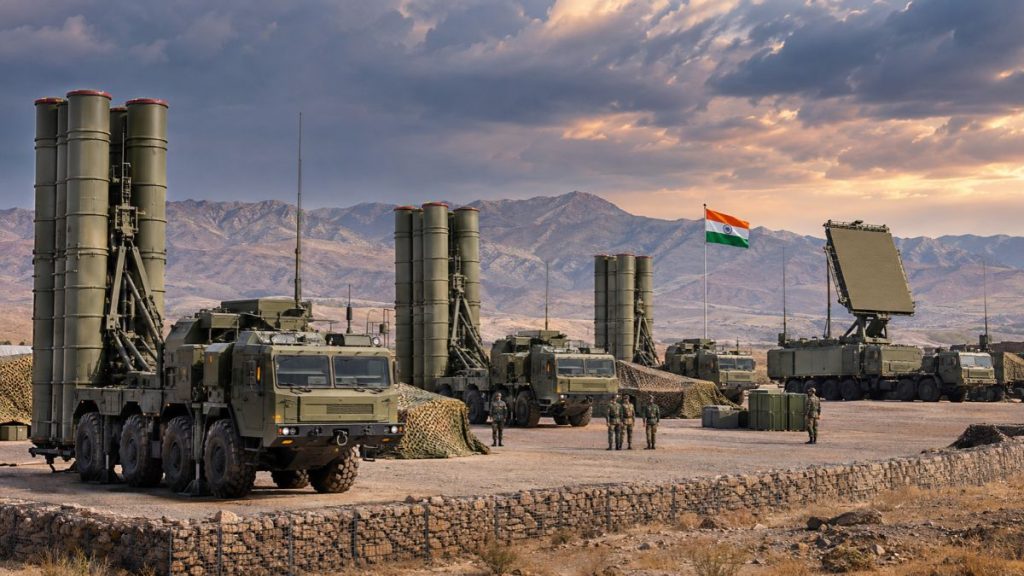
New Delhi: India is preparing to position its fifth Russian-made S-400 Triumf air defence system on the Pakistan-facing frontier, with the equipment expected to be ready for deployment by February 2027. An Indian Air Force team is due to visit Russia in December for a pre-dispatch inspection, according to two senior officials cited by Hindustan Times.
The officials said the system would reinforce coverage of the approximately 740 kilometre line of Control (LOC) in Jammu & Kashmir. The Union government has not publicly confirmed the deployment timetable or disclosed a specific location.
RNA Media reported in June that India had received its fourth S-400 squadron from Russia, with the shipment arriving in multiple consignments. The delivery followed delays to the original schedule caused by disruptions linked to the Russia-Ukraine conflict.
The fifth system is the final outstanding unit under India’s $5.43 billion agreement with Russia in 2018. Four have been delivered, including one received in May–June 2026, Hindustan Times reported earlier this month. Components of the remaining system could begin arriving in January, after an earlier delivery expectation for November slipped.
Existing shield and operational claims
Hindustan Times reported that three systems are stationed in Punjab, Rajasthan and Gujarat, while a fourth is in Assam to provide protection in the eastern theatre. Those reported positions reflect separate requirements along the Pakistan-facing LOC and the line of actual control (LAC) with China.
The S-400 is a mobile surface-to-air missile system designed to engage aircraft, missiles, drones and airborne surveillance platforms. Its interceptor variants have reported engagement ranges of approximately 40 to 400 kilometres, depending on the missile and target. It forms part of layered air defence alongside shorter-range weapons, radar and command systems.
The newspaper credited the S-400 with stopping Pakistani missiles and rockets during Operation Sindoor in May 2025 and reported the destruction of fighter and surveillance aircraft. Those individual aircraft-loss claims have not been independently established.
In a January 2026 announcement describing its Republic Day tableau, the defence ministry depicted an S-400 engagement against an adversary’s airborne early-warning platform at 350 kilometres. The release described a military presentation rather than providing independently verifiable evidence of that particular engagement.
Regional threats and further procurement
The officials linked the planned deployment to Pakistan’s growing military cooperation with China and Turkey, alongside proposed upgrades to its US-origin F-16 fleet. Chinese-origin J-10 fighters and PL-15E air-to-air missiles are among the capabilities informing Indian planning, while the reported possibility of Pakistan receiving J-35 stealth fighters in 2027 remains unconfirmed.
They also cited Turkish support for Pakistan’s submarine upgrades and long-range attack drones, alongside Chinese unmanned aircraft supplied to strengthen Pakistan’s aerial capabilities.
India is also seeking longer-range air-to-air, air-to-ground and ground-to-ground weapons, including loitering munitions, while improving infrastructure along the LAC. A senior military officer quoted by Hindustan Times said: “Whoever has a longer-range missile and better anti-missile capability will have an edge.”
The emphasis on stand-off weapons reflects the increasing importance of striking and intercepting targets without bringing aircraft or ground formations into direct contact. Additional S-400 coverage could improve India’s ability to protect sensitive areas but would not eliminate the challenges posed by low-flying or saturation attacks.
Hindustan Times separately reported that India wants to buy five more S-400 systems from Russia. The defence acquisition council approved the need for further S-400 procurement in March 2026, the defence ministry confirmed, but no new five-system contract has been announced.
The February timetable therefore concerns the final system already ordered in 2018, not the proposed additional purchase. Its eventual deployment, and any further acquisitions, remain dependent on delivery arrangements and subsequent government decisions.