


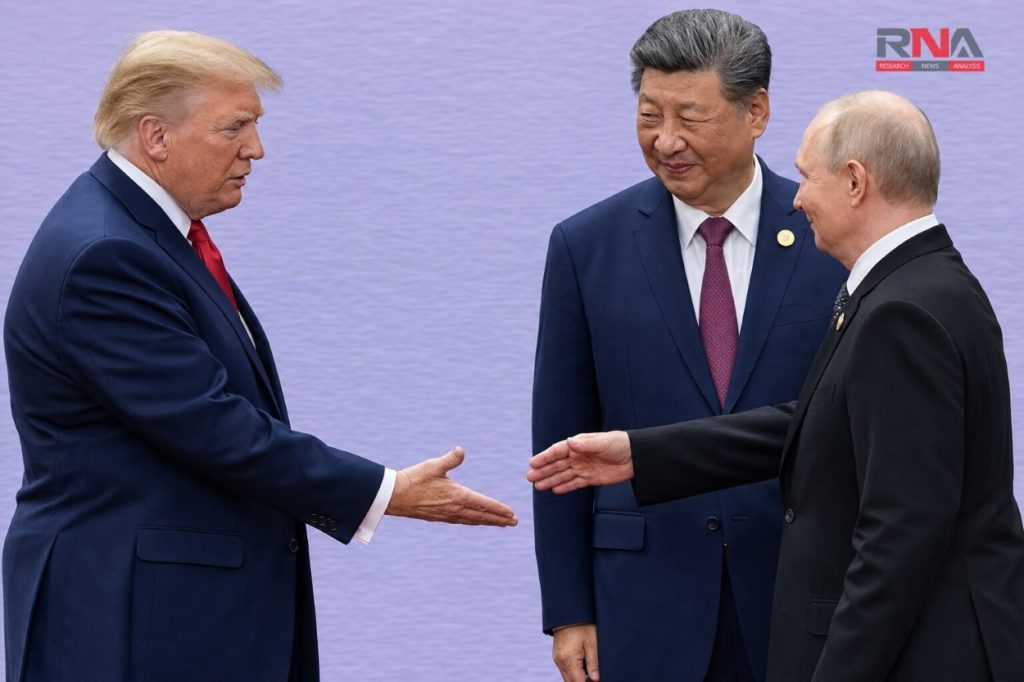
New Delhi: The presidents of the United States, Russia and China came together in a rare diplomatic encounter in Shenzhen, China, on Wednesday, exchanging handshakes and pleasantries ahead of a potentially consequential trilateral summit that could influence the direction of several major international conflicts. The meeting between Donald Trump, Vladimir Putin and Xi Jinping took place during the Asia-Pacific Economic Cooperation (Apec) summit, providing an early indication of the diplomatic engagement expected when the three leaders hold formal discussions on Thursday.
Television footage showed Putin approaching Trump before the customary group photograph, with the two leaders shaking hands and exchanging greetings as Xi looked on. The encounter marked their first face-to-face meeting since August 2025 and came before a welcome banquet hosted by the Chinese leader, bringing together the heads of three nuclear powers whose relations have become increasingly important to international security.
The occasion followed another carefully watched diplomatic gesture earlier in the day, when Xi personally welcomed Trump at the airport in Shenzhen, where the two leaders shook hands and briefly embraced. According to Reuters, it was the first time Xi had personally received a visiting foreign leader at an airport since assuming China’s presidency, reciprocating Trump’s welcome during his visit to the United States in September.
China signals ambitions for a bigger diplomatic role
Beijing has presented the November 19 trilateral summit as an opportunity to improve relations among the three powers and address challenges to international peace and security. The Chinese foreign ministry’s spokeswoman, Mao Ning, described the meeting as being of “groundbreaking significance”, emphasizing the need for major powers to manage disagreements and maintain strategic stability.
China’s position was reinforced on Wednesday when its foreign ministry spokesman, Guo Jiakun, was asked whether the leaders would discuss Ukraine and whether Beijing would resist such discussions. Guo avoided confirming individual agenda items, saying the three presidents would exchange views on important matters affecting global peace and that details would be released subsequently.
Earlier, Xi used his keynote address at the Apec CEO Summit to advocate open international trade, stable supply chains and stronger cooperation in emerging technologies, including artificial intelligence. His remarks also contained an implicit criticism of protectionist economic policies, at a time when Washington’s restrictions on advanced semiconductor exports and broader trade disputes continue to strain US-China relations.
Putin and Xi underline their strategic partnership
Before the informal encounter with Trump, Putin and Xi held separate bilateral discussions in Shenzhen, reaffirming their commitment to strengthening their strategic partnership and promoting a multipolar international order. The meeting was their fifth interaction this year, including one conducted virtually, illustrating the continuing diplomatic coordination between Moscow and Beijing despite differences in their respective economic and strategic priorities.
Putin also criticized Western sanctions against Russia, arguing that economic restrictions had failed to achieve their intended political objectives. The two leaders’ positions, outlined in RNA Media’s report on their Shenzhen meeting, reflected their shared opposition to what they regard as Western dominance of international institutions and global decision-making.
The strengthened Russia-China relationship presents Washington with a complicated diplomatic equation, particularly as Trump seeks renewed engagement with Moscow without abandoning economic and strategic competition with Beijing. For Putin, the three-way summit offers an opportunity to participate directly in discussions on the international security order despite Russia’s continued confrontation with Ukraine and its western supporters.
Ukraine, Iran and nuclear weapons on the agenda
The war in Ukraine is expected to occupy an important place in Thursday’s discussions, although Beijing has declined to confirm whether it will be formally addressed. The Kremlin’s spokesman, Dmitry Peskov, said Putin and Trump could exchange views on Ukraine and Iran in informal conversations, but indicated that a full bilateral meeting between the two presidents was unlikely during the summit.
The question of Ukraine’s participation in any future peace arrangement remains particularly sensitive, given Moscow’s preference for negotiating major security questions directly with Washington. In an earlier report, RNA Media detailed Putin’s proposal for discussions with Trump and Xi on ending the war, an approach that raised questions about the exclusion of Kyiv from negotiations directly affecting its sovereignty.
Nuclear arms control could prove another major subject, particularly following the expiry of the New START treaty between Washington and Moscow in February this year. The White House has indicated that nuclear weapons reductions will be discussed, as RNA Media reported, although differences between the three countries’ arsenals and strategic priorities could complicate negotiations.
The conflict involving the United States and Iran, developments in West Asia, trade restrictions and competition over advanced technologies are also expected to influence the discussions. China has attempted to position itself as a diplomatic facilitator in West Asia, even as its relations with Washington remain affected by disagreements over Taiwan, semiconductor technology and regional security.
Why the meeting matters for India and wider world
For India, the summit carries implications extending beyond the symbolism of three major powers sharing a diplomatic platform, particularly because New Delhi maintains substantial relationships with Washington and Moscow while managing an unsettled strategic relationship with Beijing. Any understanding on Russia, international sanctions, energy security or nuclear arms control could influence India’s diplomatic calculations, defence relationships and economic interests.
The meeting also raises questions about whether major powers might seek understandings affecting other countries without their direct participation. Such concerns are particularly relevant to European governments over Ukraine and to Asian countries watching developments concerning Taiwan, the South China Sea and the wider Indo-Pacific.
The Shenzhen encounter has already demonstrated a willingness among the three leaders to engage publicly despite significant disagreements, but its diplomatic significance will ultimately depend on Thursday’s negotiations. The central question is whether their discussions produce practical agreements on international security and economic stability or merely establish another channel for managing the increasingly complex relationship among Washington, Moscow and Beijing.