


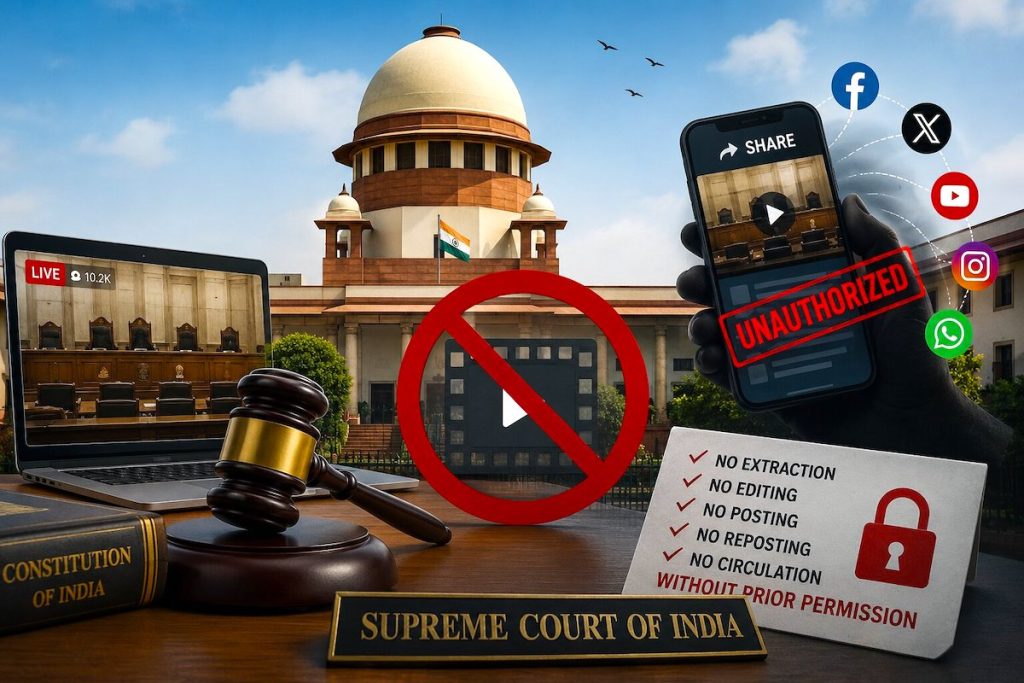
New Delhi: The Supreme Court on Friday barred the posting, reposting, editing or circulation of audio-video recordings of its livestreamed proceedings on social media and other digital platforms without prior clearance. The court took this decision after acting on a plea that flagged the growing misuse of courtroom footage.
A three-judge bench led by the chief justice of India, Surya Kant, and comprising justices Joymalya Bagchi and V Mohana, passed the interim order while hearing a public interest litigation, Harshita Grover versus Union of India. The petition sought curbs on the unauthorized extraction and monetization of videos of court hearings.
The order
The bench directed that there shall be no extraction, modification, dissemination, posting, reposting or uploading of audio-video recordings of judicial proceedings on social media or any other digital platform without the prior permission of the secretary general of the Supreme Court or the registrars general of the concerned high courts. The secretary general of the Supreme Court and the registrars general of the high courts have been asked to publish the order on their respective court websites.
Importantly, the bench clarified that the restriction will have no bearing on news reporting. Mohana is reported to have added that the order was not intended as a gag on media coverage of hearings.
What persuaded the bench
Senior advocate Vikas Singh, appearing for the petitioner, told the court that edited video snippets were routinely extracted from hearings and circulated out of context on social media, eroding the dignity of judicial proceedings. Singh went further, telling the bench that his concern extended beyond lawyers using footage for self-promotion to litigants, and even non-litigants, misusing such material for their own ends.
The solicitor general, Tushar Mehta, appearing for the Union government, backed the submission, emphasizing the urgent need for a clear regulatory framework governing courtroom footage.
Kant himself weighed in during the hearing, pointing to a recent instance in which remarks he had made in court were, in his assessment, inaccurately reported by the media. He also noted that a matter mentioned in court seeking early listing had, a day later, still not actually been filed as a petition – illustrating, in his view, how unverified snippets can distort public understanding of proceedings that are still evolving.
Notices to states, HCs and SM platforms
The bench’s directions went beyond the immediate restraint. The court issued notice to all states and impleaded every high court, directing them to report on the implementation of existing livestreaming guidelines and on the effects of continuous livestreaming of hearings. Notice was also issued to social media intermediaries, including Meta and X.
Apart from this, the court asked the Union government to submit a proposal through the relevant nodal ministries, along with a list of intermediaries to be prepared with the assistance of the Ministry of Electronics and Information Technology (MeitY).
Justice Bagchi explained the rationale for regulation rather than an outright ban. He observed that links meant for lawyers attending virtual hearings had effectively reached the public too, and that the court could not undo that access but could still regulate it to protect the sanctity of the institution.
Footage misuse an old worry
Friday’s order is the latest chapter in a debate that has run since the Supreme Court first opened its proceedings to public viewing. That shift traces back to the constitution bench ruling in Swapnil Tripathi versus Supreme Court of India, delivered on September 26, 2018 by a bench led by the-then chief justice, Dipak Misra, which held that hearings of constitutional and national importance ought to be broadcast to the public. The court itself began livestreaming constitution bench hearings only four years later, from September 27, 2022, following a full court decision taken that September.
Concerns over the abuse of that access surfaced almost as soon as streaming began. In 2022, the top court had already noted that clips were being put out on social media without context and considered building an in-house streaming platform to limit unauthorized access. The risks were laid bare more starkly in 2021, when the Karnataka high court was compelled to suspend live videoconferencing of its hearings entirely after unidentified individuals infiltrated a session and displayed obscene content, an episode that underlined how easily virtual courtrooms could be hijacked.
A three-judge committee had, in fact, already been examining the question of unauthorized online access to hearings, partly out of concern that artificial intelligence could be used to manipulate courtroom recordings. Friday’s interim order appears to give at least some of that ongoing work the force of a formal court direction, ahead of a fuller framework that the states, high courts and the Centre are now expected to help shape.
The plea will next be taken up once the states, high courts and the Union government have filed their responses.