


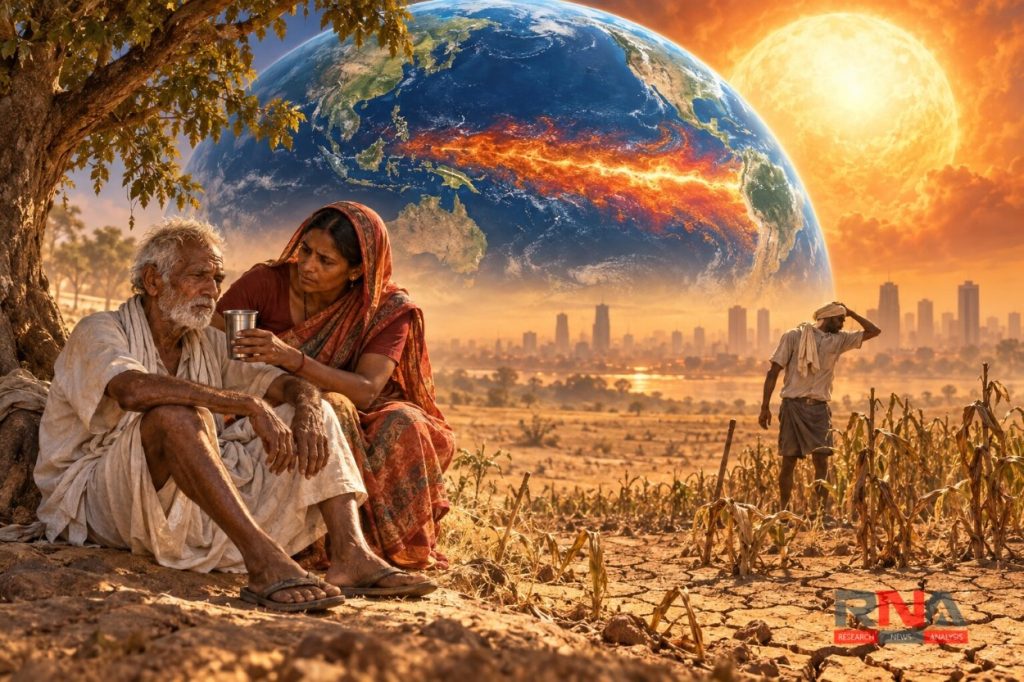
New Delhi: Extreme heat linked to the powerful 2026 El Nino could cause an estimated 451,000 additional deaths worldwide between June 2026 and February 2027, according to the Climate Impact Lab. India is among the countries facing substantial losses, with 15,800 additional heat-related deaths projected between September and February.
The report distinguishes the nine-month total from its forecast for the coming six months, which puts additional deaths at approximately 239,000. These are modelled estimates against historical conditions, rather than a count of confirmed fatalities, and the researchers say timely intervention could prevent tens of thousands of deaths.
The findings place public health alongside agriculture and disaster preparedness in the response to an unusually strong climate event. The university’s announcement says the estimated heat mortality is separate from the wider consequences of drought, wildfires and flooding, which could deepen the humanitarian burden.
Much of the projected toll is concentrated in developing countries, particularly across Africa and southeast Asia. For September to February, the estimates include 31,400 additional deaths in Nigeria, 19,300 in Indonesia, 17,500 in Sudan and 13,300 in Brazil, while the Philippines, Vietnam, Thailand and Cambodia together account for another 19,400.
The meteorological outlook suggests the threat will persist well beyond a brief spell of exceptional weather. In its September 3 update, the World Meteorological Organization (WMO) put the probability of El Nino continuing through February 2027 at nearly 100 per cent, with further strengthening expected before a peak towards the end of this year.
El Nino develops when surface waters in the central and eastern equatorial Pacific become unusually warm, altering atmospheric circulation and weather far beyond the ocean itself. It is a naturally occurring phenomenon, but its effects now unfold in a climate already warmed by human activity.
Its consequences differ sharply between regions: some experience heavier rainfall and flooding, while others face drought and reduced water availability. WMO associates El Nino with suppressed monsoon activity in parts of South Asia, drier conditions in Indonesia and parts of Australia, and increased rainfall in parts of South America, East Africa and the southern United States.
However, the strength of the Pacific warming does not determine the severity of conditions in every country. WMO stresses that geography, season and other climate influences, including temperatures in the Indian and Atlantic Oceans, can reinforce or modify the effects, making local forecasts essential for planning.
The mortality analysis combines temperature–death relationships across 24,378 regions with seasonal forecasts from the European Centre for Medium-Range Weather Forecasts. It compares projected mortality with corresponding months in the 1996–2025 baseline, accounts for uncertainty in both weather and health relationships, and says full methodological details will appear in a forthcoming peer-reviewed publication.
The distinction between estimated heat-related mortality and reported heatstroke deaths is significant. Earlier research underpinning the lab’s approach explains that temperature can worsen existing illnesses, meaning its contribution to a death may never be identified in an individual record.
That earlier work also shows why similar temperatures can produce different outcomes in different places. Income, familiarity with hot conditions and access to protective measures such as indoor cooling influence vulnerability, making the health consequences of warming inseparable from living conditions and public infrastructure.
According to the World Health Organization (WHO), excessive heat places additional strain on the heart and kidneys and can aggravate cardiovascular, respiratory and other chronic conditions. Prolonged hot days and nights allow stress to accumulate, while severe exposure can cause heat exhaustion or heatstroke.
Older people, outdoor and manual workers, and poorer households without adequate housing or cooling face particular risks. Heat can simultaneously weaken the services needed to protect them, as power shortages and disruption to water supplies, transport and health facilities complicate emergency care.
For India, the forecast period does not capture the whole potential danger: the researchers expect heat-related mortality in India and Pakistan to continue rising into the northern hemisphere summer. The practical implication is that preparedness must extend beyond February, rather than treating the end of the current forecast as the end of the threat.
A parallel warning concerns food security, with the World Food Programme (WFP) estimating that the 2026-27 El Nino could push at least 49 million additional people into acute food insecurity by the end of 2027. Its analysis, released on August 5, 2026, covers 45 vulnerable countries and projects an increase from approximately 225 million to 274 million people facing such conditions.
The agency warns that disruption to planting and harvest cycles can prolong hardship after the weather event itself weakens. Countries already affected by conflict, poverty and economic instability are particularly exposed, because households and governments have fewer resources to absorb another shock.
Preparatory assistance is already being deployed, although the scale of need is much larger. WFP said it had provided more than $14 million in early support to around half a million people through measures activated since May in South Sudan, Chad, Mauritania, Uganda, Guatemala and El Salvador.
For heat, WHO emphasizes advance warning, identification of vulnerable populations and emergency plans matched to local health-service capacity. Its guidance also stresses that intervention must follow alerts quickly, because deaths and hospital admissions can increase on the day of exposure and in the days immediately afterwards.
The Climate Impact Lab’s co-founder, Michael Greenstone, said the projections allow authorities to identify where emergency measures could save lives. The researchers intend to update their estimates as El Nino develops, giving governments a changing picture of where protection is most urgently needed.