


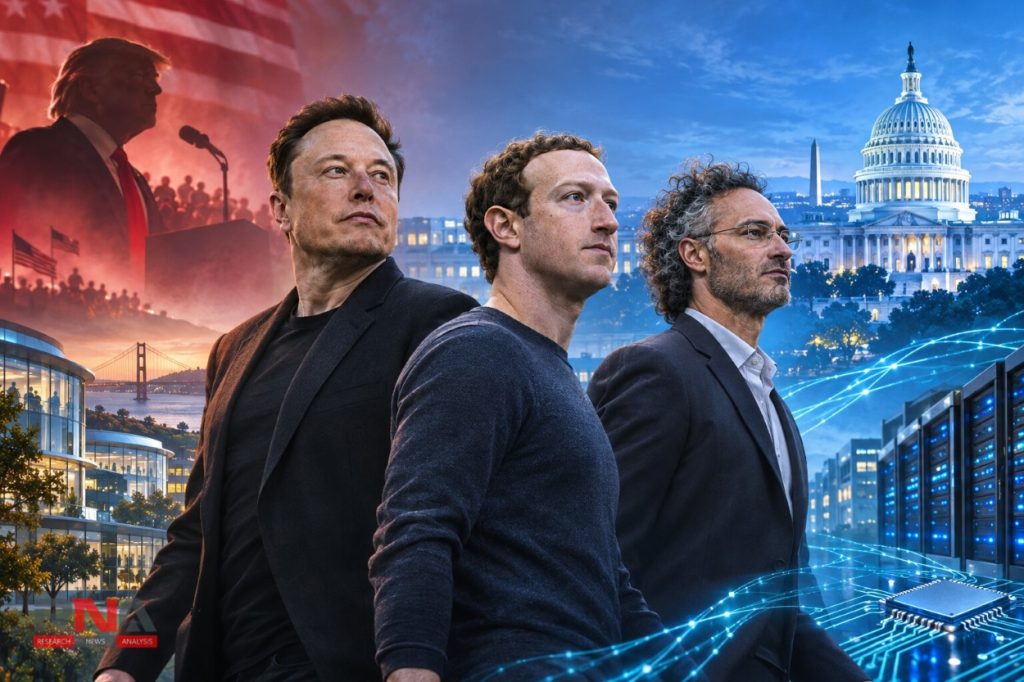
New Delhi: America’s technology billionaires are rapidly reassessing their political allegiances following the Democratic Party’s sweeping victory in the November 3 midterm elections, with several prominent Silicon Valley executives distancing themselves from the US president, Donald Trump, and his Make America Great Again (MAGA) movement. The emerging change in political positioning, particularly among business leaders who had invested heavily in Republican campaigns, reflects growing concern over the consequences of a Democratic-controlled Congress for the technology industry’s commercial and regulatory interests.
The most striking reversal has come from Elon Musk, the billionaire entrepreneur who spent hundreds of millions of dollars supporting Republican candidates but now questions both his political identification with MAGA and the wisdom of his electoral expenditure. Speaking at the New York Times DealBook Summit on November 18, Musk declared that he did not consider himself part of MAGA and acknowledged feeling foolish about the enormous sums he had invested in the unsuccessful Republican campaign.
The comments represented a remarkable departure from October 2024, when Musk enthusiastically identified himself with Trump’s political movement and became one of his most influential financial supporters. According to an analysis of campaign contributions, his spending during the 2026 election cycle exceeded $440 million, making him one of the most consequential individual political financiers in modern American history.
Musk subsequently became closely associated with Trump’s second administration through his leadership of the Department of Government Efficiency, which sought to reduce federal expenditure and restructure government operations. However, his relationship with the White House became increasingly complicated, particularly following disagreements over the administration’s taxation and spending policies.
The billionaire now describes his political outlook as moderate, although his financial support for Republican candidates and previous public positions remain part of his political record. His change in rhetoric suggests an attempt to regain flexibility in dealing with a Congress increasingly capable of scrutinizing his business interests, including Tesla, SpaceX and artificial intelligence company xAI.
Palantir chief distances himself from immigration crackdown
A similar repositioning has emerged at Palantir Technologies, whose chief executive, Alex Karp, has adopted a more critical position towards the Trump administration’s immigration enforcement policies. In a November 11 interview, Karp emphasized his longstanding Democratic sympathies and welcomed Trump’s acknowledgement that immigration enforcement had gone too far.
Karp’s remarks are particularly significant because Palantir has supplied sophisticated data-analysis technology to US Immigration and Customs Enforcement (ICE), the federal agency responsible for immigration investigations and deportations. The company has also maintained substantial defence and intelligence contracts, making its relationship with successive administrations a central element of its business model.
Palantir’s involvement in immigration enforcement has attracted criticism from civil liberties organizations, which argue that its technology facilitates government surveillance and deportation operations. The company, however, has consistently maintained that its software supports legitimate government missions and that responsibility for the policies governing its use rests with public authorities.
The political adjustment therefore raises questions about whether changing rhetoric will eventually produce substantive changes in the company’s government relationships or operational practices. For technology contractors dependent on federal expenditure, preserving access to policymakers across party lines can be commercially important regardless of executives’ personal political preferences.
Meta prepares for a new political balance
The recalibration is also visible at Meta, the parent company of Facebook, Instagram and WhatsApp, where the chief executive, Mark Zuckerberg, had cultivated closer ties with Trump following his return to the White House in January 2025. As Axios reported, Meta has been assembling a bipartisan government-relations team to strengthen its engagement with Democrats without sacrificing its relationships with Republicans.
The restructuring accompanies the planned departure of Joel Kaplan, Meta’s chief global affairs officer and a prominent Republican-connected executive who helped strengthen the company’s Washington relationships. Kaplan, who is expected to leave in 2027, will remain involved during the transition, meaning the personnel changes cannot yet be interpreted as a complete reversal of Meta’s political strategy.
Meta’s repositioning reflects the broader challenges confronting major technology companies as Washington debates artificial intelligence regulation, competition policy, online content moderation and corporate accountability. Although executives may prefer a lighter regulatory environment, an antagonistic relationship with Congress could expose their companies to investigations, legislative restrictions and renewed scrutiny of their market power.
Why midterm verdict matters for Big Tech
The Democratic victory has altered the political calculations of Silicon Valley by strengthening congressional oversight of an industry that had invested heavily in favourable access to the Trump administration. A Reuters report published on Saturday said Democrats were preparing an ambitious legislative agenda ahead of assuming control of Congress on January 3, 2027, including possible action against concentrated corporate power.
Technology companies have particular reasons for concern because artificial intelligence, cryptocurrency, data privacy and market concentration have become increasingly prominent political issues. During the midterm campaign, opposition to large data centres and questions over the economic consequences of artificial intelligence also contributed to a growing backlash against the industry’s influence.
An earlier investigation into election financing highlighted the expanding role of wealthy technology donors and politically active corporations in shaping US electoral contests. The concentration of political spending among a relatively small number of billionaires has consequently intensified debate over the relationship between private wealth, democratic accountability and public policy.
For India, these developments carry wider implications because American technology companies are important investors, digital infrastructure providers and strategic partners in artificial intelligence, defence technology and semiconductor development. Changes in Washington’s regulatory priorities could influence cross-border technology cooperation, data governance and the operating environment for Indian companies connected to the American digital economy.
Nevertheless, the apparent retreat from Trump should not automatically be interpreted as a genuine ideological conversion among Silicon Valley’s corporate leadership. As technology-industry observers have noted, major companies are likely to seek political accommodation with whichever party exercises meaningful power over regulation and government expenditure.
The immediate question is whether the executives’ newly moderated positions will translate into different corporate policies, political contributions and government contracting decisions. For now, Silicon Valley’s response to the Democratic victory illustrates how quickly the political preferences of powerful business interests can become negotiable when the balance of power in Washington changes.