


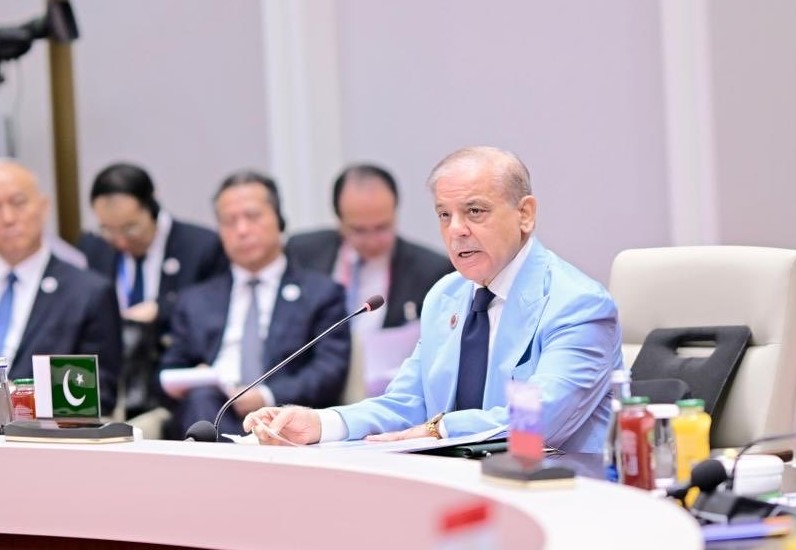
New Delhi: Pakistan’s prime minister’s office attracted scrutiny on Tuesday after posting a cropped official photograph from the 26th Shanghai Cooperation Organization (SCO) Summit that omitted the prime minister, Narendra Modi, and four other leaders from the full line-up. A few hours later, the Pakistan prime minister, Shehbaz Sharif, shared the complete frame on his personal account, creating a conspicuous contrast between the two official social-media presentations.
At 11.42am IST on Tuesday, the Pakistan PMO account on X published a version of the summit photograph showing only seven of the 12 people in the original frame. Its caption nevertheless described the image as a group photograph of Sharif with heads of state attending the SCO Council of Heads of State Summit in Bishkek.
Those removed from the left of the original photograph were the SCO secretary-general, Nurlan Yermekbayev; the Belarus president, Alexander Lukashenko; Modi; the Iran president, Masoud Pezeshkian; and the Kazakhstan president, Kassym-Jomart Tokayev. The complete line-up was subsequently visible in images published by the Indian PMO and distributed by international news agencies.
The cropped photograph retained the Chinese president, Xi Jinping; the Kyrgyz president, Sadyr Japarov; the Russian president, Vladimir Putin; Sharif; the Tajik president, Emomali Rahmon; the Uzbek president, Shavkat Mirziyoyev; and the SCO Regional Anti-Terrorist Structure chief, Ularbek Sharsheev. Removing the five figures on the left placed Sharif fourth in the seven-person composition – precisely at the centre – although he stood fourth from the right in the full photograph.
At 3.32pm IST, Sharif used the complete photograph in a separate post on X about his summit address and Pakistan assuming the SCO chairmanship for 2027. He did not refer to the earlier crop or explain why his personal account and the Pakistan PMO had used different versions of the same official picture.
The visual discrepancy was first highlighted by social-media users and subsequently reported by several Indian publications. Critics characterized the edit as discourteous at a multilateral gathering, particularly because an official government account had presented an incomplete photograph as a gathering of participating leaders.
A photograph may be cropped for routine editorial, formatting or platform-related reasons, but the Pakistani PMO did not publicly offer such an explanation. In the absence of a clarification from Islamabad, the effect of the edit – removing five participants and repositioning Sharif at the centre – can be established, but its political intent cannot be stated as fact.
The episode unfolded as Modi delivered a pointed counterterrorism message at the summit, calling on SCO members to reject “double standards” and dismantle networks supporting terrorist financing, recruitment, radicalization and safe havens. He also said countries using terrorism as an instrument of state policy, or providing sanctuary to terrorists, must be told that terrorism could never serve as a strategic asset.
Sharif, for his part, emphasized Pakistan’s casualties and economic losses from terrorism and raised the Indus Waters Treaty, arguing that water should not be weaponized. The juxtaposition of the two speeches reflected the continuing divide between New Delhi and Islamabad over cross-border terrorism and the suspended operation of the water-sharing agreement.
Established in 2001, the SCO now comprises 10 member states, with India and Pakistan joining together in 2017 and Iran and Belarus admitted subsequently. Pakistan’s assumption of the chairmanship for 2027 means Islamabad is expected to host the next leaders’ summit, placing greater attention on how it manages diplomatic protocol and official communication involving all member countries.