


New Delhi: The prime minister, Narendra Modi, began his fourth visit to Uzbekistan on Saturday as he arrived in Tashkent for a two-day state visit aimed at taking India-Uzbekistan strategic ties forward. At the invitation of the Uzbek president, Shavkat Mirziyoyev, Modi is set to hold discussions on trade, investment, defence, digital connectivity, energy, education and people-to-people ties before travelling to Kyrgyzstan for the 26th Shanghai Cooperation Organisation (SCO) Summit.
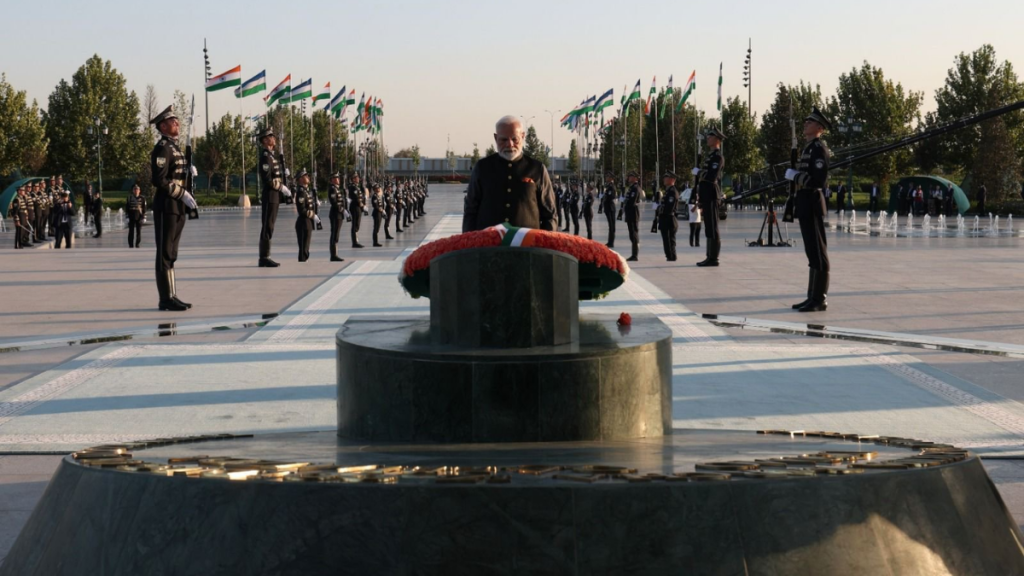
On arrival, Mirziyoyev received Modi at the airport, where the two leaders exchanged greetings. The Uzbek president later accompanied Modi to Yangi Uzbekistan Park, where the prime minister laid a wreath as part of his engagements in Tashkent, ANI reported.
The visit marks Modi’s fourth trip to Uzbekistan after his earlier visits in 2015, 2016 and 2022. His latest visit comes as both countries look to widen their strategic partnership and build stronger cooperation across economic, security and connectivity-related areas.
According to the Prime Minister’s Office, Modi will review the progress of bilateral cooperation with Mirziyoyev and discuss the future course of the partnership. The two leaders are also expected to exchange views on their respective development priorities, including Viksit Bharat and Yangi Uzbekistan.
Economic cooperation is expected to occupy a significant space in the talks, with the two sides looking at opportunities in trade, energy, healthcare, pharmaceuticals, agriculture and mechanical engineering. Political, cultural and humanitarian exchanges are also likely to form part of the discussions.
India and Uzbekistan are also expected to explore greater cooperation in defence and strategic affairs. New Delhi considers Tashkent an important partner in Central Asia and has been working to expand its engagement with the region through stronger economic, connectivity and security links.
Modi’s journey to Tashkent also took an unusual route, with Pakistan’s airspace closed to Indian aircraft and the ongoing conflict involving Iran affecting regional air routes. The prime minister is reported to have taken a longer flight path, adding a significant detour to his journey.
Modi’s programme in Tashkent also includes visits to the Shastri Memorial and the Mahatma Gandhi Centre at the Tashkent State University of Oriental Studies. The engagements are expected to underline the longstanding cultural and people-to-people relationship between India and Uzbekistan.
From Tashkent, Modi will travel to Bishkek to attend the 26th SCO Summit from August 31 to September 1 at the invitation of the Kyrgyz president, Sadyr Zhaparov. The summit will coincide with the 25th anniversary of the SCO and bring together leaders to discuss a range of regional and international issues.
Leaders such as the Russian president, Vladimir Putin, and the Chinese president, Xi Jinping, are also expected to attend the summit in Bishkek. The Iranian president, Masoud Pezeshkian, and the Pakistan prime minister, Shehbaz Sharif, are also expected to participate in the plenary session.
One of the most closely watched moments of the summit will be an expected bilateral meeting between Modi and the Russian president, Vladimir Putin, on the sidelines of the SCO gathering in Bishkek. The talks are expected to cover trade, energy and defence ties between the two countries, even as both navigate pressure from Western sanctions and tariffs linked to the Ukraine war.
Modi and Xi last met on the sidelines of the SCO Summit in Tianjin last August, their first meeting on Chinese soil in seven years, where the two leaders discussed border de-escalation and resuming direct flights between the countries.
The 10-member SCO comprises India, Russia, China, Pakistan, Iran, Belarus, Kazakhstan, Kyrgyzstan, Tajikistan and Uzbekistan. The grouping, which was initially established around regional and economic cooperation, now has 15 dialogue partners, while Afghanistan and Mongolia have observer status.
The presence of leaders from India, China, Russia, Pakistan and Iran is expected to give the Bishkek summit considerable geopolitical significance. For India, the meeting will provide a platform to advance discussions on regional security, connectivity and economic opportunities while pushing for a region free from terrorism, separatism and extremism.
In Bishkek, Modi will also meet the Kyrgyz president, Sadyr Zhaparov, and other SCO leaders. He is scheduled to attend the opening ceremony of the sixth World Nomad Games, which showcases the traditional sports and cultural heritage of Central Asia.
Ahead of his departure, Modi said he was confident that his visit would strengthen India’s strategic partnerships in Central Asia, deepen its civilisational connect with the region and advance the shared pursuit of peace, stability and prosperity.