


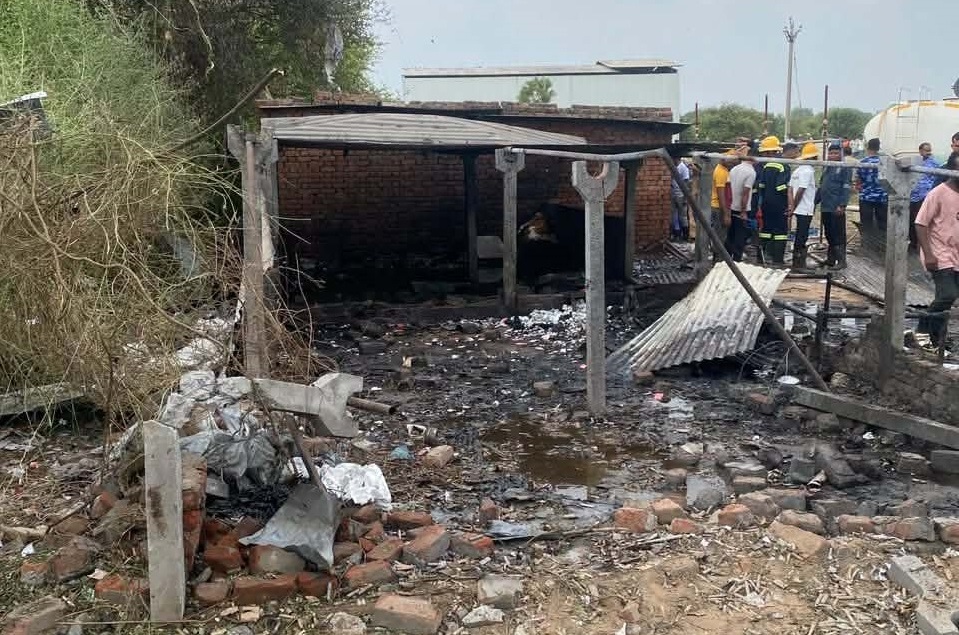
New Delhi: At least nine people have died and several others were injured after a powerful explosion ripped through an unlicensed firecracker manufacturing unit in the Ramol area of Ahmedabad, Gujarat, on Saturday, July 18, 2026, police said.
The blast occurred at around 3.30pm at a facility set up on open ground along the Ramol-Gatrad road, behind a camp of the Rapid Action Force (RAF), in the Vastral locality of the city. The explosion, reportedly heard several kilometres away, was followed by a fierce fire that trapped a number of workers under debris.
Casualty figures shifted repeatedly as the day progressed, with early police estimates putting the toll at four, then eight, before hospital authorities confirmed by Saturday evening that nine people had died. Four victims – one man and three women – were declared dead on arrival at LG Hospital in Maninagar, while four more, all of whom had suffered burns covering roughly 95 per cent of their bodies, died during treatment. One woman remained in stable condition at the same hospital.
A separate group of casualties was taken to the Asarwa Civil Hospital, where the medical superintendent, Dr Rakesh Joshi, said one person was brought in dead alongside five injured, who were undergoing treatment. Officials cautioned that the toll could rise further given the critical condition of some patients.
The joint commissioner of police, Jaipal Singh Rathore, said between 12 and 15 people were believed to have been working at the site when the blast occurred.
Factory had no valid licence
Rathore said the unit was operating without a valid licence and was allegedly run by one Mehul Dodiya, whose licence to manufacture firecrackers had previously been cancelled. Police plan to register a case of culpable homicide not amounting to murder under the Bharatiya Nyaya Sanhita, along with charges under the Explosives Act. Ahmedabad’s crime branch has taken up further investigation, and teams from the Forensic Science Laboratory have been deployed to establish the cause of the explosion.
The episode has revived long-standing questions over the enforcement of industrial safety regulations in Gujarat, and over how units stripped of their licences continue to function largely unchecked.
Personnel from the nearby RAF camp were the first to reach the site, pulling several people from the rubble before fire crews arrived. Ahmedabad Fire and Emergency Services subsequently deployed a mini fighter unit, two 20-kilolitre water bowsers, two Bolero rapid intervention vehicles and an ambulance. The chief fire officer, supported by additional chief fire officers and other senior personnel, supervised the operation. By evening, officials said the blaze had been fully contained and cooling operations were continuing.
PM, CM announce relief
The prime minister, Narendra Modi, expressed grief over the incident in a post from the Prime Minister’s Office, saying his thoughts were with the bereaved families and that he was praying for the injured to recover quickly. Modi announced an ex-gratia payment of ₹2 lakh from the Prime Minister’s National Relief Fund for the next of kin of each deceased, and ₹50,000 for those injured.
The Gujarat chief minister, Bhupendra Patel, separately announced state assistance of ₹4 lakh to the family of each deceased and ₹50,000 to the injured, describing the incident as extremely tragic and offering condolences to the affected families. He said the local administration was extending all necessary assistance to those affected.
Saturday’s tragedy is the latest in a series of deadly explosions at unauthorized firecracker units across India in recent years, several of them in Gujarat itself. Such facilities, often set up on open farmland or in residential clusters to avoid detection, frequently store volatile compounds – including aluminium and magnesium powders – without the safeguards mandated for licensed explosives manufacturing. Enforcement of the Explosives Act, 1884, and related state rules has long been criticized as inconsistent, with cancelled licences doing little to shut down operations that quietly resume under the same or a different name.