


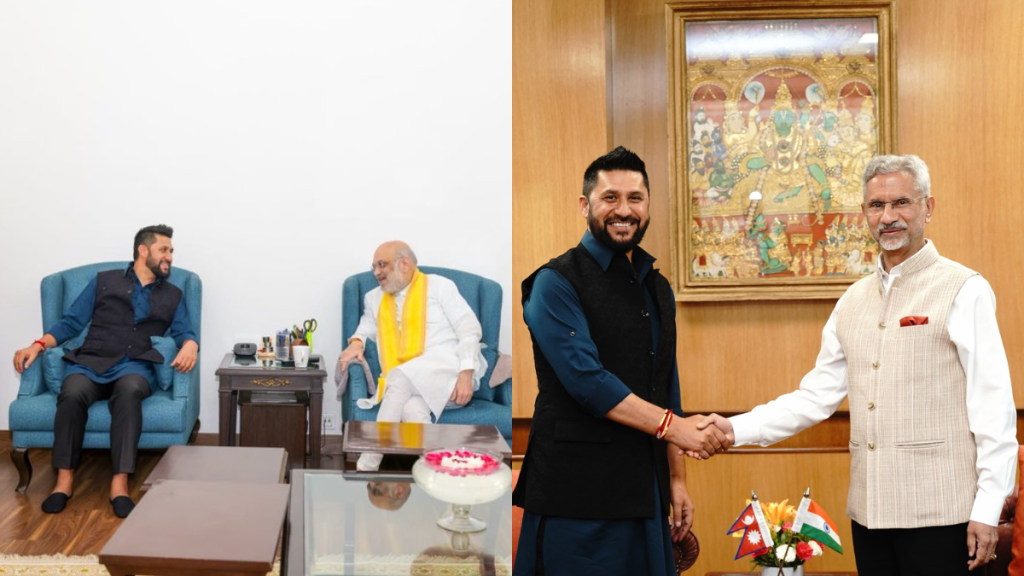
New Delhi: Rastriya Swatantra Party (RSP) chief Rabi Lamichhane is on a five-day visit to India, holding a series of high-level meetings in New Delhi at a time when Nepal’s newly elected government has renewed focus on unresolved border issues with India.
On Tuesday, Lamichhane met the external affairs minister, S Jaishankar, in New Delhi. Their discussions focusing on strengthening bilateral ties, development cooperation and people-to-people relations between the two neighbouring countries
During the meeting, Jaishankar and Lamichhane discussed the India-Nepal development partnership and people-to-people ties, which both sides highlighted as key drivers of growth and prosperity in the two countries
Lamichhane also shared details of the meeting on X, writing: “We held a constructive dialogue on strengthening Nepal–India relations, focusing on our development partnership, and multifaceted engagements.”
The Nepalese leader later visited the Bharatiya Janata Party (BJP) headquarters under the party’s “Know BJP” initiative. During the interaction, BJP leaders briefed the visiting delegation on the party’s organisational structure, membership expansion strategy, candidate selection process and grassroots outreach model.
According to the president of BJP, there was a meaningful discussion on strengthening party-to-party relations between the BJP and the RSP. The delegation was also briefed on governance initiatives and development-focused policies implemented under the leadership of the prime minister, Narendra Modi.
Lamichhane subsequently met the Union home minister, Amit Shah. Following the meeting, in a post on X, he said it was pleasure meeting Shah. He said they had a “constructive dialogue” on strengthening the Nepal-India relationship, enhancing security cooperation, and fostering greater collaboration between our parties to promote democratic values and mutual interests.
The RSP chief is also expected to meet Modi and the national security advisor, Ajit Doval, later during his visit. The delegation will also engage with the Nepali diaspora in India and travel to Ayodhya before concluding his visit on June 5.
The visit has attracted more attention than usual due to recent remarks made by the Nepalese prime minister, Balendra Shah, regarding longstanding border disputes with India.
As RNA Media had reported, Shah, addressing Nepal’s parliament on Sunday, said all outstanding border issues with India would be resolved through diplomacy and dialogue. Referring to Nepal’s claim over the Lipulekh-Limpiyadhura region, he said Kathmandu would pursue a peaceful resolution through diplomatic channels while maintaining friendly ties with New Delhi.
India and Nepal share a 1,751-kilometre open border and maintain deep cultural, economic and people-to-people ties. However, disputes over the Kalapani-Limpiyadhura-Lipulekh region in the west and Susta in the south have periodically strained relations.
India has consistently maintained that the disputed areas are part of its sovereign territory and has said all boundary-related differences should be addressed through established bilateral mechanisms and diplomatic dialogue.