


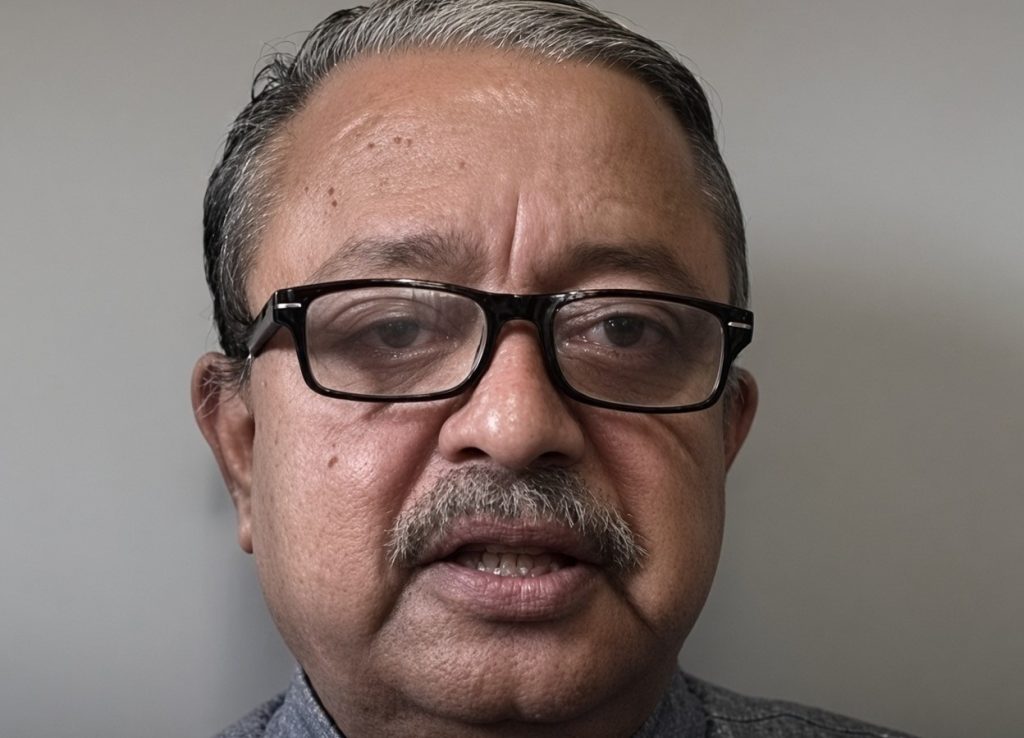
New Delhi: The Nepali supreme court has demanded an explanation for the arrest of political analyst Bharat Dahal after he shared a report alleging that American-funded programmes helped cultivate the country’s emerging political leadership. The case has brought together two contentious questions: whether the government is using cybercrime provisions to suppress criticism, and how far the available evidence supports allegations of foreign interference in Nepal’s political transformation.
A bench of Justice Kumar Regmi issued a show-cause order on Wednesday following a habeas corpus petition filed by Dahal’s daughter, Denika, challenging his detention. Dahal had reportedly shared the American media outlet Grayzone’s investigation on September 12, before police detained him.
Dahal, who comments on Nepali politics and regularly shares foreign reportage with his social media following, had travelled to Koshi Province on September 18 for a series of political discussions. Nepal Police’s Cyber Bureau detained him on September 20 at Salakpur in Sundarharaicha, Morang district, just as he was preparing to head back to Kathmandu.
The charge against him sits awkwardly with a government that rose to power only a year ago on promises to end precisely this kind of heavy-handedness. Police accuse Dahal of spreading misinformation for sharing, on September 12, the Grayzone investigative report.
Police said the arrest followed a complaint lodged with Nepal Police’s Cyber Bureau and a warrant issued by the Kathmandu District Court. Although initial accounts differed over the precise location, Republica placed the detention at a tea shop in Salakpur, where Dahal was preparing to return to Kathmandu after attending political programmes.
The free-expression organization Freedom Forum subsequently reported that a Cyber Bureau officer had identified section 47 of the Electronic Transactions Act as the provision invoked against Dahal. According to its Wednesday statement, police declined to disclose the complainant’s identity or provide details of the grounds for the investigation.
Freedom Forum warned that using cybercrime provisions against someone merely for sharing reporting and expressing political opinions could discourage legitimate public debate. The Supreme Court’s intervention concerns the justification for Dahal’s detention; it does not establish the truth of the allegations contained in the article he circulated.
The controversy centres on the Grayzone’s September 9 investigation, which cited a 2019 work plan for an American-funded political assistance programme. It alleged that the programme helped prepare the rise of figures including the prime minister, Balendra “Balen” Shah; the home minister, Sudan Gurung; the Rastriya Swatantra Party chairman, Rabi Lamichhane; and the parliamentarian, Sagar Dhakal.
The secretary of the Communist Party of Nepal (Unified Marxist–Leninist), Mahesh Basnet, accused the government of retaliating against Dahal and demanded an explanation of the reporting. His further allegation that the prime minister’s secretariat directed the arrest remains an opposition claim, rather than an independently established account of the decision.
The dispute also unfolds against earlier concerns about judicial independence in Nepal. On July 24, Amnesty International, Human Rights Watch and the International Commission of Jurists said they had received credible reports of pressure on three senior Supreme Court judges, including Regmi, to resign or face impeachment.
What the US-funded programme reveals
The existence of the programme itself is independently documented in American public records. An archived USAID factsheet describes Niti Sambad, or Policy Dialogue, as a five-year initiative for 2017–2022, with a stated value of $20 million and objectives involving the Nepali parliament, the Election Commission and political parties.
Its implementing consortium, the Consortium for Elections and Political Process Strengthening, comprised the International Foundation for Electoral Systems, the National Democratic Institute and the International Republican Institute. The published objectives included improving institutional accountability, broadening political participation and helping parties function more effectively, establishing that the programme’s existence and broad remit were publicly acknowledged.
The more sensitive issue is how its internal plans identified particular political and civic figures for engagement. According to the Kathmandu Post’s examination, the work plan named Shah, Gurung, Dhakal and Lamichhane, but also included the late civic leader Ujwal Thapa and figures associated with other political formations.
That wider selection complicates the claim that the document describes a programme designed exclusively to install Nepal’s present rulers. The Post also reported that the document had already been covered by an Indian publication in March, and that it remained unclear whether the four prominent figures actually participated in Niti Sambad activities.
These distinctions matter because a proposal to support somebody does not establish that assistance was delivered, accepted or decisive in their subsequent political career. Demonstrating a foreign-directed transfer of power would require further evidence linking money, instructions and operational coordination to identifiable political events.
Commentator Bhairaja Pandey made a similar distinction in a September 13 analysis published by Danfe TV, arguing that the underlying material deserved scrutiny but did not establish American orchestration of the uprising. That assessment leaves room to investigate foreign influence without treating every training programme or political contact as proof of covert control.
There are nevertheless substantive questions about strategic intent. The Kathmandu Post reported that the work plan aligned youth activities with the objectives of Washington’s Indo-Pacific strategy. Such language warrants examination of programme design and implementation, but does not by itself demonstrate CIA direction or a plan to overthrow a government.
A USAID-commissioned mid-term evaluation provides another perspective, describing institutional gains alongside uneven results, limited activities and weaknesses in measuring outcomes. Although an assessment commissioned by the donor cannot settle allegations about the donor’s intentions, its mixed findings caution against assuming that ambitious programme language translated into comprehensive political influence.
The most useful next disclosures would therefore be participant records, actual disbursements, training material, implementing partners’ correspondence and evidence of any subsequent political coordination. They would help distinguish routine assistance, attempts to influence political priorities and the much more serious allegation of externally directed regime change.
The arrest raises a separate question that should survive whichever interpretation of the documents proves stronger. A government can dispute reporting and seek lawful remedies while still being required to justify why an individual’s online expression warranted detention.
Why India has a direct stake
For India, the immediate strategic concern is whether the controversy weakens Nepal’s institutional stability or disrupts practical cooperation across the border. The relationship encompasses an open border, extensive social connections and mechanisms covering security, trade, transport, water resources and electricity, making prolonged instability a matter of direct consequence.
There is also a current diplomatic context. RNA Media reported on September 19 that New Delhi and Kathmandu were working towards a possible Shah visit to India in the second half of November. Its report identified economic cooperation, energy and cross-border connectivity as priorities, although the proposed visit should not be treated as a confirmed engagement.
From an Indian strategic perspective, the first task is to assess whether the dispute produces measurable changes in Nepal’s external policies. Training histories and donor contacts merit scrutiny, but decisions on security cooperation, infrastructure access, investment and diplomatic commitments provide stronger evidence of a government’s direction.
India should also watch how the authorities respond to judicial scrutiny and whether further arrests follow the circulation of disputed political material. An escalating confrontation involving the executive, courts and opposition could make bilateral decisions harder to sustain and reduce confidence in institutional commitments.
The third concern is whether allegations of American influence become part of a broader contest over Nepal’s relations with China and India. If competing factions begin portraying commercial projects, disaster cooperation or diplomatic engagement as evidence of foreign allegiance, necessary partnerships could become harder to negotiate on their merits.
For New Delhi, that calls for close attention to changes in border coordination, project approvals, power trade and the implementation of existing agreements. Maintaining working relationships across Nepal’s institutions would help preserve cooperation if the controversy intensifies or political alignments shift.
The available evidence supports scrutiny of American-funded political engagement and of the grounds for Dahal’s arrest, while leaving the strongest allegations of covert control unproven. India’s assessment should follow further disclosures and observable policy decisions, with particular attention to whether Nepal’s institutions can resolve the dispute transparently and lawfully.