


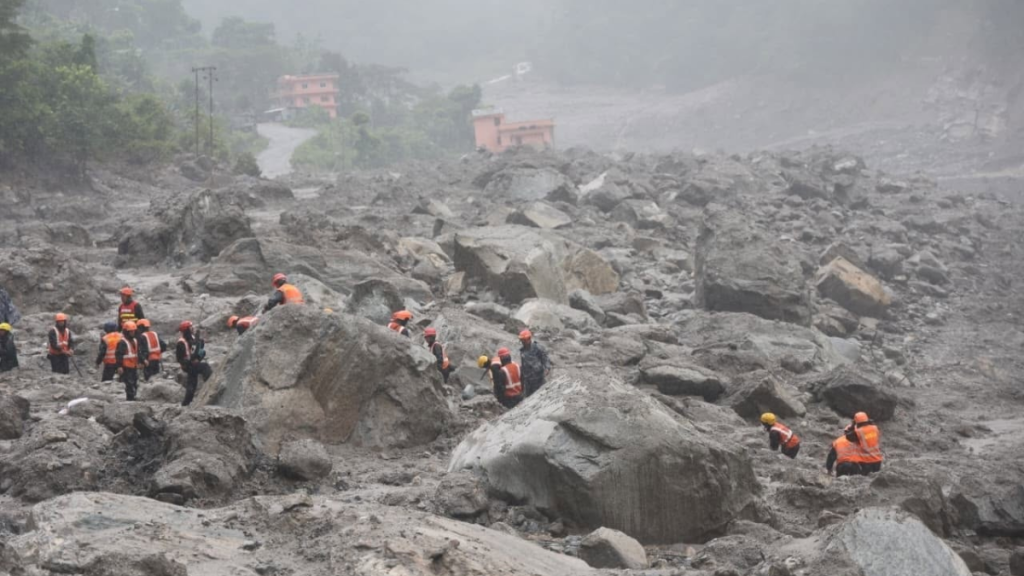
New Delhi: Nepal’s death toll from last week’s deadly floods and landslides crossed 1,000 on Tuesday, with rescuers stepping up operations to reach hundreds of people still stranded at damaged hydropower stations and other remote areas. The confirmed death toll has risen to 1,003, while around 4,000 people remain missing, including 590 foreign nationals from other countries.
At least 639 people are still stranded at several hydropower stations, making the sites a major focus of the ongoing rescue operation. More than 11,000 people have been rescued so far, while over 9,200 personnel have been deployed across the affected areas for search and rescue, road clearance, medical assistance and recovery operations.
Rescue teams from India, Nepal and China are using helicopters, excavators, heavy machinery and temporary bridges to reach isolated areas. Nepali Army personnel and specialized teams have also been working to clear flooded and collapsed tunnels at hydropower projects, where workers are believed to remain trapped.
According to the Kathmandu Post, 279 people were rescued alive from various hydropower projects immediately after the floods, including 221 from Upper Trishuli-3A and 33 from Upper Trishuli-1. Rescue teams, involving personnel from Nepal, India and China, have been working to reach those still missing, with water being drained from tunnel entrances and excavators and rock breakers used to clear access routes.
The disaster has also triggered a major international relief effort, with more than $42 million in aid flowing into the country, The Nepali prime minister, Balendra Shah, said adding that the government expected contributions to increase, Reuters reported.
China said it would send DNA testing experts to the disaster-hit areas and provide another batch of relief supplies, including drones and water-purification equipment. South Korea has also announced a 44-member emergency relief team to assist rescue operations in Rasuwa, where nine South Korean nationals working at a hydropower project remain missing.
Japan has also offered support. During a telephone conversation with Shah on Tuesday, the Japanese prime minister, Sanae Takaichi, expressed condolences over the loss of lives and reaffirmed Tokyo’s readiness to assist Nepal. Shah thanked Japan for its support and said the search for missing Japanese nationals would receive priority.
Meanwhile, glaciers surrounding the Chhochen Khola river impact crater in Nepal remain susceptible to further collapse, posing a potential hazard, Global Times reported, citing China’s ministry of water resources. The ministry said 14 glacial lakes in the Gyirong Tsangpo River basin remained relatively stable, while drone imagery showed that water accumulated in the impact crater had largely drained and the downstream river was flowing normally.
However, the ministry warned that the risk of further glacier collapses around the impact crater remains, according to the report.
Road and communication links are gradually being restored in some of the worst-hit areas. Access to Nuwakot, one of the severely affected districts, has been reopened at several points, allowing rescue teams to move relief supplies and continue operations.