


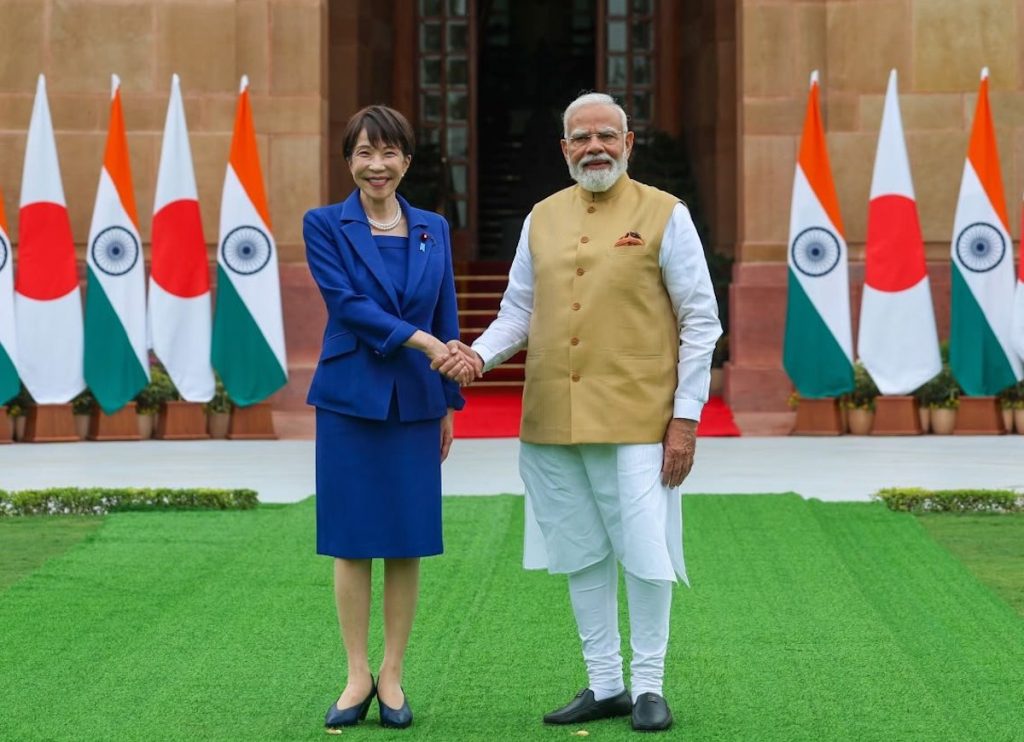
New Delhi: India and Japan signed their first-ever defence co-development agreement and unveiled close to 130 fresh cooperation pacts worth roughly ¥2 trillion (about $12.5 billion) on Thursday, as the prime minister, Narendra Modi, hosted his Japanese counterpart, Sanae Takaichi, for the 16th India-Japan Annual Summit at Hyderabad House. Takaichi started her visit by landing in Delhi on Wednesday evening.
The summit, held on the second day of Takaichi’s three-day visit to New Delhi, produced a joint roadmap on economic security, a fresh push on artificial intelligence collaboration, a biogas initiative targeting 1,000 plants across India, and a draft joint statement voicing concern over China’s export curbs on rare earths and other critical materials, according to officials and Japanese media reports cited by wire agencies.
Takaichi’s day began with a ceremonial reception at the forecourt of Rashtrapati Bhavan, where marching contingents from the Army, Navy, and Air Force, followed by a band, presented a guard of honour. Modi stood beside her throughout the ceremony and introduced his cabinet colleagues and other dignitaries to the visiting leader.
The two prime ministers then moved to Hyderabad House for bilateral talks, followed by delegation-level discussions. The external affairs minister, S Jaishankar; the national security adviser, Ajit Doval; and the foreign secretary, Vikram Misri, were part of the Indian side, officials said.
Addressing a joint media interaction afterwards, Modi described Takaichi, Japan’s first woman prime minister, as his “younger sister” and said her visit opened “a new chapter” in the India-Japan Special Strategic and Global Partnership. He noted that Japan had contributed significantly to India’s growth story over the decades, from automobiles to electronics, and said the convergence of Japan’s precision technology with India’s software strength would give fresh momentum to global AI development.
On defence, Modi confirmed that the two sides had signed an agreement for their first co-development project, without elaborating on the platform involved. Officials familiar with the broader India-Japan defence dialogue said the move builds on years of slow-moving talks between the two governments, which had previously produced only limited outcomes, including joint work on unmanned ground vehicles and a ship-mast communications system.
On the economic front, Modi said the two countries had prepared a joint roadmap for economic security aimed at strengthening supply chain resilience in semiconductors, quantum technology, and advanced materials. He also announced the India-Japan Biogas Initiative, under which the two sides will work to set up 1,000 biogas and organic-fertiliser plants across India, and a Japan Business Week meant to ease business conditions for Japanese firms operating in the country.
Japan’s side of the announcements centred on investment. More than 150 Japanese companies, including Suzuki, Toyota Tsusho, and Itochu, took part in the India-Japan Economic Forum held alongside the summit, where Tokyo confirmed close to 130 private-sector cooperation agreements worth about ¥2 trillion. These reportedly include a semiconductor materials plant tied to Fujifilm, a biogas facility project involving Suzuki, joint ventures between Japanese and Indian artificial-intelligence startups, and a large green-ammonia project. The figure builds on Tokyo’s existing commitment, set at last year’s summit in Tokyo, to mobilize ¥10 trillion (roughly $68 billion) in private Japanese investment into India over 10 years.
According to details of the draft joint statement reported by Japanese media, the two countries flagged serious concern over “nonmarket policies and economic coercion,” an apparent reference to Beijing’s recent export restrictions, without naming China directly. The statement also welcomes Japan’s evolving Free and Open Indo-Pacific concept, records appreciation for maritime security cooperation, and sets out plans to hold a Japan-India foreign and defence ministerial dialogue, known as the 2+2, before the end of the year.
On energy, the two sides agreed to work towards joint stockpiling arrangements to guard against supply shocks, while also backing cooperation on bringing Japan’s next-generation Shinkansen technology to India’s high-speed rail programme.
Takaichi, speaking through her office ahead of the visit, had said she intended to focus discussions with Modi on three areas: deepening the strategic partnership, advancing economic security cooperation, and expanding business collaboration between the two countries. She also referred to India and Japan’s shared responsibility, as leading Asian democracies, for peace and stability in the Indo-Pacific, including through the Quad framework.
Thursday’s outcomes come against a backdrop of worsening Tokyo-Beijing relations. China imposed fresh export controls on 40 Japanese entities, including defence contractors, just days before Takaichi’s departure for New Delhi, after her earlier remarks in Japan’s parliament on Taiwan drew sharp protests from Beijing. Officials on both sides have said the timing has sharpened Tokyo’s focus on diversifying its economic partnerships, with India emerging as a central piece of that strategy.
The arrival
As RNA Media had reported, Takaichi’s visit began on Wednesday evening, when she landed at Palam Technical Airport in New Delhi to begin her first official trip to India since taking charge as prime minister on October 21, 2025. She was received on arrival by the minister of state for science and technology, Jitendra Singh, while the ministry of external affairs spokesman, Randhir Jaiswal, welcomed her arrival on social media, calling the visit “an important step” in advancing the India-Japan partnership.
Modi, in a post welcoming her, said he looked forward to “wide-ranging discussions” the following day that would further deepen the bilateral relationship. Takaichi arrived with a business delegation of about 50 executives, including Suzuki Motor’s president, Toshihiro Suzuki, along with representatives from Itochu and Toyota Tsusho.
Before leaving Tokyo, Takaichi had told reporters at an informal media interaction that growing uncertainty in the international situation made collaboration with India, which she said shared Japan’s fundamental values and strategic interests, increasingly important. Earlier the same day, Japan’s ambassador to India, Ono Keiichi, spoke at the Japan session of a Human Resource Mobility Forum hosted by the External Affairs Ministry in New Delhi, describing the visit as an opportunity to deepen people-to-people exchanges between the two countries.
The venue for this year’s summit was itself a late change. New Delhi had earlier offered Guwahati, in Assam, as an option, reviving a plan first floated for the cancelled 2019 summit. However, the tight window created by an ongoing session of Japan’s parliament, the Diet, meant Takaichi’s schedule had to be confined to the capital throughout her stay.
What to expect on visit’s final day
Takaichi is scheduled to depart for Tokyo on Friday, bringing her three-day visit to a close. With the substantive engagements, the ceremonial welcome, summit-level talks, and the business forum, concentrated into Thursday because of her compressed schedule, no separate high-profile public events had been announced for the final day as of Thursday evening.
The visit is expected to conclude with courtesy engagements before Takaichi’s departure, though neither the Indian nor the Japanese side had published a detailed public itinerary for Friday at the time of writing this report. Her return to Tokyo comes as the Japanese parliament (Diet) session leaves her only a narrow window for foreign travel, officials had indicated ahead of the visit, which is also why a full state visit with a longer itinerary was not scheduled this time round.
Officials on both sides have said the 2+2 ministerial dialogue planned for later this year, along with the implementation of Thursday’s economic security roadmap and investment pledges, will be the key markers to watch in the coming months as New Delhi and Tokyo look to build on this visit.