


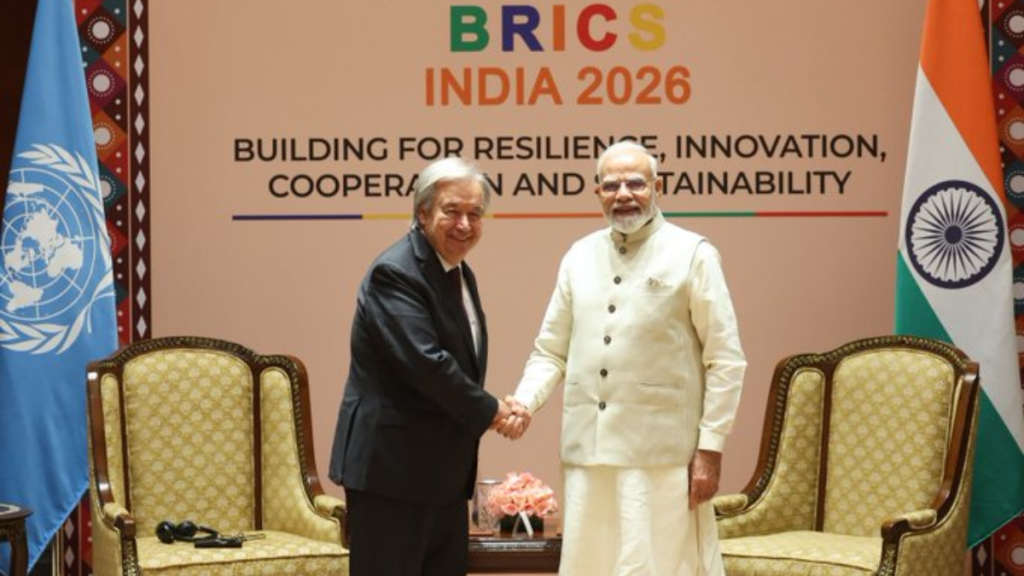
New Delhi: The prime minister, Narendra Modi, held a series of high-level meetings with global leaders on the sidelines of the 18th BRICS Summit in New Delhi on Saturday, with discussions ranging from UN reforms and multilateralism to defence, critical minerals, clean energy, investment and connectivity. The meetings came as leaders gathered at Bharat Mandapam for the summit’s session on “Inclusive Global Governance and Strengthening Multilateralism”, reflecting India’s focus on strengthening multilateral institutions and amplifying the voice of the Global South.
Modi’s meeting with the UN secretary-general, António Guterres, centred on New Delhi’s commitment to strengthening multilateralism. Modi also stressed the urgent need for reforms in the United Nations, as global institutions face growing demands to reflect present-day geopolitical realities – an issue also highlighted by Yojna Patel, chargé d’affaires at India’s Permanent Mission to the UN, who said the challenges facing the world today are vastly different from those the organization dealt with in 1945.
A series of bilateral meetings followed, including Modi’s engagement with the Ethiopian prime minister, Abiy Ahmed Ali, whom he welcomed on his first visit to India. The two leaders discussed taking the longstanding India-Ethiopia friendship into new areas, with defence, capacity building, investment linkages, critical minerals, clean energy and healthcare featuring prominently in their talks.
The discussion with Abiy also carried a wider India-Africa dimension, with both sides looking to strengthen cooperation and amplify the voice of the Global South. The focus on capacity building and strategic sectors further underlined India’s effort to build deeper partnerships with African countries as part of its broader engagement with developing nations.
Modi also held separate bilateral meetings with southeast Asian countries deepening India’s strategic partnerships.
Modi first met the Malaysian prime minister, Anwar Ibrahim, with the two leaders looking to expand the India-Malaysia comprehensive strategic partnership into emerging areas of cooperation. The discussion covered semiconductors, critical minerals, clean energy, infrastructure and talent mobility, alongside an expanding defence partnership and growing two-way investments.
The Malaysian engagement also placed greater emphasis on economic and people-to-people links, with Modi noting the fresh momentum in the bilateral relationship. The two countries are seeking to widen cooperation beyond traditional areas while strengthening their strategic partnership across technology, defence and critical sectors.
Meetings subsequently turned towards the Gulf, as Modi met the Abu Dhabi crown prince, Sheikh Khaled bin Mohamed bin Zayed Al Nahyan, to discuss taking the India-UAE strategic partnership to greater heights. Defence, artificial intelligence, space, critical minerals, energy, food security and connectivity were among the areas discussed by the two sides.
The UAE engagement also covered investment ties, strategic energy infrastructure and connectivity through the India-Middle East-Europe Economic Corridor. Against the backdrop of continuing uncertainty in West Asia, Modi described a strong India-UAE partnership as a symbol of stability, prosperity and peace.
Continuing his engagements with key Asian partners, Modi also met the Vietnamese prime minister, Lê Minh Hưng, on the sidelines of the BRICS Summit. The two leaders discussed deepening defence and security cooperation, including the proposed 2+2 mechanism, while also exploring greater cooperation in energy, rare earths and space.
Economic ties also featured in the Modi-Lê Minh Hưng discussions, with the two sides working towards a target of $25 billion in bilateral trade by 2030 and greater two-way investment. Modi also highlighted the importance of India and Vietnam’s cultural and civilizational links, describing Vietnam as a key pillar of India’s Act East Policy and Mahasagar vision.
The bilateral meetings were complemented by Modi’s engagement with BRICS leaders gathered at Bharat Mandapam ahead of the session on inclusive global governance and strengthening multilateralism. Taken together, the day’s engagements showcased India’s effort to use its BRICS presidency to deepen strategic partnerships while advancing priorities ranging from UN reform and defence cooperation to critical minerals, technology, energy, connectivity and the interests of the Global South.