


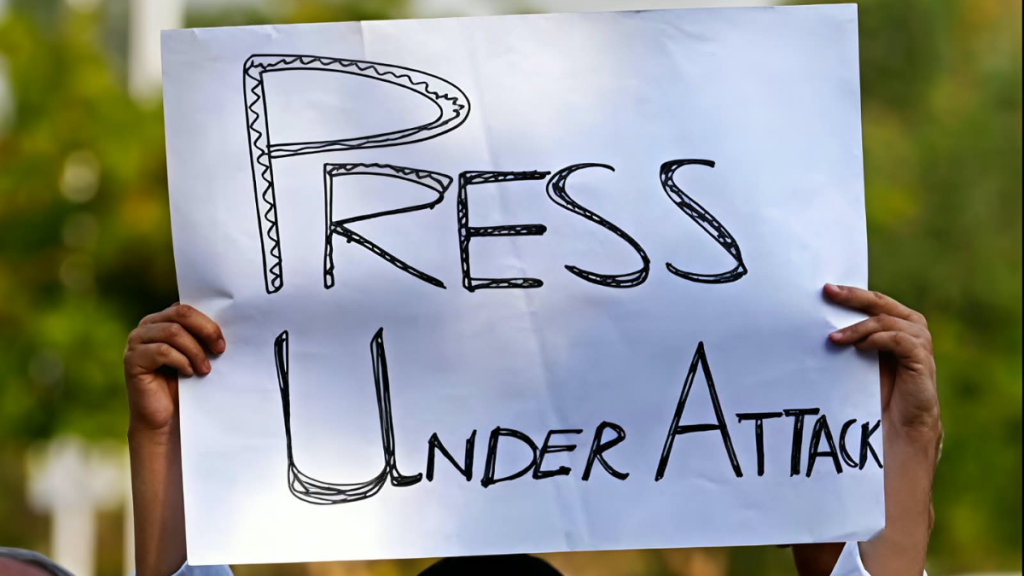
New Delhi: Pakistan-occupied Kashmir (POK) is witnessing a widening crackdown on criticism, with authorities expanding the use of anti-terrorism measures from political activists and protestors to journalists covering the unrest. The latest case involves Kahmir Times columnist Danish Irshad, whose placement on the “Fourth Schedule” (Pakistan’s anti-terror watchlist) has triggered fresh concerns over press freedom and the growing use of security laws against independent reporting.
Irshad was among 24 people named in a July 29 notification issued by the home department of POK. Listed at number 12, he was placed under Section 16(1) of the Azad Jammu & Kashmir Anti-Terrorism Act, 2014.
The notification does not specify any alleged offence committed by Irshad or directly connect his journalism to his designation. Irshad said he was not served the order and discovered his inclusion through social media on August 18. He later confirmed the listing through a source in the department.
What is Pakistan’s Fourth Schedule?
The Fourth Schedule is Pakistan’s anti-terror watchlist, used to monitor people whom authorities consider linked to terrorism or activities deemed a security threat. Being placed on the list does not by itself amount to a criminal conviction, but it can lead to restrictions on travel, passports, bank accounts, credit facilities, arms licences and government employment, along with increased surveillance by security agencies.
Journalists raise alarm over Irshad’s anti-terror listing
Irshad told Drop Site News that his inclusion had taken place without a court order or trial, questioning how journalistic work could be treated as terrorism. He said placing someone on the Fourth Schedule without due process raised serious questions about the credibility of the state.
The government banned the movement in June and subsequently used anti-terrorism provisions against its activists and supporters. On June 20 alone, 147 people linked to the Jammu Kashmir Joint Awami Action Committee (JAAC) were reportedly placed on the Fourth Schedule, covering districts including Poonch, Sudhnoti, Kotli, Bagh, Mirpur, Bhimber, Neelum, Haveli and Muzaffarabad.
Another 10 people were reportedly added to the list on August 10. The crackdown intensified around the July 27 election, which the JAAC boycotted. A long march towards Muzaffarabad was followed by clashes, while authorities pursued prominent figures associated with the movement.
The government also announced rewards for information leading to the arrest of four wanted JAAC leaders, including Shaukat Nawaz Mir, who was subsequently arrested.
Islamabad-based journalist Syed Farhad Ali Shah was detained in July over his reporting on the protests, according to press freedom advocates. Independent journalists Razi Tahir and Muhammad Saif were also reportedly taken from their Islamabad office on August 1 by men wearing police uniforms and held at an undisclosed location.
Such detentions, along with Irshad’s inclusion under the Fourth Schedule, raise fears that journalism related to the political crisis in POK is now being perceived in security terms.
Irshad has covered Kashmir’s political and security affairs for nearly a decade. His recent reporting has included interviews with families whose children were allegedly killed by Pakistan’s armed forces. His designation has drawn criticism from journalists and activists in Pakistan and abroad.
Pakistani journalist Saleh Safeer Abbasi described the move as a “direct attack on press freedom” and called for Irshad’s removal from the Fourth Schedule, saying dissent should not be treated as a crime.
UK-based Pakistani activist Azhar Ahmed also criticized the use of anti-terrorism legislation against journalists, warning that it could send a chilling message to reporters documenting protests, state actions and human rights conditions.
“Journalism is not terrorism,” Ahmed said, arguing that reporting, documenting events and questioning those in power should not be criminalized through anti-terror laws. New York-based Pakistani investigative journalist Areeba Fatima also questioned the absence of a trial or court order in Irshad’s case.
Crackdown continues amid political tensions
The pressure on the JAAC has continued alongside the territory’s contested electoral process. The movement boycotted the July 27 election, while violence and security concerns led to disruptions and postponements in some constituencies.
The crackdown is also unfolding against the backdrop of wider political and security pressures facing Pakistan’s military establishment, including militant violence in Balochistan and Khyber Pakhtunkhwa, tensions with Afghanistan and continuing political confrontation with supporters of jailed former prime minister, Imran Khan.
For journalists in POK, however, the immediate concern is the shrinking space to report on the unrest. The crackdown has now moved from protesters to activists and journalists, raising concerns about growing restrictions on political opposition and independent reporting in POK.