


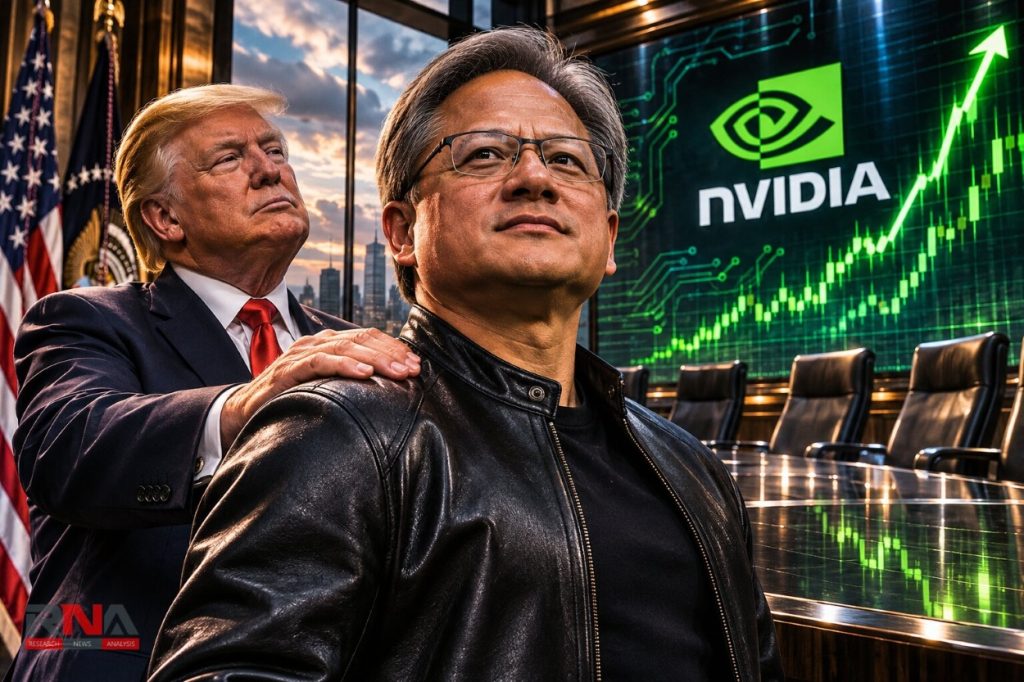
New Delhi: The United States president, Donald Trump, personally orchestrated a behind-the-scenes effort to reinstate Jensen Huang as Nvidia’s chief executive officer, enlisting senior members of his administration to overcome the company’s concerns over national security. The extraordinary intervention culminated in the chipmaking giant’s dramatic boardroom reversal on Monday, November 23, less than two weeks after its co-founder was forced to resign over a scandal involving a suspected Chinese intelligence asset.
Fresh details of the negotiations reveal how the White House mobilized some of its most powerful officials to secure Huang’s return, despite continuing federal investigations into the suspected diversion of advanced American artificial intelligence chips to China. The episode highlights the growing intersection of corporate power, national security and economic policymaking in Washington, where Nvidia has emerged as a strategically important asset in America’s technological competition with Beijing.
How White House engineered Huang’s comeback
According to a New York Times report, Trump decided towards the end of last week that his administration should actively work towards restoring Huang to his former position. The decision came despite concerns within the American intelligence establishment over the technology billionaire’s relationship with Alice Huang, a Chinese businesswoman suspected of having links with Beijing’s intelligence apparatus.
Trump entrusted the vice-president, JD Vance, with the task of engaging Nvidia’s leadership and addressing the concerns that had prompted directors to oppose Huang’s return. Vance held private discussions with the former CEO over the weekend and helped communicate Washington’s assessment that his reinstatement would not compromise American national security.
The choice of Vance was significant given his extensive connections with Silicon Valley’s investment and technology communities. Among his associates is David Sacks, an influential technology investor and co-chair of the President’s Council of Advisers on Science and Technology, who has been a prominent supporter of Huang.
A crucial breakthrough reportedly came on Saturday when the attorney general, Todd Blanche, briefed Trump and Vance on the Justice Department’s findings. According to the Wall Street Journal, Blanche informed them that Huang was not personally the target of a Justice Department investigation and that investigators had uncovered no evidence of criminal conduct on his part.
Nvidia’s cooperation with federal investigators examining suspected semiconductor export violations involving its customers reportedly contributed to that assessment. The assurances provided the White House with the opening it needed to persuade Nvidia’s directors to reconsider their position.
On Sunday afternoon, Nvidia’s board held an extensive meeting with Huang, during which the executive reportedly acknowledged additional extramarital affairs and expressed remorse over his conduct. Following discussions about transparency and personal accountability, the directors unanimously approved his reinstatement and informed the administration of their decision that evening.
The negotiations were conducted under extraordinary secrecy, with only a handful of senior administration officials reportedly aware of the initiative. The announcement was deliberately scheduled for Monday morning before trading commenced on Wall Street.
From outright rejection to unanimous approval
The development represented a remarkable reversal for Nvidia’s directors, who had unanimously accepted Huang’s resignation and subsequently ruled out his return. As RNA Media reported, Trump had publicly advocated Huang’s reinstatement even as the company maintained that it was looking for a new chief executive.
In its official announcement on Monday, Nvidia acknowledged that representations from senior American government officials had influenced its decision. Huang also regained his position as the company’s president and board member, while Harvey Jones retained the chairmanship and the interim CEO, Colette Kress, returned to her previous responsibilities as chief financial officer.
Trump subsequently claimed personal credit for the turnaround, telling CNBC that he had communicated with Nvidia’s directors through both direct and indirect channels. He also acknowledged that the severe turbulence in financial markets following Huang’s departure had probably influenced his decision to intervene.
Nvidia shares closed 31.5 per cent higher on Monday at $165.05, reversing much of their recent losses. The wider market also staged a spectacular recovery, with the benchmark S&P 500 gaining 4.7 per cent.
National security questions remain unanswered
Huang’s reinstatement, however, does not bring the investigations surrounding Nvidia to an end. American authorities continue to examine allegations that Alice Huang maintained contact with an official of China’s Ministry of State Security for more than a year during her relationship with the Nvidia chief.
Investigators are also examining the activities of Megaspeed International, a Singapore-based technology company where Alice Huang held an executive position. The company is suspected of facilitating the diversion of advanced Nvidia chips to China in violation of American export restrictions – allegations that Megaspeed has denied.
Significantly, within hours of Huang’s reinstatement, Washington placed Megaspeed and several associated companies on its trade blacklist. Nvidia, meanwhile, has established a committee comprising independent directors to strengthen oversight of export-control compliance and national security matters.
Trump’s intervention has also drawn criticism from lawmakers across party lines. Huang is expected to face questioning by congressional committees examining the controversy, with several legislators maintaining that the absence of evidence of criminal wrongdoing does not necessarily resolve broader counterintelligence concerns.
Why Huang matters to Trump’s technology strategy
Behind the extraordinary presidential intervention lies Nvidia’s increasingly central position in the American economy and Washington’s strategic competition with Beijing. Its advanced graphics processing units underpin much of the global AI infrastructure, with applications extending from commercial computing and scientific research to military intelligence and autonomous systems.
For Washington, maintaining American dominance in advanced computing while preventing sensitive technologies from strengthening China’s military and intelligence capabilities remains a fundamental policy challenge. Huang’s return suggests that the Trump administration believes retaining his leadership at Nvidia is compatible with that objective, provided the company strengthens its regulatory safeguards.
Nevertheless, the administration has now invested considerable political capital in Huang’s reinstatement. Any adverse findings emerging from the continuing investigations could raise uncomfortable questions not only for Nvidia’s directors but also for the White House that persuaded them to bring him back.