


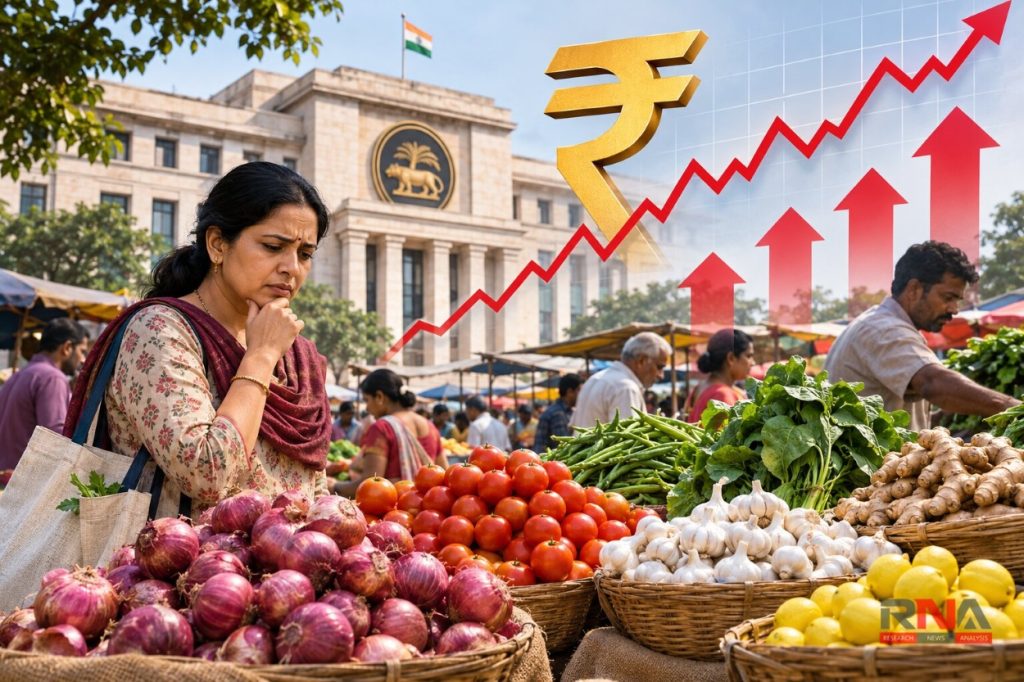
New Delhi: India’s retail inflation climbed to 6.09 per cent in October, crossing the Reserve Bank of India’s upper tolerance limit for the first time in two years, as soaring food prices and rising household expenses intensified pressure on consumers. The unexpectedly sharp increase has complicated the central bank’s efforts to contain inflation without undermining economic growth, strengthening expectations of another interest rate increase in December.
According to official figures released by the Ministry of Statistics and programme implementation on Thursday, consumer price inflation accelerated from 5.54 per cent in September, exceeding the 5.93 per cent forecast in a Reuters survey of economists. The reading marks the first breach of the RBI’s six per cent ceiling under the revised consumer price index (CPI) series introduced in February, with 2024 replacing 2012 as the base year.
Food inflation emerged as the principal contributor, surging to 8.94 per cent from 7.74 per cent in September, reflecting mounting pressure on the prices of vegetables and other essential commodities. Food accounts for nearly 35 per cent of the revised CPI basket, making fluctuations in agricultural prices particularly consequential for household expenditure and the overall inflation outlook.
The most striking increase was recorded in onion prices, which rose 116.22 per cent compared with October 2025, effectively more than doubling over the corresponding period. Garlic prices increased 60.74 per cent, ginger 48.32 per cent and lemons 47.30 per cent, illustrating the severity of supply-related disruptions affecting several widely consumed vegetables.
However, the price increases were not uniform across agricultural commodities, with potatoes becoming 14.24 per cent cheaper and cauliflower prices declining 10.57 per cent year on year. These contrasting movements suggest that seasonal supply conditions and distribution bottlenecks, rather than a single nationwide agricultural shortage, are contributing to the uneven pattern of food inflation.
The inflationary pressure was considerably more pronounced in rural India, where consumer prices increased 6.63 per cent, compared with 5.41 per cent in urban areas. Rural food inflation reached 9.09 per cent against 8.68 per cent in cities, raising concerns about purchasing power in agricultural communities already affected by an uneven monsoon.
Price pressures have also spread beyond food, suggesting that inflation is becoming more firmly embedded across the economy. Transport costs increased 5.84 per cent, restaurant and accommodation services recorded inflation of 10.06 per cent, and personal care and miscellaneous services registered an increase of 10.14 per cent.
According to a Reuters report, 19 of the 43 CPI subgroups recorded inflation of at least four per cent in October, compared with 14 in September. The widening distribution of price increases suggests businesses are increasingly passing higher operating, transportation and input costs on to consumers, making inflation harder to contain through improvements in agricultural supplies alone.
The latest figures present a policy challenge for the RBI, which operates within an inflation-targeting framework centred on four per cent, with a tolerance band of two percentage points on either side. Inflation has now remained above the central bank’s four per cent target for five consecutive months, increasing the likelihood that monetary policy will remain restrictive.
In October, the RBI increased its benchmark repo rate to 5.50 per cent, initiating its first monetary tightening cycle in nearly four years. Economists increasingly expect another 25-basis-point increase at the December monetary policy meeting, potentially taking the rate to 5.75 per cent, although the decision will depend on incoming inflation and growth indicators.
The central bank has already revised its inflation forecast for the current financial year from five per cent to 5.2 per cent, with inflation expected to average six per cent during the October–December quarter. Its governor, Sanjay Malhotra, has identified weak monsoon conditions and the possibility of El Niño-related agricultural disruptions as significant risks to food production and rural economic activity.
External developments are adding another layer of uncertainty, particularly the consequences of the US–Iran conflict for international energy markets and maritime commerce. Although Brent crude prices have retreated towards $92 a barrel, instability around the Strait of Hormuz continues to threaten shipping and energy supplies, exposing India – a major crude oil importer – to potentially higher transportation and production costs.
A prolonged period of elevated inflation could weaken domestic consumption by reducing households’ disposable income, particularly among lower-income groups that spend a larger proportion of their earnings on essential commodities. Higher interest rates, meanwhile, could increase borrowing costs for businesses and consumers, affecting housing demand, private investment and broader economic activity.
The immediate concern for policymakers is whether the October increase represents a temporary food-driven spike or the beginning of a more persistent inflationary phase. With price pressures spreading across services and transportation, the RBI faces an increasingly difficult choice between tightening monetary conditions to restore price stability and preserving the momentum of India’s economic expansion.
For households, however, the consequences are already evident in rising grocery bills and everyday expenses, regardless of how monetary policy evolves. The next inflation reading, scheduled for December 14, will provide an important indication of whether the latest surge is beginning to moderate or whether India faces a longer period of elevated consumer prices.