


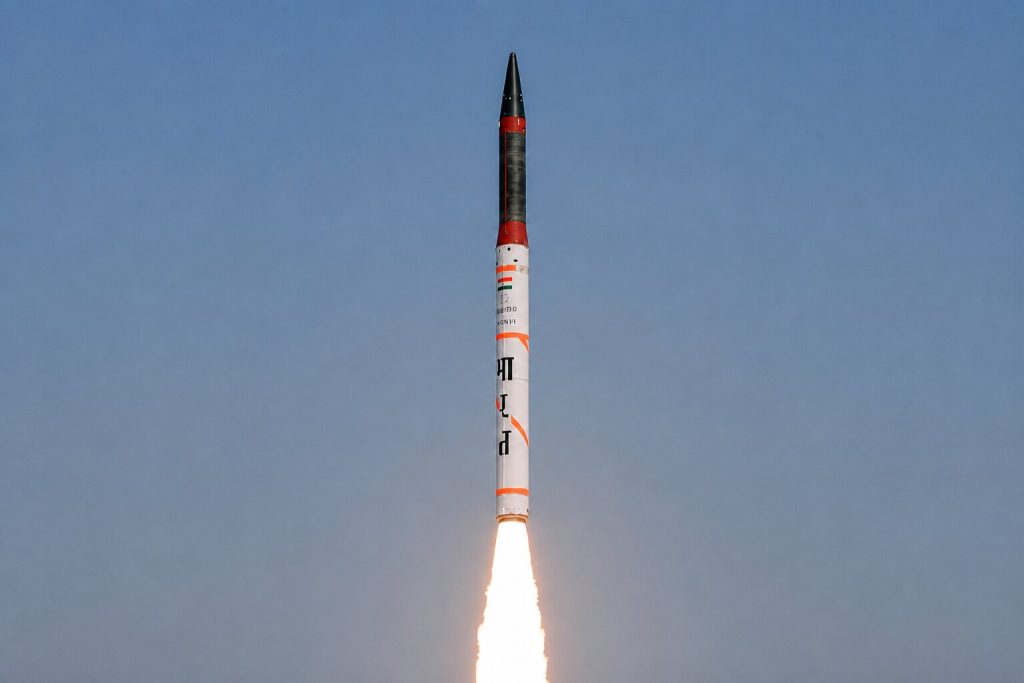
New Delhi: India successfully test-fired the medium-range ballistic missile (MRBM) Agni-4 from the Integrated Test Range, Chandipur, Odisha, on Thursday. The launch, carried out under the aegis of the Strategic Forces Command validated all operational and technical parameters, according to the government.
The trial answers part of a question that has hung over the Odisha coast for nearly a week, but not all of it.
On Sunday, India issued a notice to air missions (Notam) for a 2,530-kilometre test corridor, active from Thursday to Friday. The notified distance, and the secrecy around it, fuelled talk of a next-generation Agni system or the K-4 submarine-launched ballistic missile being trialled. Officials, as is customary, offered no confirmation either way.
The picture shifted on Monday, as RNA Media reported, when the Notam was extended to cover a 3,760-kilometre corridor, although the test window itself stayed unchanged. That widened range only sharpened the guessing game, with some analysts pointing to an upgraded Agni variant, like the still-untested ICBM (intercontinental ballistic missile) Agni-6, and others returning to the K-4.
Agni-4, a proven system in the SFC’s inventory since 2014, is the one that was flown on Thursday, a reminder that Notam distances mark the outer edge of a safety corridor and not any single missile’s flight profile. Crucially, the Notam itself remains in force until 11.59pm on August 7.
That leaves the window open for a second, longer-range launch before the corridor lapses. The 3,760-kilometre notification comfortably covers a trial of the Agni-6 ICBM or the K-4, either of which would explain why the wider range was sought in the first place.
This was not Agni-4’s first outing in recent years. The missile was last tested from the same range in September 2024, when it likewise validated all parameters in a training launch overseen by the SFC.
Thursday’s test also fits a pattern this year of back-to-back long-range trials off Odisha. In May, an advanced Agni missile fitted with a multiple independently re-entry vehicle (Mirv) payload was fired from Abdul Kalam Island, striking separate targets across the Indian Ocean region.
The Agni-6 continues to loom over every such Notam, according to the former DRDO chairman, Samir V Kamat, who has said the system is technically ready for trial and awaits only final government clearance. Whether Thursday’s Agni-4 launch was the sole use of this week’s corridor, or merely the first of two, should become clear before the Notam expires.
What is Agni-4 MRBM?
Agni-4 is the fourth missile in the Agni series developed by the Defence Research and Development Organisation (DRDO), and one of the mainstays of India’s land-based nuclear deterrent. The name is drawn from the Sanskrit word for fire, one of the five elements in classical Indian thought, a naming convention that runs across the entire Agni family.
The missile is a two-stage, solid-fuelled system about 20 metres long, capable of carrying a payload of up to 1,000kg. Its range is rated at roughly 4,000km, placing it between the shorter Agni-3 and the longer-range Agni-5 in the series’ escalating ladder of strike distances.
Agni-4 is road-mobile and can be launched from a canister on a transporter erector launcher, which improves survivability and cuts down launch-preparation time compared with older, silo-style systems. It uses a ring laser gyroscope-based inertial navigation system paired with a secondary micro-inertial navigation system, giving it high strike accuracy over its full range.
The missile first entered the SFC’s operational inventory after a series of development trials between 2011 and 2014, and has since been tested periodically to certify continued readiness rather than to prove new capability. The SFC, which conducted Thursday’s launch, forms part of India’s Nuclear Command Authority (NCA), the body responsible for the command and control of the country’s nuclear weapons. The NCA is headed by the prime minister.
Within the wider Agni family, which now spans the short-range Agni Prime through to the developmental Agni-6, Agni-4 occupies the middle tier, covering targets that fall short of the intercontinental range but well beyond India’s immediate neighbourhood.