


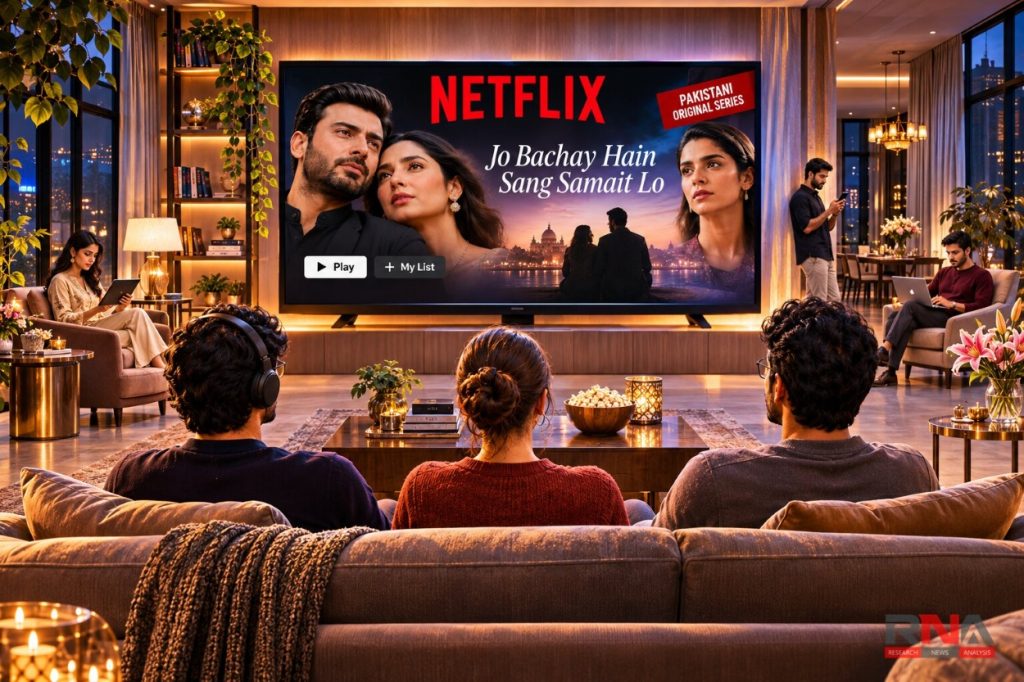
New Delhi: The Centre has asked American streaming giant Netflix to keep Pakistani-origin content off its platform in India, following objections to the possible release of its first Pakistani original web series “Jo Bachay Hain Sang Samait Lo”. The move reaffirms New Delhi’s restrictions on Pakistani entertainment content introduced in the aftermath of the April 2025 Pahalgam terrorist attack and the subsequent military confrontation between the two countries.
On Thursday, the Ministry of Information and Broadcasting reminded Netflix of an assurance it had given the government in June 2025 that films and television series originating in Pakistan were not being made available to its Indian subscribers. The ministry has asked the streaming company to maintain that position in accordance with the government’s existing policy.
The intervention follows several complaints and representations received by the ministry over the possible Indian release of the series, which features prominent Pakistani actors Fawad Khan, Mahira Khan and Sanam Saeed. The production is scheduled to make its international debut on December 4, although its availability in India remains uncertain.
The government’s communication is essentially a reiteration of its existing restrictions rather than a fresh prohibition directed exclusively at the forthcoming series. It also indicates that New Delhi has no immediate intention of relaxing its policy on Pakistani entertainment content, more than 18 months after the military confrontation of May 2025.
Bollywood bodies mount pressure on Netflix
The controversy gathered momentum after two Indian film industry organizations – the All Indian Cine Workers Association (AICWA) and the Federation of Western India Cine Employees (FWICE) – approached the prime minister, Narendra Modi, seeking government intervention to prevent the series from being released in India.
The AICWA argued that allowing the programme to reach Indian audiences would run contrary to the government’s national security advisory and undermine the sentiments of Indians following the Pahalgam attack. The association also alleged that some Pakistani actors associated with the production had made statements against India during periods of heightened bilateral tensions.
Going beyond the immediate controversy, the association called for permanent legislation prohibiting Pakistani entertainment content in India, with stringent penalties for violations.
The FWICE, an umbrella organization representing 32 film industry associations and around 500,000 workers, also warned of industrial action against Netflix. It threatened to disrupt the filming of the streaming company’s productions in India if it proceeded with the domestic release of the Pakistani series.
Meanwhile, Pakistan’s minister for planning and development, Ahsan Iqbal, criticized the demand for restrictions, accusing New Delhi of politicizing cultural exchanges. He questioned the rationale behind treating a television drama as a national security concern.
What is the controversial Netflix series about?
Marketed internationally as “All the Love Our Hearts Carry”, “Jo Bachay Hain Sang Samait Lo” is Netflix’s first Pakistani original series and represents a significant milestone for Pakistan’s entertainment industry. It is adapted from a bestselling 2013 Urdu novel by Pakistani author Farhat Ishtiaq.
Produced by Momina Duraid Films, the romantic drama explores the complexities of human relationships through the interconnected lives of six couples. The production was filmed across Pakistan, Italy and the United Kingdom and brings together several leading names from Pakistan’s television and film industry.
The cast also includes Hania Aamir, Ahad Raza Mir, Iqra Aziz and Hamza Ali Abbasi, several of whom enjoy considerable popularity among Indian audiences. The series’ trailer was released on November 24, generating considerable interest on both sides of the border.
Why India restricted Pakistani entertainment content
On May 8, 2025, a day after India launched Operation Sindoor against terrorist infrastructure in Pakistan and Pakistan-occupied Kashmir (POK), the I&B ministry issued a national security advisory to digital content distributors.
The advisory covered films, television programmes, web series, music, podcasts and other digital media produced in Pakistan, irrespective of whether they were distributed through paid subscriptions or made available free of charge.
The ministry invoked provisions of the Information Technology (Intermediary Guidelines and Digital Media Ethics Code) Rules, 2021, relating to national security, sovereignty, territorial integrity and public order. It cited established cross-border links involving Pakistan-based actors in terrorist incidents on Indian soil.
The immediate trigger was the terrorist attack in Pahalgam, Jammu & Kashmir, on April 22, 2025, which claimed 26 lives, including that of a Nepali national. Subsequent investigations by the National Investigation Agency (NIA) identified links to Pakistan-based Lashkar-e-Taiba (LeT) handlers, although Islamabad has denied involvement in the attack.
Cultural ties caught in geopolitical crossfire
Restrictions on Pakistani artists in India are not new. Cross-border entertainment collaborations came under intense pressure following the September 2016 Uri terrorist attack and again after the February 2019 Pulwama terrorist attack, with Indian film industry bodies imposing restrictions on professional engagements with Pakistani artists.
However, in October 2023, the Bombay high court dismissed a petition seeking a blanket prohibition on Indian individuals and companies employing Pakistani artists. The Supreme Court subsequently declined to entertain a challenge to that decision in November 2023.
The 2025 government advisory marked a significant shift by extending restrictions to the digital distribution of Pakistani-origin entertainment, regardless of whether Indian companies were directly involved in its production. The distinction is particularly important in an increasingly interconnected entertainment industry, where international streaming platforms commission productions across multiple jurisdictions.
For Netflix, the controversy presents a regulatory and commercial challenge in one of its most important growth markets. According to an HSBC estimate cited by Reuters, the company has around 20 million users in India, where affordable mobile internet has helped expand demand for digital entertainment.
Netflix could restrict the series geographically while proceeding with its international release, thereby complying with India’s policy without disrupting distribution elsewhere. However, the company has yet to publicly clarify its position on the proposed Indian release.
For now, the Centre’s intervention makes clear that the international release of a programme does not exempt it from India’s country-specific content restrictions. The controversy also underscores how the continuing geopolitical estrangement between India and Pakistan is increasingly shaping cultural commerce in the digital age.