


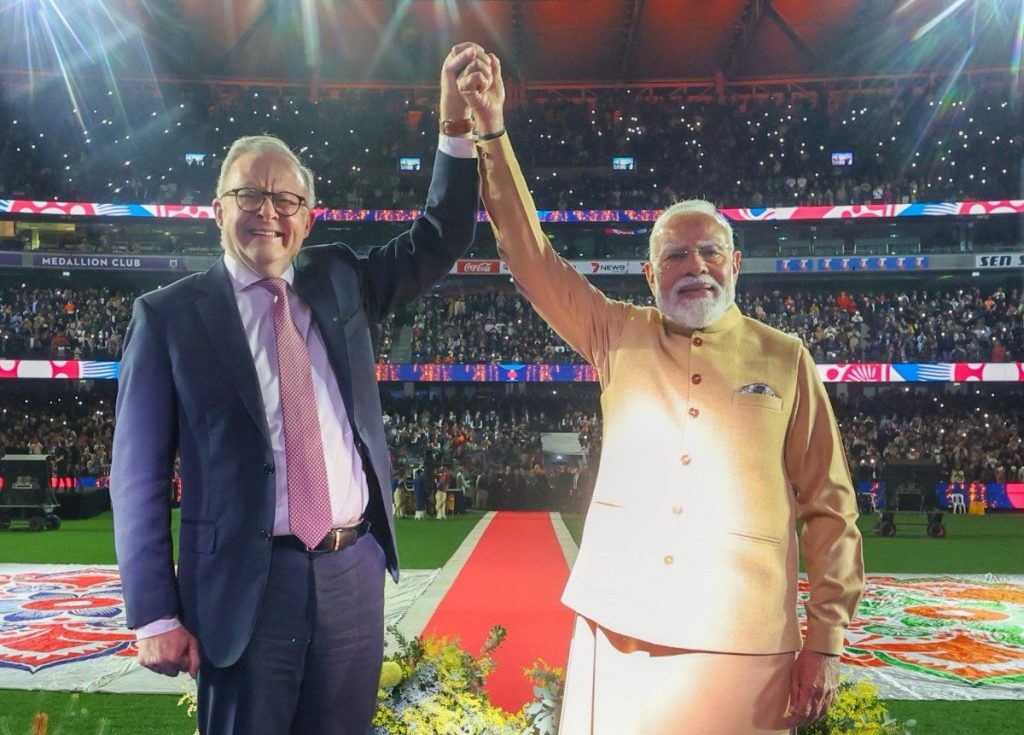
New Delhi: India and Australia have significantly expanded their strategic partnership by announcing a series of agreements spanning nuclear energy, defence, critical minerals, clean energy, trade and investment during the Annual Leaders’ Summit between the prime minister, Narendra Modi, and the Australian prime minister, Anthony Albanese, in Melbourne on Thursday. The announcements underscore the two countries’ growing alignment on Indo-Pacific security and economic resilience, while setting an ambitious agenda for closer cooperation across strategic sectors.
The centrepiece of the visit was the long-awaited agreement enabling Australia to begin commercial exports of uranium to India for peaceful civilian nuclear use. The arrangement operationalizes the civil nuclear cooperation framework signed in 2014 but held up for years over technical and regulatory issues linked to India’s status outside the Nuclear Non-Proliferation Treaty. Both governments stressed that the exports will remain subject to International Atomic Energy Agency safeguards and will be used exclusively for civilian power generation.
The uranium agreement marks a strategic breakthrough for both countries. India sees Australian uranium as an important component of its plan to expand nuclear power generation to 100GW by 2047 in support of its energy transition and decarbonization goals. For Australia, the deal diversifies its resource exports while reinforcing its role as a trusted supplier to one of the world’s fastest-growing major economies.
Beyond nuclear cooperation, the two leaders unveiled a broad package of initiatives aimed at strengthening economic and strategic ties. They committed to intensifying collaboration in renewable energy, green hydrogen, critical minerals, low-carbon aluminium and advanced manufacturing. Both governments also agreed to accelerate negotiations on a “comprehensive economic cooperation” agreement to expand trade beyond the existing interim pact and to work towards a bilateral investment treaty that would provide greater certainty for investors.
Investment featured prominently during the summit and the accompanying India-Australia CEOs Forum. Australian institutional investor AustralianSuper announced an additional investment commitment of AU$500 million ($347.14 million) to India’s National Investment and Infrastructure Fund, adding momentum to Australia’s expanding investment footprint in Indian infrastructure. Modi invited Australian companies to participate more actively in India’s infrastructure, logistics, manufacturing and technology sectors, describing India as a stable long-term investment destination.
Defence and security cooperation emerged as another major pillar of the summit. The two governments announced a new defence declaration designed to deepen military cooperation and reinforce their shared commitment to a free, open and rules-based Indo-Pacific. The package includes stronger coordination between the armed forces, expanded naval cooperation, greater interoperability, more complex joint military exercises, enhanced maritime domain awareness, defence innovation partnerships and closer collaboration on shipbuilding and defence industrial capabilities.
Officials from both countries indicated that maritime security, supply chain resilience and freedom of navigation featured prominently in the leaders’ discussions. While neither leader directly named China, the announcements reflected growing concern in both capitals over an increasingly contested Indo-Pacific strategic environment. The summit reaffirmed the importance of the Quad and broader regional partnerships in maintaining stability across the Indian and Pacific Oceans.
Critical minerals also occupied a central place in the talks. Australia, which possesses some of the world’s largest reserves of lithium, cobalt and rare earth elements, agreed to deepen cooperation with India to build resilient supply chains for minerals essential to electric vehicles, batteries, semiconductors and clean-energy technologies. Both sides also pledged greater collaboration in emerging technologies, artificial intelligence and digital infrastructure.
People-to-people ties received equal emphasis. Modi addressed a large gathering of the Indian diaspora in Melbourne, where thousands welcomed him at a community event. Albanese praised the Indian-Australian community for strengthening bilateral relations, describing it as “a living bridge” between the two democracies. The leaders also announced greater cooperation in education, research and cultural exchanges, including arrangements concerning the return of cultural artefacts and ancestral remains.
Addressing members of the diaspora, Modi described the relationship as entering a new phase of strategic trust and economic partnership.
“This is my third visit to Australia, and it is a hat-trick,” Modi said, drawing applause from the audience. He said India and Australia were building a partnership that would contribute not only to the prosperity of both nations but also to peace and stability across the Indo-Pacific.
During bilateral talks, Modi underlined India’s long-term energy ambitions.
“India has set an ambitious target of achieving 100 gigawatts of nuclear power capacity by 2047,” he said, adding that Australia’s decision to supply uranium would support India’s clean-energy transition.
Albanese described India as one of Australia’s most important strategic partners.
“The Australia-India relationship has never been more consequential, and our partnership fosters peace, stability and prosperity in the Indo-Pacific,” Albanese said ahead of the summit. During the community event, he also praised the Indian diaspora, calling it “a living bridge” connecting the two countries.
The Australian leader emphasized that the two countries were broadening cooperation well beyond traditional trade by expanding into defence, advanced technology, clean energy and critical minerals. The summit, he said, demonstrated that Canberra and New Delhi shared a long-term strategic outlook for the region.
The visit also drew limited protests from some groups in Melbourne over domestic political issues and human rights concerns, although these remained on the margins of events dominated by official engagements and strong public participation from the Indian diaspora. Australian authorities maintained extensive security throughout the visit.
The outcomes from Melbourne build on the India-Australia Comprehensive Strategic Partnership established in 2020 and reflect the rapid transformation of ties between New Delhi and Canberra over the past decade. Bilateral trade has expanded steadily, defence engagement has become increasingly institutionalized, and both countries have emerged as key partners in Indo-Pacific initiatives covering maritime security, resilient supply chains, critical technologies and clean-energy cooperation.
With the uranium agreement finally concluded, new defence commitments announced and investment flows gathering pace, the summit has delivered one of the most substantial packages of bilateral outcomes since the elevation of the relationship to a comprehensive strategic partnership. The announcements are expected to shape India-Australia cooperation across strategic, economic and technological sectors well beyond the current decade.