


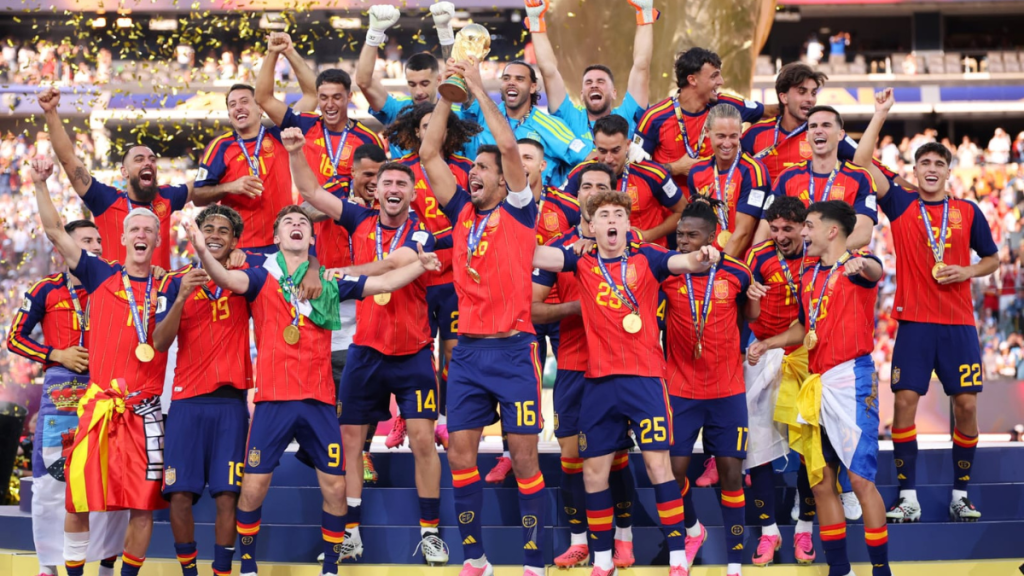
New Delhi: The final whistle at New York-New Jersey Stadium brought the curtain down on one of the most memorable Fifa World Cups in recent history. The champions lifted the trophy, fireworks lit up the sky, and millions celebrated across continents. Yet, long after the result fades from memory, another image from the tournament is likely to endure – not one from the final itself, but a photograph taken nearly two decades ago.
It shows a 20-year-old Lionel Messi, still years away from becoming arguably football’s greatest player, gently bathing a six-month-old Lamine Yamal in a plastic tub. Taken in 2007 by photographer Joan Monfort for a Barcelona charity calendar, the image was forgotten almost as soon as it was published. Neither Messi nor Yamal could have imagined that one day they would stand on opposite sides of football’s biggest stage, contesting the Fifa World Cup final.
The photograph resurfaced in the days leading up to the final and quickly became one of the defining images of the tournament. Speaking at Fanatics Fest before the final, Messi himself described the coincidence as “insane”. After the final, the picture came to symbolize far more than a remarkable twist of fate. It captured the passing of football’s torch from one generation to another, while also reflecting how the modern game has become inseparable from the story of migration and identity.
Every World Cup sparks debates that extend well beyond tactics and trophies. This edition was no different. One recurring question was why so many European national teams are increasingly made up of players whose parents or grandparents came from elsewhere. The answer lies not in football alone but in centuries of history.
Take France, for example. Many of its leading players trace their family roots to former French colonies in Africa or the Caribbean. England’s squad, too, reflects generations of immigration from the Caribbean and across Africa. Belgium, Portugal, Spain and the Netherlands all fielded players whose family histories stretch across former colonies, while Germany’s diversity owes much to decades of post-war labour migration, particularly from Turkiye and later from the Balkans and Eastern Europe.
Yamal’s rise in Spain perfectly illustrates this evolution. Born near Barcelona to a Moroccan father and a mother from Equatorial Guinea, the teenage sensation represents a generation of Europeans whose identities effortlessly span more than one culture. For millions of supporters, that diversity is no longer unusual – it is simply the face of modern football.
The pattern is not confined to Europe. The United States, one of the tournament’s co-hosts, fielded a squad that reflected decades of immigration from every corner of the world. Australia’s team included players from numerous cultural backgrounds, among them former refugees whose journeys to international football began in circumstances far removed from the glamour of the World Cup.
Migration in football, however, is rarely a one-way story. Players who grow up in Europe sometimes choose to represent their parents’ or grandparents’ countries of origin, while others who miss out on European national teams go on to become stars for African or Asian nations. International football today is less about rigid national identities than about personal histories shaped across borders.
To understand why, one has to step back from the football pitch and into history.
Much of Europe’s modern demographic landscape was shaped by empire. During the late nineteenth century, European powers divided vast parts of Africa among themselves, forging political and economic links that survived long after colonial rule ended. As countries gained independence through the 1950s, 1960s and 1970s, many people from former colonies retained citizenship rights, enjoyed easier access to their former imperial capitals, or migrated in search of education and opportunity. In many ways, migration followed the map of empire in reverse.
Also read: How Gaza’s war split the world’s loyalties in the Spain-Argentina World Cup final
World War II accelerated that process. Europe’s shattered economies urgently needed workers to rebuild cities, factories and transport networks. Governments actively recruited labour from overseas. France turned to North and West Africa, Britain welcomed migrants from the Caribbean in what became known as the Windrush generation, Belgium recruited workers from Morocco and Turkiye, while West Germany’s Gastarbeiter programme attracted millions of guest workers, many of whom settled permanently.
What began as temporary labour migration gradually transformed into permanent communities. Family reunification policies allowed workers to bring spouses and children, creating second and third generations who would grow up speaking European languages, attending local schools and, eventually, representing their countries on the football field.
Later, fresh waves of migration arrived under very different circumstances. Civil wars, political instability and humanitarian crises across Africa and the Middle East drove refugees towards Europe. Others moved for economic opportunity, education or family reasons. Each wave added another layer to societies that were already becoming more diverse.
Football simply reflected those changes. It did not create them.
Far from weakening national teams, diversity has often strengthened them. Players from different backgrounds have introduced varied playing styles, technical skills and cultural influences that have enriched the game. Modern football has become a living demonstration that national identity is not frozen in time but evolves with society itself.