


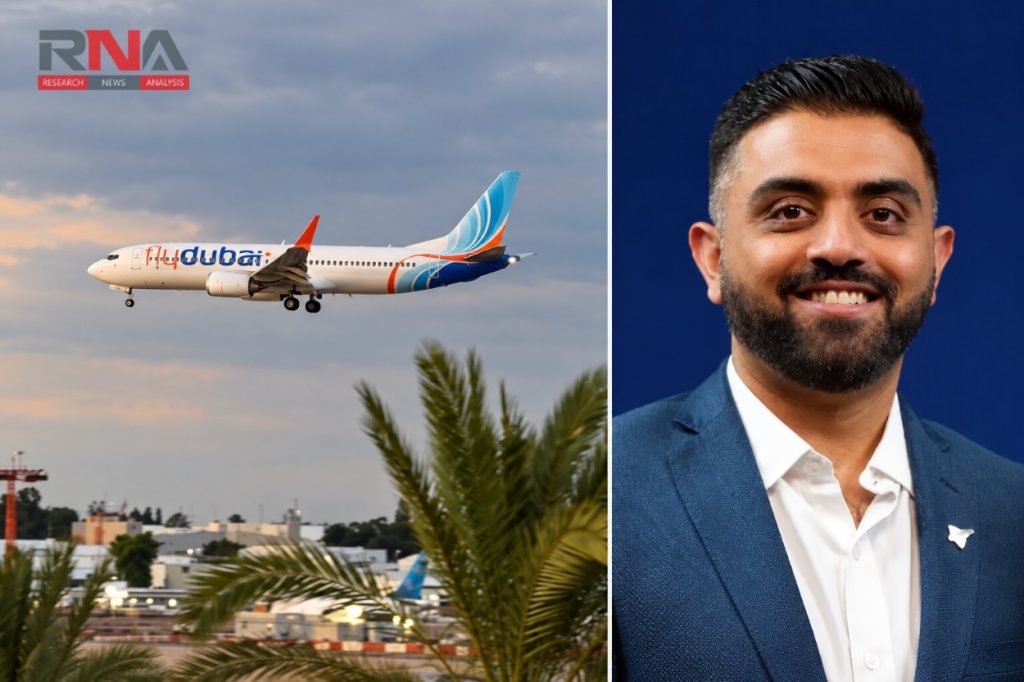
New Delhi: A Flydubai flight from Dubai to Tel Aviv was diverted to Saudi Arabia after a cockpit emergency triggered distress signals and an abrupt loss of altitude, as RNA Media reported earlier on Wednesday. The incident subsequently emerged as an alleged stabbing of the captain by his copilot, with the prime minister of Israel, Benjamin Netanyahu, saying the attacker apparently tried to crash the aircraft before passengers and crew intervened.
The Boeing 737 MAX 8, operating flight FZ1073 on Wednesday, landed safely at Tabuk in northwestern Saudi Arabia, and its passengers were subsequently flown to Israel on a replacement Flydubai aircraft. Netanyahu said Saudi authorities had arrested the suspected attacker and were questioning him, while the airline said the motive remained unknown and cautioned against speculation.
Indian media identified the injured captain as Smit Machchhar, a former SpiceJet pilot, while Israeli reports described the suspected attacker as an Omani national. These later accounts place the Indian pilot in command of the aircraft, rather than in the copilot’s seat, although Flydubai had not publicly identified either man in the statements reviewed.
Reports generally put the passenger count at 174, with most of those aboard Israeli, although early accounts gave differing totals and nationality breakdowns. Flydubai said everyone was safe and accounted for, while Saudi airport authorities confirmed that both the captain and first officer had sustained injuries and were taken to hospital.
The flight departed Dubai at 7.05am local time, according to flight-tracking information cited by ABC News. During the journey towards Israel, a violent confrontation developed inside the cockpit, followed by a steep descent that frightened passengers and prompted an emergency response on the ground.
Tracking reports differed over the precise altitude loss and the interval involved, but consistently showed a sudden, substantial descent from cruising altitude. Reuters, citing Flightradar24, reported that the aircraft dropped nearly 14,000 feet in less than 30 seconds; the recorded descent establishes the seriousness of the emergency but does not, by itself, establish the attacker’s intention.
The aircraft transmitted code 7700, signalling a general emergency, and code 7500, indicating unlawful interference, before reverting to the general emergency code ahead of landing. Those signals initially raised fears of a hijacking, although the precise sequence of cockpit actions and who entered the codes remained unresolved in the public accounts.
Netanyahu subsequently said he had spoken to an Israeli passenger who described the aircraft beginning to dive and a struggle to regain control. According to his account of the intervention, a passenger and a crew member entered the cockpit and subdued the man responsible for the stabbing, while another crew member stabilized the aircraft.
Machchhar reportedly resisted the attack before other people intervened, although the extent of his actions and the exact order of events had not been formally established. A Netanyahu spokesman told reporters that the wounded captain opened the cockpit-door release, allowing assistance to reach the flight deck.
The Indian Express, citing people familiar with the matter, reported that Machchhar joined Flydubai as a captain in June 2022 after 11 years with SpiceJet. His professional profile listed 9,750 flying hours and experience as a senior commander and line training captain on Boeing 737 aircraft, but his medical condition following the attack was not immediately known.
The suspected attacker’s name and professional background had not been officially disclosed in the material reviewed. Israeli reporting described him as Omani, but conflicting early reports about the pilots’ nationalities underline the need to distinguish attributed media accounts from findings established by investigators.
Passenger testimony provides a fuller account of how the threat was contained, with Tzvika Manes, an executive at an Israeli underwriting firm, saying his wife heard shouting from the cockpit while their daughter was in the lavatory. She alerted a relief pilot sitting nearby, after which Manes and two other men helped restrain the attacker; he also said a doctor travelling aboard treated and bandaged the wounded captain.
In a separate account to Israel’s Kan broadcaster, Manes said a crew member entered the cockpit and brought the suspected attacker out, allowing three passengers to overpower him. They used airline headphones to bind him, according to the account reported by Times of Israel.
Another passenger, identified as Daniel, told Channel 12 that he heard a struggle near the cockpit before the aircraft plunged and appeared to spin. He said two additional pilots aboard took control after the attacker was subdued, stopping the uncontrolled movement, although those in the cabin initially remained uncertain whether the danger had passed.
Flydubai’s own statement credited additional crew travelling aboard with securing, diverting and landing the aircraft. Taken together, the accounts indicate that the injured captain, intervening passengers, crew members and replacement pilots contributed at different stages, while leaving the investigation to determine their precise roles.
Tabuk’s Prince Sultan bin Abdulaziz International Airport said it received a distress call at 8.44am Saudi time and that the aircraft landed safely at 9.45am. Photographs published after landing appeared to show substantial damage to its rudder, although the cause and extent of that damage require an engineering assessment.
Israel scrambled fighter aircraft as the emergency unfolded, and Netanyahu convened security consultations with the defence minister, Israel Katz. The chief of the general staff, Lieutenant General Eyal Zamir, also held an assessment with senior commanders, while Israeli airspace was temporarily closed before reopening after the aircraft landed in Saudi Arabia.
Returning the passengers required coordination with a country that has no formal diplomatic relations with Israel, and Israeli officials considered sending military or civilian aircraft. There have been reports that Saudi Arabia declined an Israeli request to dispatch military transport aircraft, citing two security sources; the Saudi government did not immediately respond to that account.
Flydubai deployed two replacement aircraft to Tabuk, and the passengers ultimately travelled onwards aboard one of its flights. The replacement flight landed at Ben Gurion International Airport on Wednesday evening, bringing the stranded travellers to their intended destination.
Netanyahu praised those who intervened for preventing a major disaster and directed the security establishment to prepare for possible additional threats. His office also said security would be strengthened for Israeli and foreign airlines operating into Israel.
Katz went further, describing the incident as an attempted jihadist attack and saying preliminary information suggested an intention to kill everyone aboard. That characterization remained an Israeli government assessment rather than a publicly established investigative conclusion, with Flydubai explicitly saying the underlying reasons and motives were still unknown.
The transport minister, Miri Regev, called for Flydubai flights to and from Israel to be halted, while El Al prepared additional assistance for Israelis abroad seeking to return on its services. Flydubai, however, said the incident had not affected other scheduled operations across its network, leaving a distinction between the proposed Israeli restrictions and the airline’s announced operating position.
The incident also became entangled in political arguments ahead of Israel’s October 27 election, with the opposition leader, Yair Lapid, rejecting suggestions that Netanyahu’s security briefing to him the previous evening had anticipated anything similar. Lapid accused government supporters of exploiting the emergency politically, while the Democrats leader, Yair Golan, praised the passengers and likewise criticized attempts to use their actions for political gain.
The diversion occurred on an important route linking Israel with the UAE, whose establishment of diplomatic relations in 2020 opened extensive travel and commercial connections. Saudi Arabia, despite lacking formal ties with Israel, opened its airspace to all qualifying carriers in 2022 and has previously accommodated emergency landings involving Israeli passengers.
The immediate emergency ended with a safe landing and the passengers’ return, but central questions remained unanswered: what prompted the attack, what weapon was used, how it reached the cockpit and whether the aircraft’s descent was deliberate. Flydubai said those matters were subject to a formal investigation and urged all parties to avoid premature conclusions.