


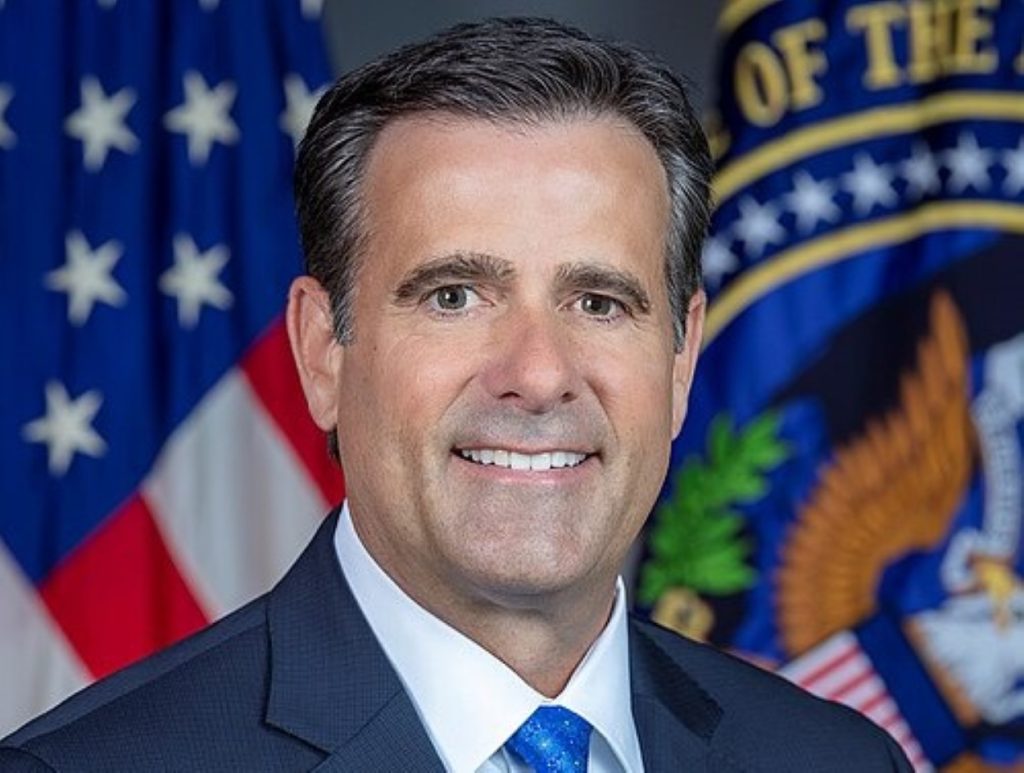
New Delhi: The CIA director, John Ratcliffe, made an unannounced visit to Moscow on Tuesday for undisclosed meetings with senior Russian officials, in the first publicly known journey to the Russian capital by a serving US intelligence chief since late 2021. The trip, conducted as the Ukraine peace process remained stalled and Washington intensified its pressure on Iran, immediately raised the possibility that the Trump administration was using its most sensitive backchannel to deliver a warning or explore a tightly controlled bargain.
CBS News first reported Ratcliffe’s presence in Moscow, citing people familiar with the visit, and Axios subsequently said it was his first trip to Russia since taking charge of the agency. Neither the CIA nor the White House disclosed whom he met, what was discussed or whether other senior American officials accompanied him.
The visit became visible only after flight-tracking data showed a US Air Force C-17A Globemaster III travelling from Joint Base Andrews in Maryland to Riga, and then onward to Moscow’s Vnukovo International Airport. A convoy containing vehicles with US diplomatic number plates was later filmed moving through central Moscow, and the aircraft left the Russian capital later the same day after a stay of several hours. The Washington Post verified footage of the motorcade and reconstructed the aircraft’s route.
The Kremlin initially maintained that it had no information about the military aircraft and said no meetings with representatives of the US administration were scheduled. However, the Kremlin spokesman, Dmitry Peskov, later told WaPo that the visit involved “contacts between security services”, although he declined to elaborate and said the Russian president, Vladimir Putin, had no planned meeting with Ratcliffe.
Before the mission, Washington informed Kyiv that a senior US delegation would be travelling to Moscow and asked Ukraine to suspend strikes until it had departed, according to Axios and some other news outlets. A Ukrainian source subsequently said the request covered Moscow, St Petersburg and parts of northern Russia between Monday and Wednesday, and that Kyiv had agreed to the temporary restraint.
The precaution reflected the operational risk surrounding the journey, as Ukraine has intensified long-range drone attacks on Russian energy, industrial and logistics facilities. Russian forces have simultaneously increased missile and drone strikes across Ukraine, leaving US-mediated negotiations unable to bridge fundamental disagreements over territory, security guarantees and the terms of any ceasefire.
The timing also coincided with US intelligence assessments suggesting that Putin’s appetite for risk may be increasing. CBS News in its original report on the trip highlighted the concern that Moscow could authorize hybrid operations or other deniable measures against Nato countries to test the alliance and the Trump administration.
WSJ separately reported that American intelligence had detected preliminary Russian preparations for a possible new mobilization and indications that Moscow was considering ways to probe Nato’s resolve. Beth Sanner, a former US deputy director of national intelligence, suggested that Ratcliffe may have carried a direct warning intended to show the Kremlin that Washington knew what it was contemplating and expected it to stop.
Iran was the other major crisis hanging over the journey, particularly because Ratcliffe has been closely involved in the US intelligence response to the conflict. Just one day earlier, as RNA Media had reported, the US treasury launched Operation Economic Outcast, an expansive campaign of sectoral and secondary sanctions intended to isolate Tehran and punish governments, companies and financial intermediaries that continue helping it.
Russia and Iran signed a 20-year comprehensive strategic partnership in January 2025 covering military, intelligence and security cooperation, although it does not contain a mutual-defence obligation. Western and Ukrainian officials have accused Moscow of providing Tehran with satellite imagery, targeting intelligence, cyber assistance and improved drone technology – allegations Russia has either denied or declined to address.
A Reuters investigation in July found that US intelligence analysts were examining whether Russian assistance had helped Iran strike CIA facilities in the Gulf, although they had not reached a firm conclusion. The possibility that Russian support had endangered American intelligence personnel gives Ratcliffe a direct institutional reason to raise Iran with his Russian counterpart.
Detainee diplomacy offers a less dramatic but credible third explanation, as the CIA has previously used its contacts with Russian intelligence to arrange prisoner exchanges. Ratcliffe was personally involved in the negotiations that led to the April 2025 release of the Russian-American dual national Ksenia Karelina, and Russia freed the ailing former US Marine Robert Gilman on humanitarian grounds on August 11, 2026.
Ratcliffe has also maintained a direct channel with the director of Russia’s Foreign Intelligence Service (SVR), Sergei Naryshkin. The two spoke in March 2025 about crisis management and areas of common interest, and Naryshkin later said they had agreed that either could contact the other whenever necessary.
Possibilities behind Ratcliffe’s unusual Moscow trip
Intelligence chiefs sometimes perform diplomatic functions when ordinary political channels are blocked, but a CIA director entering the capital of a country engaged in two conflicts touching core US interests is an exceptional event. The last known comparable visit occurred in November 2021, when Ratcliffe’s predecessor, William Burns, went to Moscow to warn Putin against invading Ukraine and outline the consequences Russia would face.
Burns later met Naryshkin in Ankara in November 2022 to caution Moscow about the consequences of using nuclear weapons and to discuss detained Americans, demonstrating the breadth of issues that can pass through an intelligence channel. Those precedents suggest that Ratcliffe’s journey was more likely to involve crisis communication, intelligence-backed warnings or a specific transaction than conventional peace negotiations.
The choice of messenger matters because a CIA director can present highly sensitive evidence without publicly revealing how it was obtained, allowing the recipient to understand that Washington possesses information it is not prepared to disclose. An intelligence-to-intelligence meeting also allows both governments to communicate without committing themselves publicly or creating expectations of a diplomatic breakthrough.
The most evidence-supported explanation is that Ratcliffe delivered a warning connected to Russian military preparations or possible operations against Nato members. If Washington believed Moscow was considering a major escalation, sending the CIA director would allow the US to confront Russian officials with intelligence, specify unacceptable actions and clarify potential consequences before the situation crossed a point from which neither side could easily retreat.
Public speculation has gone further, with some commentators asking whether Ratcliffe was warning Moscow against a nuclear strike on Ukraine. There is, however, no public evidence supporting that conclusion, and neither major reporting nor the Institute for the Study of War’s assessment on Tuesday connected the visit to preparations for nuclear use.
The Iran explanation is also plausible because the US sanctions campaign cannot fully isolate Tehran if Russia continues providing it with trade routes, technology and intelligence. Air Marshal Andrew Turner (retired), a former senior British military planner, described the journey as extraordinarily unusual and suggested that Washington could be seeking to persuade Moscow to reduce or end its support for Tehran.
A complete Russian break with Iran would nevertheless require substantial incentives and remains unlikely, given the two countries’ shared interest in weakening US influence and evading western sanctions. The more realistic American objective may have been narrower – to demand that Russia stop supplying targeting intelligence, define limits on assistance to Iran, or establish rules intended to prevent attacks on sensitive US facilities.
The relationship between Moscow and Tehran is strategic but transactional rather than an automatic alliance, which leaves some room for bargaining. Lowy Institute analysis notes that their partnership is shaped by mutual isolation and practical cooperation but contains no Russian obligation to defend Iran, meaning Moscow could modify particular forms of assistance if the price were acceptable.
At the same time, research by the Middle East Institute describes Russian help to Iran as extending across targeting data, drone technology, weapons and sanctions-resistant Caspian trade. That depth of cooperation means Ratcliffe would probably have needed to offer more than a warning if Washington wanted Moscow to make a significant strategic shift.
A detainee arrangement could have featured in the discussions without being their sole purpose, particularly because intelligence agencies have already handled such exchanges successfully. Yet the timing, the temporary Ukrainian strike restraint and the intersection of the Ukraine and Iran crises indicate a mission carrying wider security implications than a routine prisoner negotiation alone.
The highly visible C-17, the motorcade and the absence of any formal announcement created another unusual feature: the trip was discreet but not genuinely covert. That may have been deliberate, allowing Washington to preserve secrecy over the agenda while signalling to Moscow, Kyiv, Tehran and Nato allies that a senior crisis-management channel remained active.
For Ukraine, the American request to pause strikes will inevitably generate concern that Washington could be discussing the war directly with Moscow without Kyiv at the table. However, Kyiv was informed beforehand and was reportedly promised a briefing afterwards, and there is no evidence that the short operational pause amounted to a ceasefire, a political concession or a restriction on its wider military campaign.
For India, any connection between the visit and Iran would have particular significance because New Delhi has important relations with both Washington and Moscow and remains exposed to disruptions in the Gulf, the Strait of Hormuz and international energy markets. A US-Russia understanding that reduced escalation around Iran could help maritime and energy stability, whereas a broader confrontation over Russian assistance to Tehran would complicate India’s diplomatic balancing and connectivity interests.
The safest conclusion is that Ratcliffe’s journey represented urgent intelligence diplomacy rather than proof of an imminent peace agreement or nuclear crisis. Whether it concerned Ukraine, Iran, detainees or a combination of all three, the decision to send the CIA director to Moscow showed that Washington believed the matter was too sensitive for ordinary diplomacy and too consequential to handle only by telephone.