


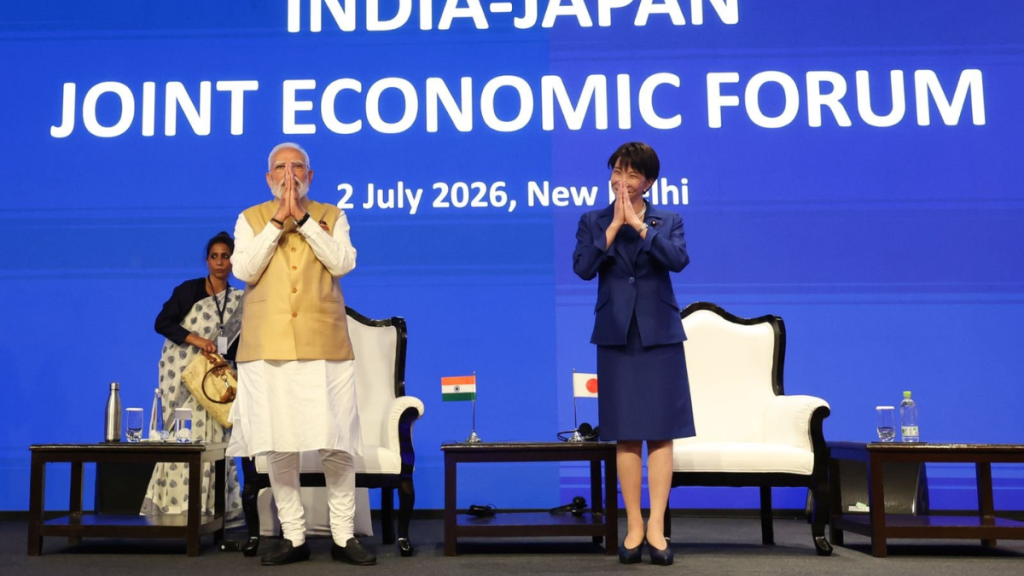
New Delhi: China on Friday responded cautiously to the expanding relationship between India and Japan. The response followed the announcement of a framework agreement to deepen cooperation on three strategic sectors that are important to both countries: critical minerals, defence, energy security and economic cooperation.
As reported by Global Times, China’s foreign ministry spokesman, Guo Jiakun, stated that bilateral partnerships should develop regional confidence among the countries in the area and create trust, rather than divide the region.
He went on to say, “Cooperation between countries should not be directed towards any third party nor should that cooperation negatively impact the interests of any third party,” adding that the establishment of “exclusive small-nation groupings” could lead to confrontations among nations. In addition, he emphasized that maintaining secure and stable global industrial and supply chains is the joint obligation of all nations.
The comments came after Modi and Takaichi’s announcement of a major upgrade in India-Japan ties. The two leaders agreed on a framework for a new economic partnership, increased cooperation on AI and emerging technologies, improved cooperation on energy security and to establish a roadmap for resilient supply chains.
One of the key outcomes of this summit was the agreement to deepen cooperation in critical minerals and joint development of defence technologies and military hardware, which reflects the growing convergence of strategic interests between New Delhi and Tokyo.
Critical minerals are particularly significant for China given its prominence in the sector. Currently, China possesses approximately 70% of the world’s capacity for rare earth elements and 90% of the world’s rare earth element-processing capacity. This gives China significant influence over global supplies that are critical to the manufacture of semiconductors, electric vehicles and renewable energy systems.
China recently imposed stricter trade restrictions on some of its rare earths, and this has prompted many countries, including India, Japan, US, and European partners to accelerate efforts toward diversification of supply chains and making strides to reduce dependence on Chinese processing.