


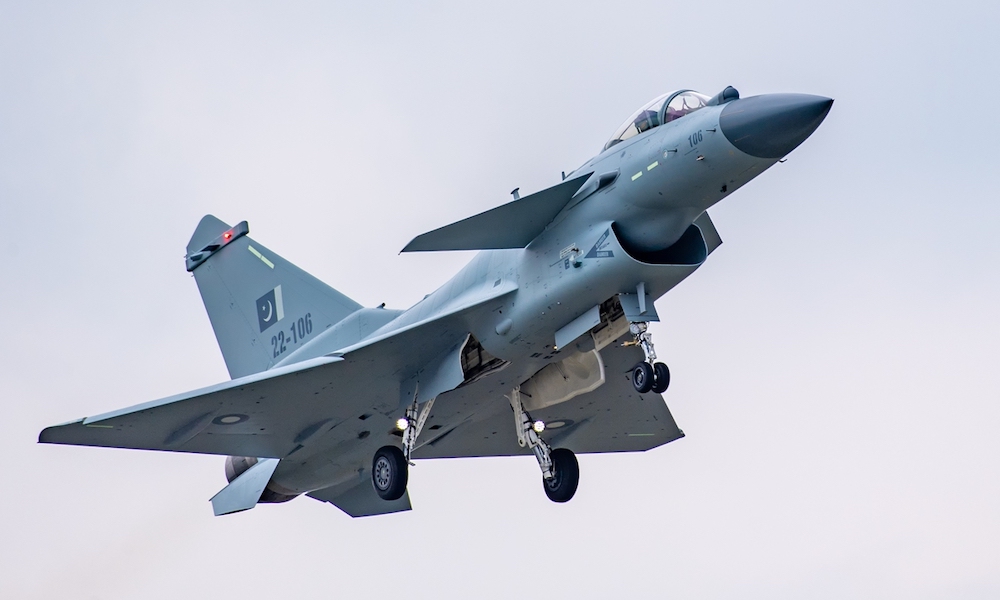
New Delhi: The Bangladeshi prime minister, Tarique Rehman, who is on an official two-day visit to China from June 24 to June 26, is likely to take forward the country’s plan to purchase 24 J-10 CE fighter jets from China. Pakistan too operates these jets and has used them against India during the May 2025 conflict between the two countries.
The J-10 CE is a 4.5-generation single-engine multi-role fighter aircraft. It is an export variant of the Chengdu J-10C in use with the People’s Liberation Army – Air Force (PLA-AF) since 2018.
The fighter is powered by a WS-10B afterburning turbofan engine and built around a delta-wing, canard layout with digital fly-by-wire controls. It carries up to 5,600kg of ordnance across 11 hardpoints, is equipped with an AESA radar, and can fire the long-range PL-15 air-to-air missile.
Bangladesh’s current air combat fleet is modest by comparison. However, it is not new to using Chinese tech. Bangladeshi fighter fleet is made up of F-7s (China’s MiG-21 derivative) and Russian MiG-29s.
The move, a major step in its military modernization, would dramatically enhance Dhaka’s air combat capabilities. Dhaka-based news organisation, Daily Waadaa, quoted officials saying that it hopes to sign the procurement agreement by August officially.
Bangladesh’s J-10 CE procurement comes under the larger umbrella of its military modernisation plan called the “Forces Goal 2030”, which seeks to enhance the defence capabilities of the country.
In addition to this, Dhaka is also working towards modernizing a World War II-era airbase in the Lalmonirhat district, located just 20 kilometres from the Indian border. Bangladesh has maintained that the airbase will be never used to host “missile and drone systems” targeting India. It has also denied China’s role in the construction of the airbase.
If the 24-aircraft deal between the two countries materialises, it will prove to be a significant addition to Bangladesh’s existing fleet, comprising Russian and Chinese aircraft.
Rehman’s meeting with the Chinese leadership at the Great Hall of the People in Beijing is likely to yield 15 MoUs and agreements, the Daily Star reported. The highlights are likely to be deals related to the Chinese Economic Zone, the expansion and modernization of Mongla port, and green energy. The discussions concerning the Teesta River Management Project and Bangladesh’s joining of China’s Global Development Initiative (GDI) are also likely to take place. Rehman will also call on Chinese investors to invest in Bangladesh at the Bangladesh Investment Forum.
Militarily, the acquisition will not directly alter India’s relations with Bangladesh; however, India’s concerns stem from the deal’s potential to give China increased influence in the neighbourhood. During Yunus’s regime, when the ties between India and Bangladesh had soured, there was talk of Bangladesh becoming the third front in the China-Pakistan nexus.
Those concerns still hold among some of India’s defence analysts. Given Bangladesh’s warming up to Pakistan – the threat of Pakistan and Bangladesh operating these modern fighter jets from two of its immediate neighbours sharing a land border remains a matter of concern.