


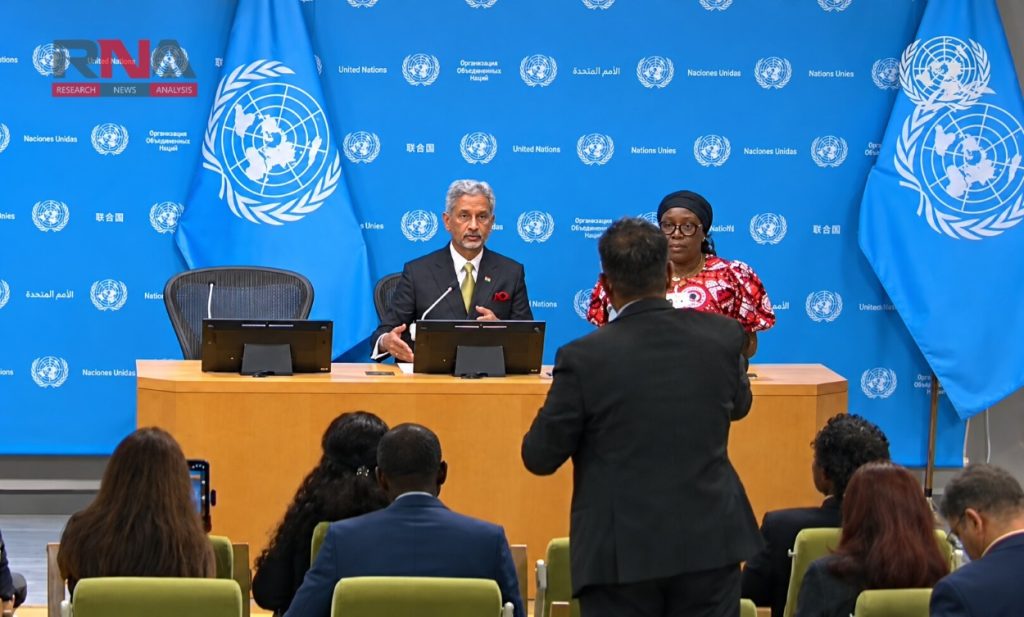
New York: The external affairs minister, S. Jaishankar, rejected a Pakistani journalist’s allegation that India sponsors terrorism, responding with a pointed accusation against Pakistan at the United Nations headquarters on Friday. The exchange took place during a media appearance on maritime safety on the sidelines of the 81st UN general assembly.
“A terrorist country is asking me that question. Come on,” Jaishankar said in the exchange. The journalist had called out a question accusing the Indian government of sponsoring terrorism in Pakistan.
Jaishankar was appearing alongside the foreign minister of Liberia, Sara Beysolow Nyanti, following discussions on protecting commercial vessels and their crews. India’s permanent representative to the UN, P Harish, subsequently intervened to tell the journalist that the minister’s response had been clear.
The encounter followed questions directed at the prime minister of Pakistan, Shehbaz Sharif, by an Indian journalist at the UN a day earlier. Sharif was asked about harbouring terrorists and prosecuting the Lashkar-e-Taiba leader, Hafiz Saeed, but walked past without answering.
Saeed’s record provides an important distinction in that debate: he has faced convictions in Pakistan for financing terrorism, while accountability for the November 2008 Mumbai attacks remains a separate issue. The UN sanctions committee’s entry on Saeed, updated in December 2023, records a cumulative 78-year prison sentence arising from seven terror-financing cases.
The UN listed Saeed on December 10, 2008, citing his association with Lashkar-e-Taiba and al-Qaida, and identifies his role in the former’s operational and fundraising activities. Its separate listing for Lashkar-e-Taiba describes the group as a Pakistan-based terrorist organization responsible for attacks on civilian and military targets, including the Mumbai assault.
Friday’s confrontation also recalled an earlier exchange between Jaishankar and a Pakistani journalist at the UN in December 2022. Responding then to a question about terrorism in South Asia, he said Pakistan’s ministers should explain their country’s intentions and urged Islamabad to act as a responsible neighbour.
The external affairs minister carried that argument into his UN general assembly address on September 27, 2025, linking international terrorist attacks to an unnamed neighbouring country. Referring to the killing of tourists in Pahalgam earlier that year, he defended India’s response as an exercise of its right to protect its people and sought stronger international cooperation against terrorist networks and their financing.
Pakistan has contested India’s accusations and presented itself as a country affected by terrorism that supports international counterterrorism efforts. The competing positions have repeatedly surfaced at the UN, where New Delhi has pressed for action against Pakistan-based organizations and Islamabad has rejected attempts to hold it responsible for cross-border violence.
The immediate purpose of Jaishankar’s latest media appearance, however, was a joint India-Liberia initiative addressing the safety of shipping and seafarers. The two countries brought together a group intended to include major ship-owning nations, shipping registries and countries supplying merchant crews.
At its inaugural meeting, Jaishankar condemned repeated attacks on commercial vessels across the Gulf, Red Sea and Black Sea, saying civilian mariners had suffered deaths and disappearances. He argued that such attacks could not be justified and called for them to end, placing the protection of crews at the centre of India’s maritime diplomacy.
The concerns extended beyond casualties to sailors stranded aboard vessels, delayed crew changes and difficulties returning home. Jaishankar also highlighted separation from families and psychological distress, underscoring the human consequences of disruption to international shipping.