


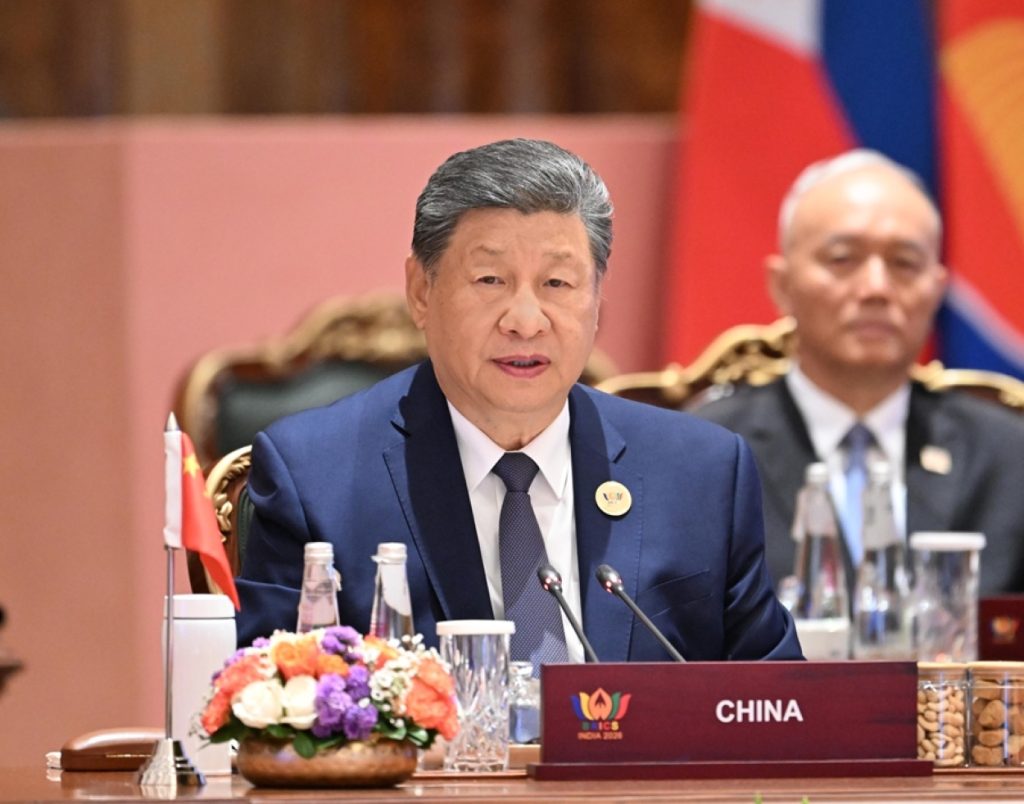
New Delhi: The Chinese president, Xi Jinping, has called on the global south to jointly defend international law and reject the principle that military or economic power should determine international affairs, using the 18th BRICS Summit in New Delhi to press Beijing’s case for a more representative global order. Speaking at the second session of the summit on Sunday, Xi argued that international rules must be created collectively and applied equally, without double standards.
“A world without rules is like a crossroads without traffic lights,” Xi said, warning that disorder becomes almost inevitable when commonly accepted rules are weakened. He said the principle of “might makes right” had no place in contemporary international relations and should have been abandoned long ago.
The remarks put sovereignty, non-interference and the peaceful settlement of disputes at the centre of Beijing’s BRICS message, while also appealing directly to the expanding global south. Xi urged developing countries to ensure that international law is applied consistently rather than selectively, an argument that has become a recurring feature of China’s diplomatic campaign for changes to global governance.
His intervention also reflects a broader Chinese effort to position BRICS as a platform for reshaping international institutions rather than simply as an economic grouping. Xi called for greater representation for developing countries in global decision-making, support for reform of multilateral institutions and stronger developing-country participation in international affairs.
The timing is significant because the New Delhi summit comes as BRICS seeks to establish its relevance in a more fragmented international system. The grouping has expanded well beyond its original Brazil-Russia-India-China-South Africa configuration, bringing in countries including Egypt, Ethiopia, Indonesia, Iran and the United Arab Emirates and giving it substantially greater demographic and economic weight.
Xi’s language also closely fits China’s wider diplomatic narrative, which portrays the existing international system as insufficiently representative of developing countries. At the summit, he called for reform of the international financial architecture, greater developing-country representation and reform of the World Trade Organization, while advocating a stronger role for the United Nations in global governance.
For India, however, the language carries a more complicated significance. New Delhi has consistently supported sovereign equality, international law and reform of global institutions, but it has also resisted attempts to turn BRICS into an explicitly anti-Western bloc and has sought to retain strategic space in its relations with both Western powers and the wider global south.
That distinction matters because China’s conception of a more multipolar order does not necessarily coincide with India’s. While both countries favour a greater voice for developing nations, India has generally emphasized a broad-based and inclusive international order rather than one structured around a China-led alternative to western influence.
Xi’s intervention came against an unusually tense geopolitical backdrop, with the Middle East conflict, the war in Ukraine, protectionist trade measures and disputes over the future of global economic governance placing pressure on multilateral institutions. He separately urged BRICS to play a greater role in promoting peace and stability, arguing that conflict and confrontation undermine wider global interests.
The Chinese president also linked his political argument to economic and technological cooperation, calling for stronger BRICS coordination in areas such as artificial intelligence, industrial development and supply chains. China has proposed initiatives including a BRICS AI open-source zone and deeper cooperation in services and industrial supply chains as part of its effort to give the expanded grouping greater practical weight.
There is therefore a strategic calculation behind Xi’s appeal to the global south. By arguing that international rules should be written collectively and applied without double standards, Beijing is seeking to turn dissatisfaction with the existing distribution of global power into support for a reformed international system in which developing countries have a larger role – and in which China’s own influence is correspondingly greater.
The challenge for BRICS will be converting that shared rhetoric into a workable common position. Its members have differing security interests, economic priorities and relationships with the United States and its allies, while India’s own strategic autonomy and unresolved differences with China place limits on how far the grouping can move towards a unified geopolitical agenda.
Xi’s message nevertheless underlines the political evolution of BRICS at its 20-year milestone. What began principally as a grouping seeking greater economic representation has increasingly become a forum through which major developing countries are debating who writes the rules of the international system – and whether those rules can remain credible if they are perceived to apply differently to powerful and less powerful states.