


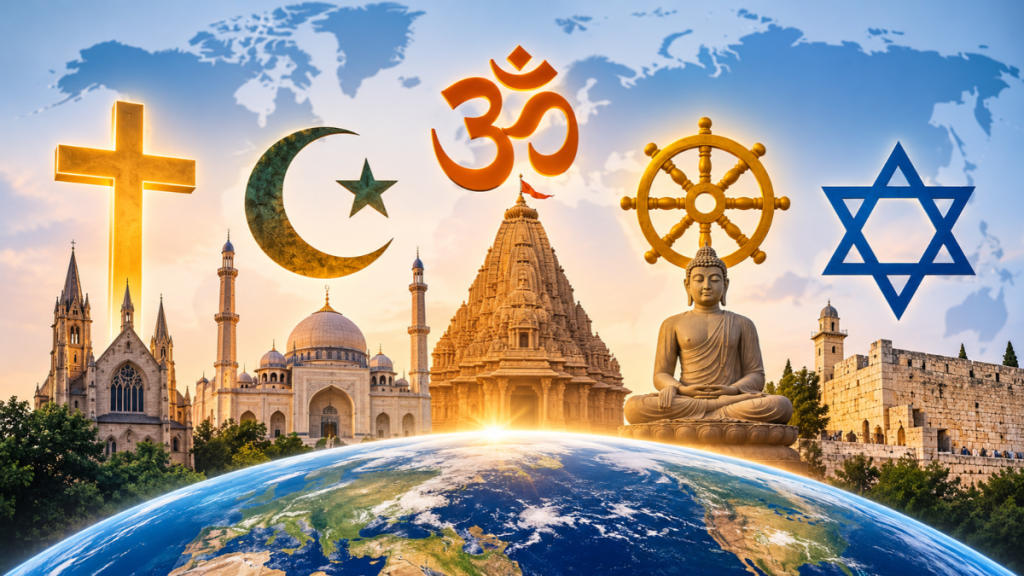
New Delhi: The world’s religious composition could look different by 2070, with changes expected in the numbers of Christians, Muslims, Hindus, Buddhists, Jews and followers of other faiths, as well as people who do not identify with any religion, according to a new study by the Pew Research Center.
The report, titled “The Future of World Religions: Population Growth Projections, 2020-2070”, examines how the populations and geographical distribution of seven religious categories could change over the next 50 years if current demographic trends continue.
The projections cover 201 countries and territories, representing 99.98 per cent of the world’s population. They show that while most religious groups are expected to increase in absolute numbers, their shares of the global population will change at different rates.
Christianity and Islam are projected to be the only two groups whose populations grow at least as fast as the world’s overall population. Buddhism and the religiously unaffiliated population are expected to decline in absolute numbers, while Hinduism, Judaism and other religions are projected to grow more slowly than the global population.
Christianity and Islam are projected to expand
Christianity, which was the world’s largest religious group in 2020, is projected to grow from about 2.27 billion people to just under 3 billion by 2070. Its share of the global population is expected to remain stable at about 29 per cent.
But its geographical distribution is projected to change considerably. Sub-Saharan Africa is expected to be home to more than half of the world’s Christians by 2070, compared with about 31 per cent in 2020.
The Democratic Republic of the Congo is also projected to overtake the US as the country with the largest Christian population.
Islam is projected to grow fastest among the seven categories. The global Muslim population is expected to increase by 80 per cent between 2020 and 2070, reaching about 3.6 billion and making up 36 per cent of the world’s population.
Pew projects that Muslims will overtake Christians as the world’s largest religious group by 2035. Pakistan is also expected to replace Indonesia as the country with the largest Muslim population.
Hindu population to grow, but its global share to decline
The number of Hindus worldwide is projected to increase by about 199 million between 2020 and 2070, reaching nearly 1.4 billion.
But their share of the global population is expected to fall from about 15 per cent to 14 per cent, because the non-Hindu population is projected to grow faster over the same period.
India remains central to these projections. The country was home to about 1.1 billion Hindus in 2020, about 95 per cent of the global Hindu population.
Pew notes that India’s 2021 census was delayed by the Covid-19 pandemic and was still under way when the study was prepared in 2026. As a result, Pew estimated India’s 2020 religious composition by projecting figures from the last census, conducted in 2011.
Pew projects that the number of Hindus in India will increase by 176 million over the next five decades. The US is also expected to record growth in its Hindu population, mainly through immigration.
The study projects that India and Nepal will remain the only countries with Hindu majorities in 2070.
Buddhism and the unaffiliated population are projected to decline
Buddhism is expected to decline in both its population and its share of the global population.
The number of Buddhists worldwide is projected to fall from 324 million in 2020 to 250 million in 2070. Their share of the world’s population is expected to fall from 4.1 per cent to 2.5 per cent.
Most of this decline is projected to occur in the Asia-Pacific region, where 98 per cent of the world’s Buddhists lived in 2020. China, Japan and South Korea are among the countries expected to contribute to the decline, along with Thailand, which now has the world’s largest Buddhist population.
The religiously unaffiliated population, often described as people with no religious affiliation or religious “nones”, is also projected to shrink globally. Their share of the world’s population is expected to fall from 24 per cent in 2020 to 17 per cent in 2070, and their number is projected to fall by 181 million.
China plays a major role in this projection because it was home to about two-thirds of the world’s religiously unaffiliated population in 2020. Pew projects that the number of unaffiliated people in China will fall by 361 million by 2070. This is expected to outweigh a projected increase of 180 million among unaffiliated people in the rest of the world, resulting in the global decline of 181 million.
Jewish population increasingly concentrated in Israel
The global Jewish population is projected to increase from about 15 million in 2020 to nearly 18 million by 2070. But its share of the world’s population is expected to fall slightly, from 0.19 per cent to 0.17 per cent.
The biggest projected change concerns where Jewish people will live. Israel is expected to be home to 62 per cent of the world’s Jewish population by 2070, compared with 46 per cent in 2020.
The number of Jews living in Israel is projected to increase from 6.8 million to 11.1 million. Pew attributes this largely to natural population growth, with births exceeding deaths.
In contrast, the Jewish population in the US is projected to fall by about 1.2 million over the same period.
Other religious groups are expected to grow modestly
Pew’s seventh category combines followers of religions not covered separately in the study. It includes Sikhs, Jains, Baha’is, Daoists, Shintoists, Wiccans, Zoroastrians and followers of various folk and traditional religions.
Their combined population is projected to increase from about 172 million in 2020 to 188 million in 2070. But their share of the global population is expected to fall from 2.2 per cent to 1.9 per cent, as the group grows more slowly than the world’s overall population.
India is projected to overtake China as the country with the largest population of followers of these other religions by 2070.
What is driving these changes?
Pew identifies five main factors shaping the projections: age structure, fertility, mortality, religious switching and migration. Fertility and age structure are particularly important. Muslims had the youngest median age among the seven groups in 2020, at 24, compared with 33 among non-Muslims. Their estimated fertility rate during 2020-2025 was 3.1 children per woman, compared with 2.0 among non-Muslims.
The report also examines religious switching, which means people changing the religious group they identified with in childhood. It projects a net increase of 117 million people in the unaffiliated category through religious switching between 2020 and 2070, with most coming from Christianity.
Migration is expected to influence the distribution of religious populations between countries and regions, although Pew says it has limited impact on global totals.
How the global religious map could change
Sub-Saharan Africa is expected to play a bigger role in the world’s religious composition. More than a quarter of the global population is projected to live in the region by 2070, contributing to the growth of both Christian and Muslim populations.
Other regions are expected to see different changes. Europe’s Muslim population share is projected to rise from 6 per cent in 2020 to 13 per cent in 2070, while the share of religiously unaffiliated people is expected to rise from 25 per cent to 33 per cent.
In North America, Christians are projected to fall from 63 per cent of the population in 2020 to 46 per cent in 2070. The unaffiliated share is expected to rise from 30 per cent to 41 per cent.
Pew’s projections are based on census and survey estimates for 2020, along with demographic data and assumptions about future fertility, mortality, migration and religious switching. The researchers say the results show how the world’s religious composition could change if recent trends continue. They do not account for every possible future development, including wars, natural disasters, epidemics or changes in economic and social conditions.