


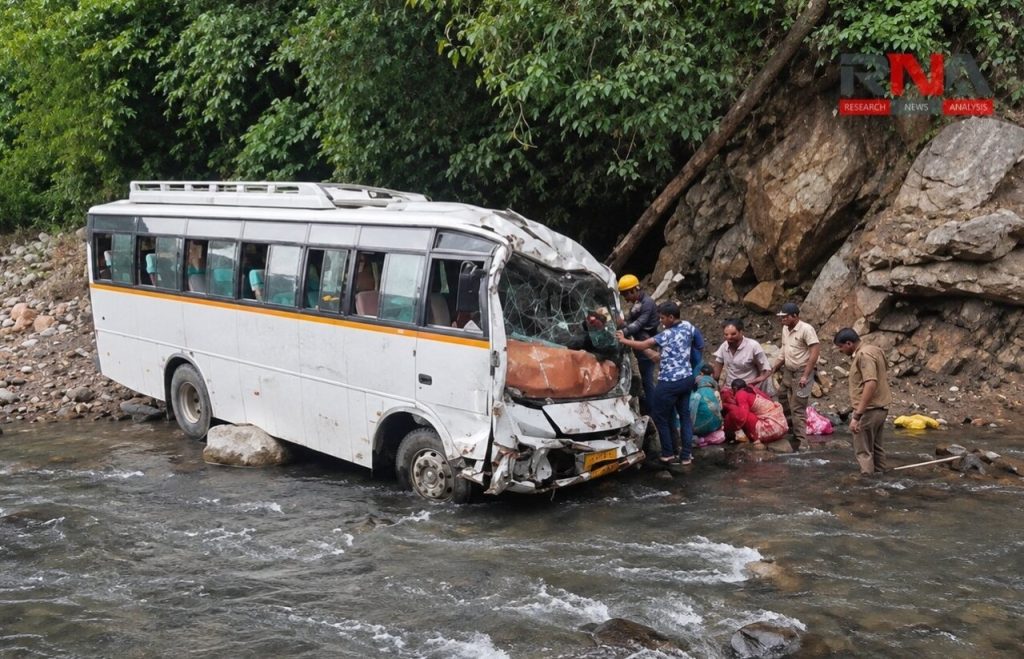
New Delhi: At least eight people were killed and 26 others injured when a passenger bus plunged nearly 100 metres from a bridge into a rocky gorge in Uttarakhand’s Tehri Garhwal district early on Tuesday. The accident, which occurred near Gular Bazaar on the Rishikesh-Badrinath national highway, triggered a major rescue operation as emergency teams struggled to reach passengers trapped in the wreckage below the bridge.
The bus, operated under the Vishwanath Sewa service, was travelling from Haridwar towards Joshimath when it reportedly crashed through the roadside railing and fell into a stream beneath the bridge. According to reports, the vehicle was carrying an estimated 30 to 35 passengers, although authorities had not established a definitive passenger count in the initial hours following the accident.
The accident occurred before daybreak, with reports placing the time between 4.30am and 5.30am, when visibility along the winding mountain highway would have been limited. Seven passengers reportedly died at the scene, while another succumbed to injuries at the All India Institute of Medical Sciences (AIIMS) in Rishikesh, taking the death toll to eight.
Initial police reports had put the number of fatalities at four, subsequently revising it to six as rescue personnel reached more victims. By mid-morning, several media reports put the toll as eight deaths and 26 injured, reflecting the evolving situation at the accident site.
Rescue teams battle difficult terrain
Teams from the Uttarakhand State Disaster Response Force (SDRF), stationed at Byasi and Dhalwala, were dispatched immediately after the accident was reported, joining local police and other emergency personnel in the rescue effort. The steep descent from the bridge and the depth of the gorge complicated the operation, with rescuers having to reach the wreckage and evacuate casualties to ambulances waiting on the road above.
Police initially confirmed that approximately 20 injured passengers had been brought out of the gorge, with subsequent reports raising the number of injured to 26. The casualties were transported to nearby medical facilities, including AIIMS Rishikesh, where doctors were treating survivors and assessing the severity of their injuries.
The district magistrate of Tehri Garhwal, Nitika Khandelwal, and the senior superintendent of police, Shweta Choubey, went to the accident site to supervise the rescue and relief operations. Authorities were also working to establish the identities of the victims and determine whether everyone travelling in the bus had been accounted for.
Survivor alleges driver ignored warnings to slow down
A survivor’s account has raised questions about whether excessive speed contributed to the accident, although investigators have yet to establish its cause. Pankaj, an injured passenger, told the Times of India that the bus was travelling at high speed and that passengers had repeatedly urged the driver to slow down before the vehicle plunged into the gorge.
Pankaj said he had fallen asleep shortly before the accident and therefore could not describe the precise circumstances in which the bus left the road. His account provides investigators with a potentially important lead, but independently establishing the vehicle’s speed, its mechanical condition and the driver’s actions will be necessary before responsibility can be determined.
Medical officials have also indicated that several survivors suffered serious injuries, raising concerns that the casualty figures could change. Dr Madhur Uniyal, a nodal officer at AIIMS Rishikesh, said the hospital had begun receiving casualties around 6.30am and that an initial assessment identified six patients in critical condition.
The prime minister, Narendra Modi, expressed grief over the accident and conveyed his condolences to the families of those killed. He also wished the injured a speedy recovery as rescue operations and medical treatment continued.
Another deadly accident hours earlier
The Tehri tragedy came just hours after another serious road accident in neighbouring Rudraprayag district, where a Bolero vehicle plunged into a deep gorge on the Banswada-Mohankhal road late on Monday night. Reports initially confirmed four deaths and six injuries, although subsequent accounts put the death toll at six.
The Bolero was reportedly travelling from Pokhari towards Ransi when the driver lost control near Bhatwari-Kandara, sending the vehicle off the mountain road. Police, SDRF and district disaster-response personnel conducted an overnight operation to recover the victims, with emergency services alerted around 10pm on Monday.
The two accidents, occurring within hours of each other, have once again drawn attention to road safety in Uttarakhand’s mountainous districts, where highways frequently run alongside steep ravines and rivers. Sharp bends, narrow carriageways, limited visibility and difficult access for emergency vehicles can substantially increase the consequences of a crash.
The Rishikesh-Badrinath highway is an important transport corridor connecting the plains with several Garhwal towns and the higher Himalayan region. Its role in carrying local passengers, commercial traffic and pilgrims makes vehicle safety, effective roadside barriers and enforcement of speed limits particularly important.
The investigation into the Tehri accident will need to establish whether speeding, driver fatigue, mechanical failure or deficiencies in roadside protection played any role.
For the authorities, the immediate priorities remain medical care for the survivors, identification of the deceased and assistance to their families. The accident also underlines the wider challenge of improving highway safety in the Himalayas, where preventing a vehicle from leaving the carriageway can be as important as the rescue operation that follows.