


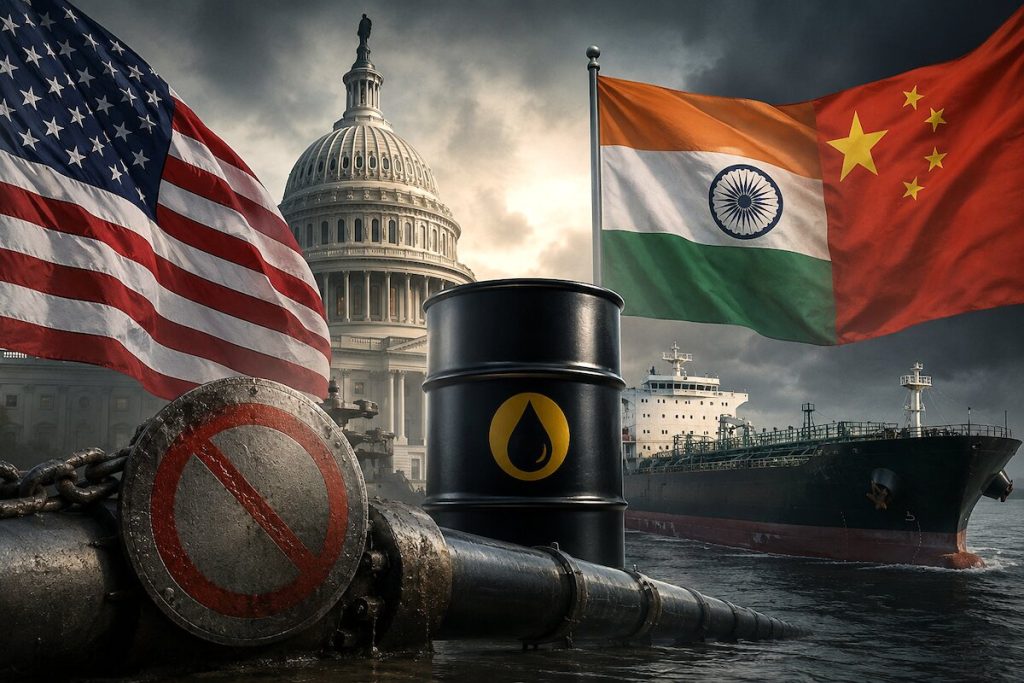
New Delhi: The United States Senate has cleared the first procedural hurdle for a sweeping sanctions bill against Russia. If it becomes law, it would also hand the US president, Donald Trump, the power to impose tariffs of up to 100% on countries that continue buying Russian oil and gas – with India and China named as the two biggest targets.
Senators voted 86–12 on Tuesday night to begin formal debate on the legislation, formally titled the Lindsey O Graham Sanctioning Russia and Iran Act of 2026. A final vote is still to come, but the scale of the bipartisan support signals the bill has real momentum after months of stop-start progress.
The legislation began life in April 2025 as the Sanctioning Russia Act, co-authored by Republican senator Lindsey Graham of South Carolina and Democratic senator Richard Blumenthal of Connecticut. Early versions proposed tariffs as steep as 500% on Russian oil, gas and uranium buyers – a figure the White House later pushed to soften.
The legislation carries an unusually personal backstory. Graham died on July 11, shortly after securing Trump’s agreement to move the bill forward. His sister, Darline Graham, was subsequently appointed to fill his South Carolina Senate seat and has since joined the bipartisan group steering the legislation – a continuity that six of its Republican and Democratic sponsors invoked in a joint statement, saying there was no better way to honour his legacy than to carry the bill to passage.
The version now before the Senate caps the tariff authority at 100% and narrows its focus to the five largest buyers of Russian energy, alongside five other nations accused of helping Moscow dodge existing restrictions. Outside China, India is squarely in that first group, with Slovakia, Hungary and Azerbaijan rounding out the list.
Blumenthal has said the bill will carve out an exception for countries whose Russian gas purchases fall below 15% of Russia’s total gas exports, according to Reuters – a threshold unlikely to offer India much shelter given the size of its crude intake from Moscow.
China, India ‘main culprits’
Blumenthal did not mince words about who the bill is aimed at. “China and India are the main culprits here,” he told reporters on Tuesday night, adding that the two countries purchase the bulk of Russia’s oil and gas and are, in effect, bankrolling the war in Ukraine.
Roger Wicker, the Republican chair of the Senate armed services committee, made a similar case on the floor, arguing that squeezing Russian president Vladimir Putin’s energy revenue is the most direct way to blunt his war effort, since Putin has shown little regard for Russian or Ukrainian lives but depends heavily on oil and gas income to keep his military machine running.
Not every senator is convinced. Democratic congressman Gregory Meeks warned that the bill amounts to little more than a broad grant of tariff power to the president, one that could end up raising costs for American consumers or striking at European allies rather than Moscow. Jeanne Shaheen, by contrast, called the measure the best available tool to back Ukraine, which she said is defending not only its own territory but the wider security of Europe.
At the White House’s urging, the revised bill also extends existing sanctions authority aimed at Iran’s energy and weapons sectors. The addition comes as the US-Iran conflict continues into its sixth month, and analysts at the Atlantic Council note that, because Iran is already subject to extensive American sanctions, this part of the bill is likely to be more symbolic than substantive.
Ukrainian president Volodymyr Zelensky was in Washington on the day of the vote, meeting senators to press for tougher action against Moscow – a visit that coincided with, though was not formally tied to, the bill’s advance.
Where this leaves India
India is already the second-largest buyer of Russian crude after China, and its imports of unprocessed Russian oil rose sharply in June this year – up 34% to roughly €4.5 billion, according to the Centre for Research on Energy and Clean Air, which put the figure at around 36% of Moscow’s total crude export earnings that month. The surge followed disruption in Gulf shipping routes after the closure of the Strait of Hormuz, which pushed several buyers back towards discounted Russian barrels.
Separately, the Atlantic Council has flagged reports that some of the refined fuel India produces from Russian crude is finding its way back into the Russian market, which is grappling with domestic shortages – a pattern it argues merits closer scrutiny even if India’s underlying case for energy security is legitimate.
New Delhi has previously defended its Russian oil purchases as a matter of energy security and affordability rather than political alignment, and it faced a similar round of pressure in mid-2025 when Graham first floated the 500% tariff proposal. The external affairs minister, S Jaishankar, said at the time that India’s concerns had been conveyed directly to Graham. Whether a renewed diplomatic push can soften the bill’s final shape – or the threshold at which India might qualify for an exemption – is likely to be the next front in this story.
The bill must still clear further Senate debate, a final floor vote and the House of Representatives before it can reach Trump’s desk to be signed as law.