


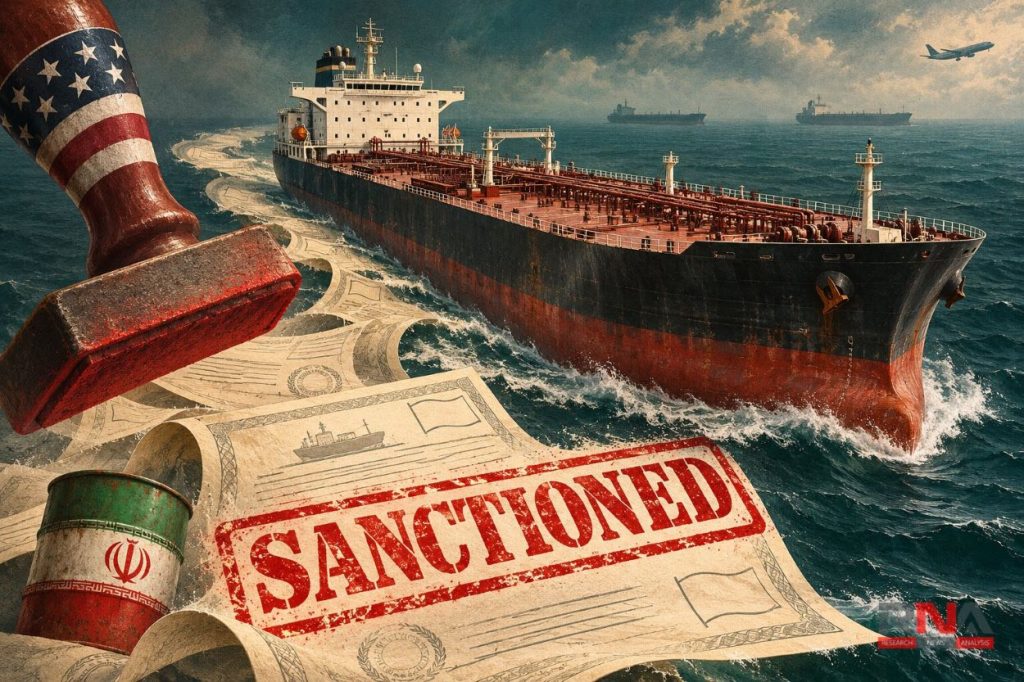
New Delhi: The United States has imposed sanctions on four Indian nationals and nine associated entities over allegations that they supplied fraudulent ship registrations and certificates to vessels carrying Iranian oil. The measures, announced on Wednesday, also targeted a Turkish aviation services company, extending Washington’s campaign against businesses accused of helping Iran sustain its maritime and air operations.
At the centre of the maritime case are the Chandigarh-based businessman, Suniel Kumar Sharma, and his wife, Jaspreet Preeti Shahid, whom US authorities accuse of operating a network of unauthorized shipping registries. Washington alleges that their services helped sanctioned tankers continue trading, including vessels operating for Iran’s military and its proxies.
The action forms part of the administration’s Operation Economic Outcast, launched on August 24, to intensify economic pressure on Tehran. Its targets extend beyond Iranian businesses to overseas intermediaries that Washington says facilitate oil exports, financial transactions and aviation services.
The Chandigarh connection
The other Indian nationals designated are Ashwani Kumar Dhiman and Ishwinder Singh, both linked in the official sanctions notice to Aryavart Ship Management Private Limited. The nine associated entities comprise eight based in India and one registered in Singapore, making the action broader than sanctions against Indian companies alone.
The India-based entities are Oceaniek Technologies India, Aryavart Ship Management Private Limited, Precept Trends Private Limited, Polynesia Maritime Private Limited, Alexarya Finserv Private Limited, Alexarya Media and Entertainment Private Limited, Viharaboating Private Limited, and Aryavart Maritime and Educational Trust. The ninth is Singapore-based Eswatini Maritime Affairs and International Ship Registry Pte Ltd.
Most of the Indian entities have addresses in Chandigarh or nearby Mohali, while Viharaboating is registered in Kerala’s Alappuzha district. The listings connect Oceaniek to Sharma and the other eight entities to Shahid, with the US alleging ownership, control or action on behalf of designated persons.
The measures concern specified individuals and businesses rather than sanctions against India as a country. The reports reviewed for this account did not include responses from the named individuals or companies, or an Indian government reaction.
How the alleged false-flag operation worked
According to maritime industry reporting, the US treasury traced the alleged operation back to 2014 and said it claimed to represent jurisdictions including Guyana, Eswatini and Laos. Some purported registries operated through websites offering maritime services, creating the appearance that vessels had authorization to sail under a particular country’s flag.
The treasury identified Oceaniek as a vehicle allegedly used to establish unauthorized registries claiming to represent Aruba, Nicaragua and Sint Maarten. It also said the Singapore-based Eswatini registry continued providing flagging services despite being publicly disavowed by Eswatini’s authorities.
Among the vessels cited by the treasury were Ping Shun, which it linked to the purported Eswatini registry, and Lattafa, Binary Star and Vera, which it associated with false registrations supplied through Sharma’s network. The department alleged that these sanctioned vessels had transported Iranian petroleum.
A separate US maritime advisory, issued alongside the designations, explains that a false flag can involve either an unauthorized registry or a vessel claiming a nationality without supporting registration documents. Such arrangements can give ships an appearance of legitimacy when seeking the services needed to continue operating.
The advisory adds an important qualification to the history of the network: some relationships initially involved legitimate registry services, but governments subsequently withdrew authorization. In several cases, it says, the operators continued issuing registrations after the relevant authorities had publicly denounced them.
Washington also framed the issue as a threat to maritime safety and coastal economies, arguing that false registrations and certificates can undermine regulatory scrutiny and insurance protection. The treasury warned that an accident involving an inadequately insured tanker could leave affected countries facing substantial losses.
Turkish firm targeted over Iranian airline services
The aviation designation covers Turkey-based Fugo Ground Services Inc, which the treasury accused of maintaining service agreements with sanctioned Iranian carriers. Those named include Iran Air Tour, Saha Airlines, Sepehran Airlines, Varesh Airlines, Taban Airlines and Ata Airlines.
The treasury said Fugo began serving several of those airlines in the weeks after their September 8 designations. It imposed the latest measures under Executive Order 13902, which Washington has used to target activity in designated sectors of Iran’s economy.
The US treasury secretary, Scott Bessent, warned that companies supporting Tehran could face action across maritime and aviation networks. His statement reinforced Washington’s position that overseas service providers could be penalized alongside Iranian operators.
What the sanctions mean
The designations place the named parties on the US office of foreign assets control’s sanctions list, triggering restrictions on property within US jurisdiction. Under OFAC’s blocking rules, relevant assets held in the United States or controlled by US persons must be frozen, and dealings involving blocked property are generally prohibited without authorization.
The restrictions can also extend to businesses that are not individually named: entities owned, directly or indirectly, 50 per cent or more in aggregate by blocked persons are themselves treated as blocked. Asset blocking freezes the ability to use or transfer property; it does not, by itself, transfer ownership to the US government.
or shipping companies, insurers and banks, the accompanying advisory calls for closer checks on vessels whose claimed nationality cannot be verified. Warning signs include missing flag information, unverifiable registration papers and radio identification details that conflict with a vessel’s reported flag.
The US state department’s account of the action urged flag states, port authorities and maritime businesses to verify registrations and deny shadow-fleet vessels access to their waters and ports. The latest measures therefore seek to disrupt not only the movement of Iranian oil, but also the registration and support services that allow the ships carrying it to remain commercially active.