


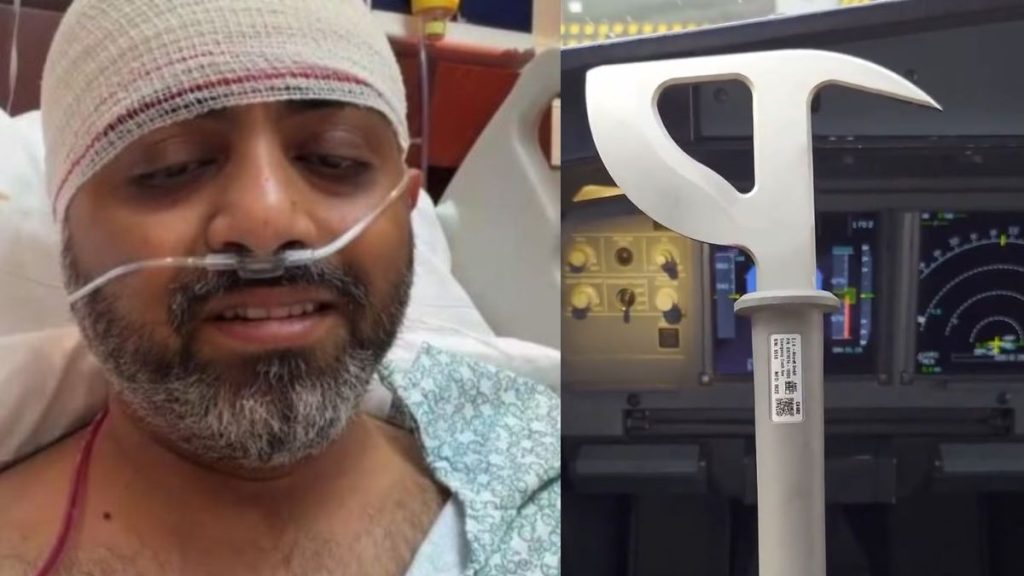
New Delhi: UAE investigators have formally classified the Wednesday cockpit assault aboard Flydubai flight FZ1073 as an attempted terrorist act, saying the copilot attacked the Indian captain, Smit Machchhar, with the aircraft’s crash axe before trying to seize the controls. The Dubai-Tel Aviv flight then plunged about 16,625 feet in just over 30 seconds before the copilot was subdued and the aircraft landed safely at Tabuk in Saudi Arabia.
Machchhar was seriously injured but managed to open the cockpit door, allowing passengers and crew to enter and overpower the copilot. A reserve Flydubai pilot travelling on the flight then took control and landed the aircraft at Tabuk. More than 170 people were aboard, most of them Israeli nationals.
The UAE attorney general, Hamad Saif Al Shamsi, said investigators had established that the copilot “attempted to carry out a terrorist act” and began executing the plan during the flight by assaulting the captain with a crash axe and trying to take control of the aircraft. Technical examinations and analysis of physical and digital evidence are continuing as investigators work to establish the full circumstances, motive and any connections.
The finding was the first time Emirati investigators had formally characterized the incident as an attempted terrorist act. In a post on X after the announcement, Anwar Gargash, the diplomatic adviser to the UAE president, said the region’s struggle against extremism was not over and reiterated the UAE position of “no tolerance for extremism and no leniency towards its rhetoric”.
Flydubai said on Saturday that the circumstances surrounding FZ1073 remained under investigation and that it was not in a position to comment further. Its chief executive, Ghaith al Ghaith, had earlier described the diversion as following a “safety incident” in the cockpit and said the airline was fully supporting the official investigation.
Machchhar received emergency treatment after the aircraft landed in Saudi Arabia and was later transferred to the UAE. He remains in an Abu Dhabi hospital and is “recovering well”, the Indian embassy in the UAE has said, adding that officials are in touch with his family and UAE authorities.
Co-pilot’s background under scrutiny
UAE authorities have not publicly named the copilot. The Wall Street Journal, citing people familiar with the matter, first identified him as Hamam al-Hammami, an Omani national. Reuters later said it had independently confirmed his identity through a source with direct knowledge and a second source briefed on the investigation.
His aviation history has become a separate line of scrutiny. AP, citing a person familiar with the matter, reported that he had earlier been barred from flying in Oman over concerns about extremist views. Royal Air Maroc told Reuters that al-Hammami underwent three months of training with the airline in 2025 but was not subsequently accepted for employment. RNA Media examined his earlier aviation history and how the concerns were handled earlier.
The case has also raised questions about how an Omani pilot came to be assigned to a Tel Aviv-bound flight. Israel does not have diplomatic relations with Oman, and the Israeli prime minister, Benjamin Netanyahu, has said pilots from countries without such relations are not permitted to operate flights to Israel. It remains unclear what procedures applied when the copilot was rostered for FZ1073.
Israeli investigators join UAE-led inquiry
Israeli investigators are expected to take part in the UAE-led investigation, an Israeli government official has confirmed, as RNA Media reported earlier. Most passengers on the flight were Israeli, giving Israeli authorities a direct aviation-security interest in the inquiry.
Netanyahu has said Israel is examining whether the copilot acted under anyone’s direction. No terrorist organization, foreign government or outside sponsor has been officially linked to the incident, and investigators have not publicly established whether the copilot acted alone or had connections to an extremist group.
Why is there a crash axe in an aircraft cockpit?
A crash axe is emergency equipment carried on commercial aircraft, and its presence on FZ1073 does not in itself indicate a security failure. UAE General Civil Aviation Authority rules require an aeroplane with a maximum certificated take-off mass above 5,700kg, or more than nine approved passenger seats, to carry at least one crash axe or crowbar in the flight crew compartment.
The security question in the investigation is therefore not why the tool was aboard, but how emergency equipment inside the flight deck came to be used against the captain during an alleged attempt to seize control.
Saudi authorities detained the copilot after the emergency landing, and he was transferred to Abu Dhabi on Thursday. With the UAE now describing the incident as an attempted terrorist act, the investigation continues into whether the assault was planned in advance, his precise motive, any extremist connections and whether anyone assisted, encouraged or directed him.