


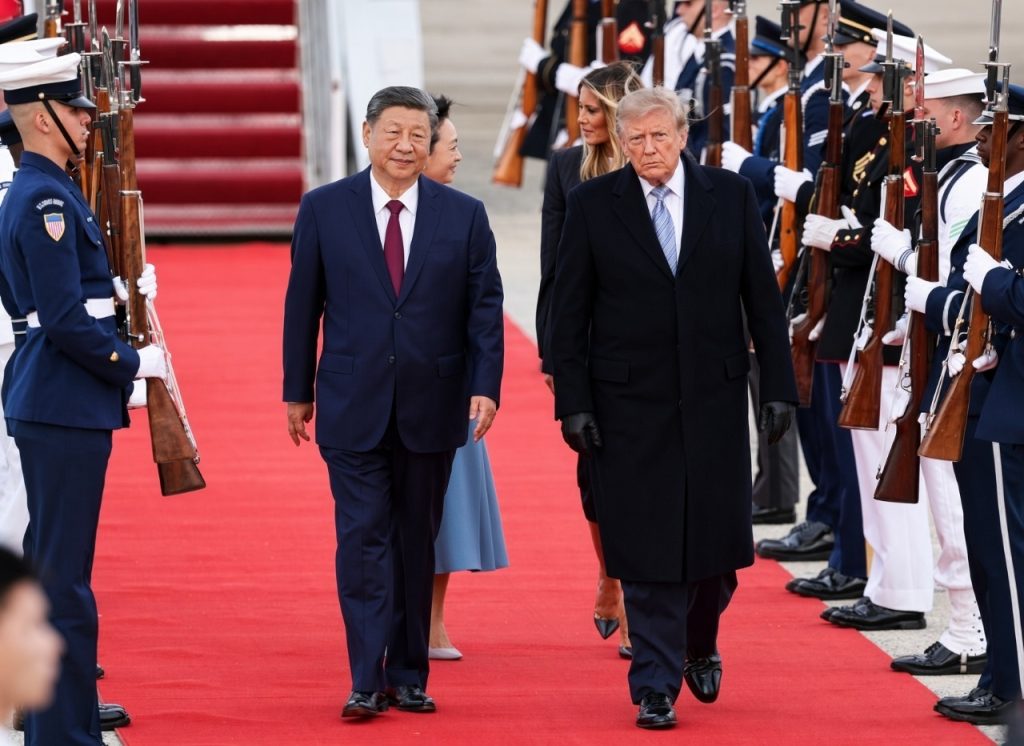
New Delhi: The US president, Donald Trump, and his wife, Melania Trump, personally welcomed the Chinese president, Xi Jinping, and his wife, Peng Liyuan, at Joint Base Andrews in Maryland on Wednesday for a three-day state visit. The rare airport reception came as Washington announced an extension of the bilateral trade truce ahead of potentially difficult talks on Taiwan, technology and Iran.
The US treasury secretary, Scott Bessent, said the two sides had agreed to extend the truce from November 10 to January 10, 2027, providing more time to address their economic differences. China’s embassy in Washington offered no immediate comment, leaving the announcement without immediate public confirmation from Beijing.
At the airbase, the two couples exchanged greetings before a ceremony featuring a 21-gun salute, the national anthems of both countries and a military flypast. American children presented flowers to Xi and Peng, while an honour guard lined the red carpet.
The personal reception underscored the importance Washington attached to the visit, with fighter aircraft displayed on the tarmac adding to the military pageantry. Xi’s programme also included a White House state banquet and a visit to the National Archives, which houses the US Declaration of Independence.
In a written arrival statement, Xi argued that the two countries should regard each other as “partners, not rivals”, presenting their national ambitions as compatible. He said China’s development and Trump’s effort to strengthen the United States could advance together, while calling for cooperation, controlled competition and differences that could be managed without confrontation.
Xi linked those proposals to the understanding reached during Trump’s visit to China in May, when the leaders endorsed a relationship based on strategic stability. His statement emphasized sustained engagement and peaceful coexistence, setting out Beijing’s preferred framework for discussions that extend beyond individual commercial agreements.
The immediate economic priority is preserving the pause in the tariff confrontation that disrupted trade between the world’s two largest economies last year. However, extending that arrangement would leave unresolved their competing restrictions on strategically important goods, including Chinese rare-earth exports and American advanced computer chips.
Earlier commitments also provide a measure against which new announcements will be judged. An Associated Press assessment ahead of the summit found uneven progress on agricultural purchases, proposed trade and investment bodies, and China’s promised acquisition of 200 Boeing aircraft, underlining the gap between leaders’ declarations and their implementation.
Artificial intelligence offers another possible opening, although the emerging proposal is limited in scope. Preliminary discussions between Bessent and the Chinese vice-premier, He Lifeng, included establishing a communication channel for AI concerns, while expectations of an agreement to regulate the technology remained low.
Such a channel would give the governments a way to discuss emerging risks while their competition for technological leadership continues. The anticipated presence of leading American technology executives at the state banquet highlights the commercial importance of that relationship, although AFP reported that Xi’s delegation included no Chinese chief executives.
Taiwan remains a particularly sensitive issue for Washington’s regional partners, which are watching for any concessions that might accompany a commercial understanding with Beijing. China claims the democratically governed island as its territory, while American support for its security remains a central point of friction.
Ahead of the summit, the US secretary of state, Marco Rubio, met his Japanese and South Korean counterparts in New York, where Washington reaffirmed its defence commitments to both allies. Their joint statement emphasized stability across the Taiwan Strait and opposition to economic coercion and export restrictions that disrupt supply chains.
Iran adds a further complication, with no certainty that Beijing will help Washington overcome the conflict’s diplomatic impasse. Reuters reported that the talks could also explore narrower agreements on tariffs, countering drug trafficking and expanding communication between the two militaries.
For Beijing, the broader objective is a more predictable relationship with Washington, according to the FT’s assessment of Xi’s priorities. The summit’s practical significance will therefore depend on whether the leaders can sustain their trade arrangements and make progress on specific disputes while keeping their wider strategic competition manageable.