


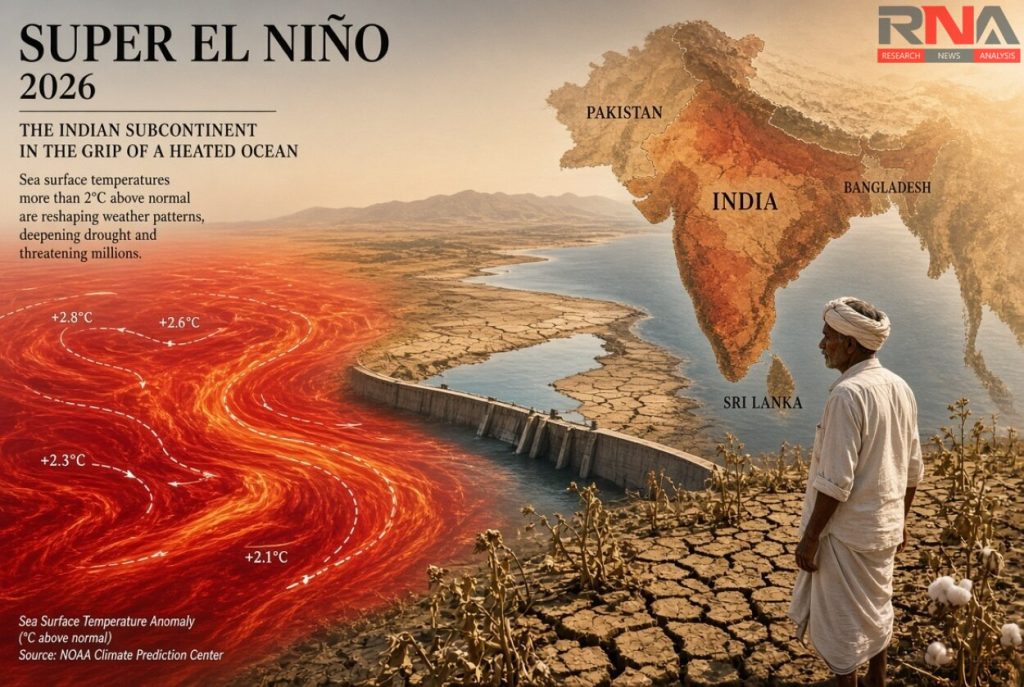
New Delhi: A powerful El Nino has taken hold in the Pacific Ocean, and data released by American forecasters this week confirms it has crossed into “very strong” territory – informally called a super El Nino. For India and the wider subcontinent, the timing is unwelcome, arriving on the back of an already patchy monsoon and reservoirs that were running low well before the rains were due.
The US National Oceanic and Atmospheric Administration (NOAA) said the sea-surface temperatures in the central and eastern Pacific had breached the 2°C rise threshold that defines a very strong event. the temperature rise threshold of 2C, thus becoming “very strong,” informally known as a super El Nino. The current episode of El Nino began developing in June and is expected to peak by early 2027, with forecasters warning it could be one of the strongest ever recorded.
El Nino is not a rare visitor. It recurs every two to seven years, typically builds between March and June, peaks in the northern winter, and can linger for up to 18 months, according to the World Meteorological Organization (WMO).
The global picture is a familiar one, if unusually severe this time. East Africa, the southern United States and parts of South America can expect heavier rain and a raised flood risk, while South Asia, Southeast Asia, Australia and Southern Africa typically turn drier. A very strong El Nino tends to bring heavier rain to East Africa, South America and the southern US, drought to South Asia, Southeast Asia, Australia and Southern Africa, as well as warmer temperatures almost everywhere.
The World Food Programme has warned that the pattern could push another 49 million people into acute hunger by the end of 2027, taking the total across the countries it tracks past 274 million. The UN’s Food and Agriculture Organization has flagged maize, rice and other rain-fed staples as most exposed, from Southern Africa and the Sahel through to South and Southeast Asia.
Temperatures are also set to climb almost everywhere between September and November, and the WMO puts an 86 per cent chance on at least one year before 2030 overtaking 2024 as the hottest on record. The UN secretary general, Antonio Guterres, put it bluntly in a WMO statement: “The planet is in uncharted waters, and those waters are heating up.”
Subcontinent bears the brunt
India is where the consequences of this cycle are already being felt most acutely, and the numbers tell a sobering story. Rainfall across the country ran 15 per cent below average between June 1 and September 9, 2026, according to the India Meteorological Department (IMD).
That shortfall was not a late surprise. The IMD had flagged the risk as early as April 13 forecasting seasonal rainfall of around 800 millimetres against a long-period average of roughly 870 millimetres and putting the odds of a deficient season at 35 per cent – more than double the long-term climatological figure of 16 per cent.
The monsoon’s arrival itself was delayed, reaching Kerala on June 4, three days later than usual. By mid-June, some readings showed the shortfall running as high as 41 to 46 per cent in parts of the country, before later rains narrowed the gap.
This matters enormously for India’s economy. Around 60 per cent of Indian farmers still depend on monsoon rain for the kharif season, and a weak season threatens both incomes and food inflation.
Water storage has offered little cushion. Central Water Commission figures showed the 150 major reservoirs it monitors were at just 24 per cent of live capacity as of May 15 against 29 per cent a year earlier and a 10-year average of 27 per cent.
Groundwater has fared no better. Maharashtra, Karnataka, Madhya Pradesh and Rajasthan have all seen levels drop to critical thresholds after two consecutive years of weak post-monsoon recharge, and Mumbai had already imposed a 10 per cent cut to its water supply before the season even peaked.
Power planners are watching just as closely. A report by the Centre for Research on Energy and Clean Air warned that India’s electricity sector could be more exposed to El Nino than that of any other country, given the combined strain of higher cooling demand and weaker hydropower generation. The government has taken note, with a high-level review reportedly chaired by the principal secretary to the prime minister.
The knock-on effect on prices is being tracked at the highest level. The Reserve Bank of India has been consulted on the inflationary risk, and economists have warned that food inflation could breach 7 per cent if the monsoon continues to underperform.
There is a partial silver lining. Positive Indian Ocean Dipole conditions and reduced snow cover over the northern hemisphere can sometimes offset El Nino’s drying effect on the subcontinent, and India’s accumulated post-2000 moisture surplus has already produced unexpected rainfall in states such as Rajasthan in recent years. Even the director general of the IMD, Mrutyunjaya Mohapatra, and the secretary of the Ministry of Earth Sciences, M Ravichandran, have pointed to these countervailing factors.
Pakistan’s experience has been mixed rather than uniformly bleak. Kharif rice output has been affected by delayed monsoon rains, even as the country’s rabi wheat harvest earlier in the year came in above average, though dry conditions and reduced sowing area have added localized pressure.
Bangladesh has, somewhat counterintuitively, faced the opposite problem in places. Sudden and unusually intense rain inundated more than 100,000 hectares of farmland in July 2026, catching rice-growers mid-preparation for the Aman transplanting season, even as fertilizer costs – up sharply worldwide in the first half of the year – added to farmers’ burdens.
Sri Lanka’s picture is similarly two-sided. Parts of the country face stressed food-security conditions through the wet season, while the later stages of the El Nino cycle could bring heavier rain and a raised risk of flooding and landslides, compounding the aftermath of Cyclone Ditwah and a slow economic recovery.
One dimension deserves closer attention in a defence and diplomacy context: water-sharing arrangements across South Asia’s river systems. The Indus Waters Treaty between India and Pakistan remains suspended following its abeyance after the Pahalgam terror attack, and the Ganges Water Treaty with Bangladesh is due for renewal, leaving two of the region’s most consequential water agreements in flux precisely as rainfall variability rises.
The Himalayan snowpack adds a further strategic layer. Persistence of snow across the Hindu Kush Himalaya has reportedly fallen to a 24-year low for a fourth consecutive year, a trend with direct bearing on glacier-fed rivers, downstream irrigation, and the terrain security forces operate in along India’s northern frontiers.
Forecasters are careful to add a caveat. The WMO has stressed that the intensity of an El Nino event does not translate in a straight line into the scale of regional impact, since conditions in the Indian and Atlantic oceans also shape outcomes.
No two El Nino events unfold identically. That much, at least, offers India and its neighbours some room to prepare rather than merely react.