


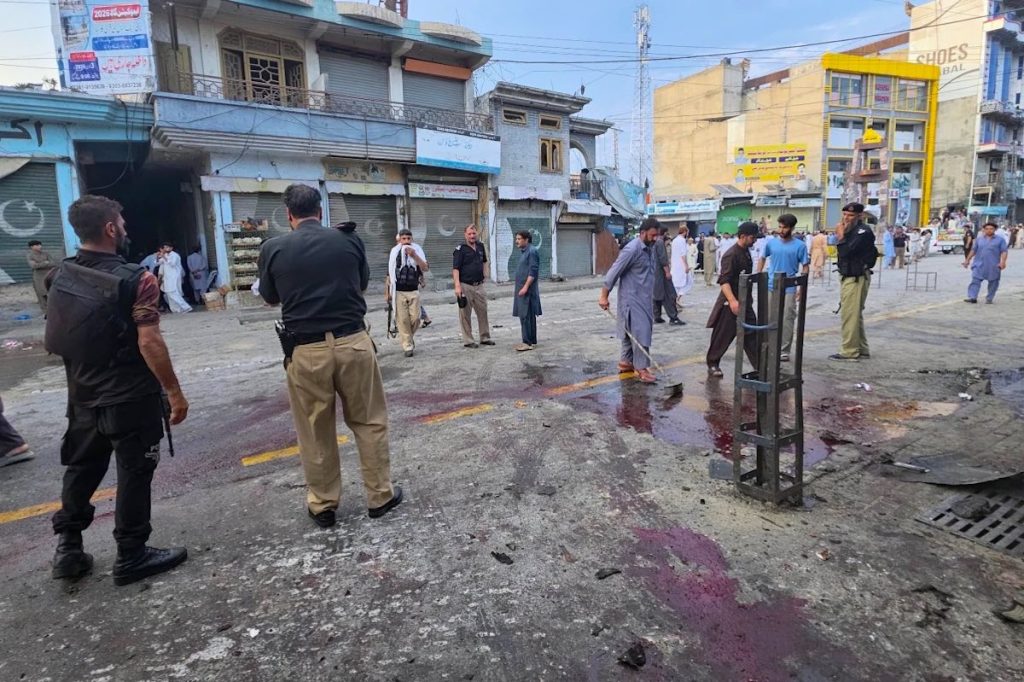
New Delhi: A suicide bomber blew himself up outside the Kabal police station in Pakistan’s Swat district on Sunday, killing at least 14 people and wounding more than 20 others. Most of the casualties were police personnel and civilians who had gathered nearby for a rally against a fresh wave of militant violence sweeping the valley.
The attacker tried to force his way into the police station but was stopped and challenged by officers at the main gate, according to the Swat district police officer, Umar Khan. Unable to get past the checkpoint, he detonated his explosives at the entrance instead. The deputy inspector general of police for Malakand, Fida Hussain, put the number of wounded at 22, though some local reports have suggested a higher figure.
The bombing struck close to Kabal Chowk, where hundreds of residents had assembled for what organizers called the Swat People’s Peace Uprising, a demonstration by locals and civil society groups against the resurgence of militancy in the valley. Speakers had just finished telling the crowd that restoring security was the state’s responsibility when the blast tore through the gathering, sending people fleeing in panic.
Witnesses said the demonstrators had accused authorities of cracking down on peaceful residents even as armed fighters moved freely through the surrounding mountains, some of them filming and circulating their activities on social media. One speaker was quoted by Dawn as saying that the valley had endured years of bloodshed and did not want another generation of widows and orphans.
The wounded were rushed to hospitals in Saidu Sharif and Mingora, with several reported to be in a critical condition. Rescue teams completed their search and evacuation operations soon after, and a district-wide medical emergency was declared to ensure the injured received priority treatment.
Pakistan’s interior minister, Mohsin Naqvi, condemned the bombing and offered condolences to the bereaved families. The prime minister, Shehbaz Sharif, and the president also issued statements mourning the dead and vowing that the fight against militancy would continue until it was, in their words, completely eradicated. No group had claimed responsibility for the attack by Sunday evening.
Swat, once a Pakistan Taliban stronghold, was cleared of the group in a 2009 military offensive that forced thousands of families from their homes before they were eventually able to return. The valley has since become a byword for the fragility of that peace, having witnessed a string of bombings in recent years, including a twin blast at a Kabal counter-terrorism police station in April 2023 that killed a dozen officers. Sunday’s attack revives fears that the militant footprint the army once claimed to have eliminated is creeping back.
The Kabal bombing is the latest in a run of attacks across Khyber Pakhtunkhwa this year. Just three days earlier, an ambush using explosive-laden drones killed 11 police officers at a checkpoint in Hangu district, and a car bombing in Tank claimed by the Tehreek-e-Taliban Pakistan (TTP) killed 27 soldiers in late July. Researchers at the Pakistan Institute for Conflict and Security Studies recorded 154 terrorism-related deaths across the province in July alone, more than double June’s toll.
Pakistan’s military spokesman, Ahmad Sharif Chaudhry, said on Friday [YouTube video] that the country had recorded 3,145 terrorism incidents since January, in which 2,084 militants had been killed. He added that 819 Pakistanis, including soldiers, police officers and civilians, had also lost their lives, and alleged that Afghanistan-based militants had carried out 28 suicide attacks in Pakistan this year, mostly involving Afghan nationals.
Pakistan has repeatedly accused the Afghan Taliban government of sheltering the TTP and other armed groups that plan cross-border attacks, an allegation Kabul denies. The dispute has strained relations between the neighbours through much of 2026, and included Pakistani airstrikes on Afghan territory that Kabul and the United Nations said killed dozens of civilians.
For India, the renewed bloodletting in Khyber Pakhtunkhwa is a reminder that Pakistan’s western frontier remains as combustible as ever, even as Islamabad’s security establishment stays focused on the eastern border. A weakened writ of the state in Swat and the tribal districts has historically had a way of spilling over into the broader regional security calculus that New Delhi watches closely.