


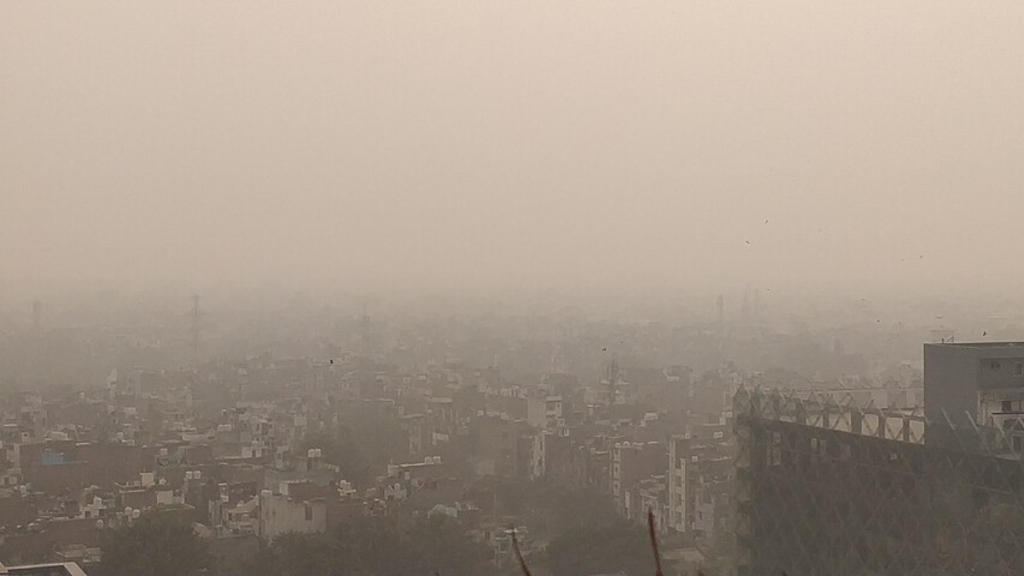
New Delhi: Delhi’s air quality remained in the very poor category on Thursday, with the Air Quality Index (AQI) standing at 367, according to the Indian Institute of Tropical Meteorology (IITM). The forecast indicates that the AQI could rise to 374, while high humidity levels of 94 per cent and unfavourable weather conditions continue to add to concerns over pollution in the capital.
The rising contribution of stubble burning in neighbouring states has added to the city’s pollution burden. According to IITM estimates, farm fires accounted for 15.6 per cent of Delhi’s PM2.5 pollution on Thursday. The contribution is projected to increase further to 19.20 per cent by Friday, according to the institute’s Decision Support System (DSS).
Stubble burning refers to the practice of setting fire to leftover crop residue after harvesting, mainly paddy. Farmers often burn the residue to quickly clear their fields and get the land ready for the next crop. The smoke released during this process contains fine particles that can travel across state borders and add to Delhi-NCR’s pollution.
To prevent stubble burning, environment ministry had taken advance measures ahead of the paddy harvesting season. On October 22, it directed Punjab and Haryana to strengthen monitoring and enforcement. On October 10, its teams visited stubble-burning hotspots in Amritsar and Tarn Taran. The commission also deployed flying squads across 18 Punjab districts from October 1 to November 30 to monitor farm fires.
The spike in pollution comes just days ahead of Diwali, raising fears of more emissions from firecrackers. RNA Media earlier reported that the highest court has permitted the use of certified green firecrackers on November 7 and 8 with conditions, with restrictions coming back into force on November 9. The court has also directed authorities to ensure compliance with certification requirements and other safeguards.
Apart from farm fires and the upcoming festival, vehicle emissions, road dust and construction activities continue to contribute to pollution in the capital. The CAQM had invoked Stage II of the Graded Response Action Plan (GRAP) on November 2, bringing additional restrictions such as intensified road cleaning, water sprinkling and stricter dust-control measures.
According to the IITM’s Air Quality Early Warning System, Delhi’s air quality is likely to deteriorate into the severe category on November 6 and 7. Construction and demolition activities across the NCR have also been scheduled to remain suspended from November 5 to 20 as part of additional pollution-control measures.
With Delhi’s AQI at 367, the capital remained in the red zone, indicating very poor air quality. Prolonged breathing of this air can cause respiratory problems. Very high levels of pollution can affect even healthy people, but people with heart or lung disease are at higher risk.