


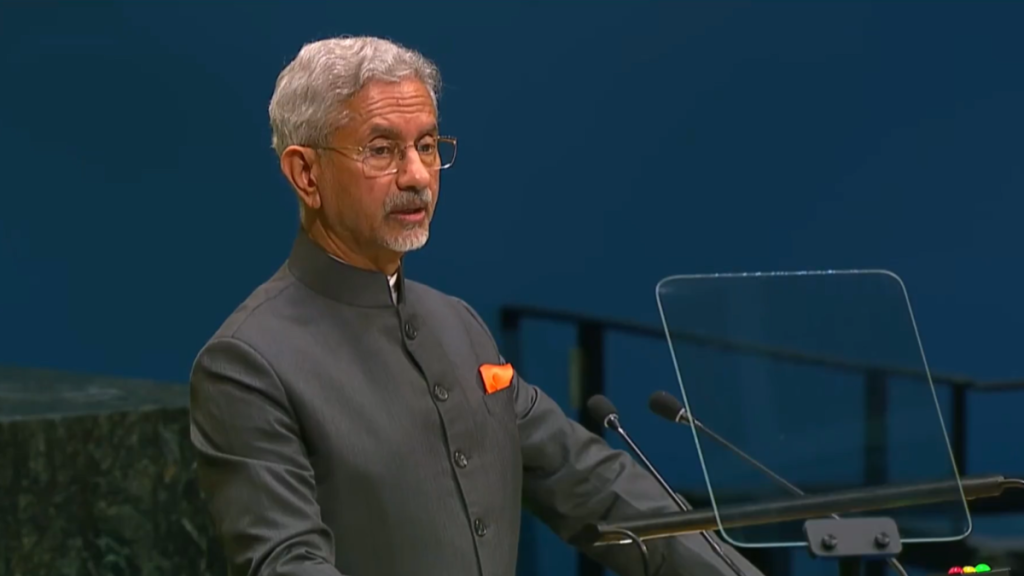
New Delhi: The external affairs minister, S Jaishankar, delivered a sharp warning against attempts to justify or normalize terrorism at the United Nations general assembly on Saturday, saying India would exercise its right to defend itself against terrorism. He said those responsible for terrorism must face its consequences and that there could be no compromise on a zero-tolerance approach.
Jaishankar said a “serial practitioner of terrorism” had misrepresented facts before the assembly and attempted to normalize terrorism. “Friendship and goodwill cannot coexist with terrorism,” he added that understandings based on such a relationship would naturally be called into question. He also said governments involved in cross-border terrorism must be held accountable.
Beyond terrorism, Jaishankar warned that conflicts and confrontations continued to threaten global security, development and economic stability. He said the impact of wars was being felt far beyond the countries directly involved, particularly through disruptions to food, energy, trade and shipping.
On the conflict in the Gulf, Jaishankar called for restraint and de-escalation while stressing the need to protect civilians and ensure the uninterrupted movement of energy and commercial goods. He also condemned attacks on commercial ships and seafarers travelling through international waterways.
On Ukraine, Jaishankar said the conflict had entered its fifth year and stressed that “endless war must give way now, to an end to war”. He said India supported ongoing efforts to bring peace and was ready to contribute to food and energy security.
On West Asia, Jaishankar said India continued to support a two-state solution to the Israel-Palestine conflict. He also said India was providing humanitarian assistance and relief to the Palestinian people.
Jaishankar said the Global South was facing a “4F crisis” involving food, fuel, fertilizer and finance. He warned that supply-chain disruptions, restrictions on technology and limited market access were putting further pressure on developing countries.
He also raised concerns over the misuse of artificial intelligence, saying it could sharpen bias and weaken mutual respect. At the same time, he described AI as an important tool for economic growth, human empowerment and solving problems at scale.
Highlighting India’s global role, Jaishankar said the country had undertaken around 600 major development projects across 78 countries. These projects cover areas including infrastructure, agriculture, manufacturing, information technology and capacity building.
He also highlighted India’s humanitarian assistance and disaster response, including medical supplies and support to countries affected by conflicts, epidemics and natural disasters. India, he said, would continue to assist partners in meeting food, medicine, energy and livelihood needs.
On UN peacekeeping, Jaishankar said Indian contingents were currently serving in nine of the UN’s 11 peacekeeping mandates. He also highlighted the recognition to an Indian woman combat helicopter pilot as the UN’s 2025 Military Gender Advocate of the Year.
Jaishankar further said India had joined Liberia and 23 other countries in an initiative opposing attacks on commercial shipping and seafarers. He stressed that the safety and security of ships and their crews must not be compromised.
The minister also referred to UN secretary-general, Antonio Guterres, whose term ends on December 31, 2026. Jaishankar said India valued his contribution to multilateralism and specifically mentioned his support for India’s Mission LiFE initiative.
Jaishankar concluded by calling for a stronger global commitment to peace, development and prosperity, quoting Mahatma Gandhi’s words, “There is no way to peace; peace is the way.”