


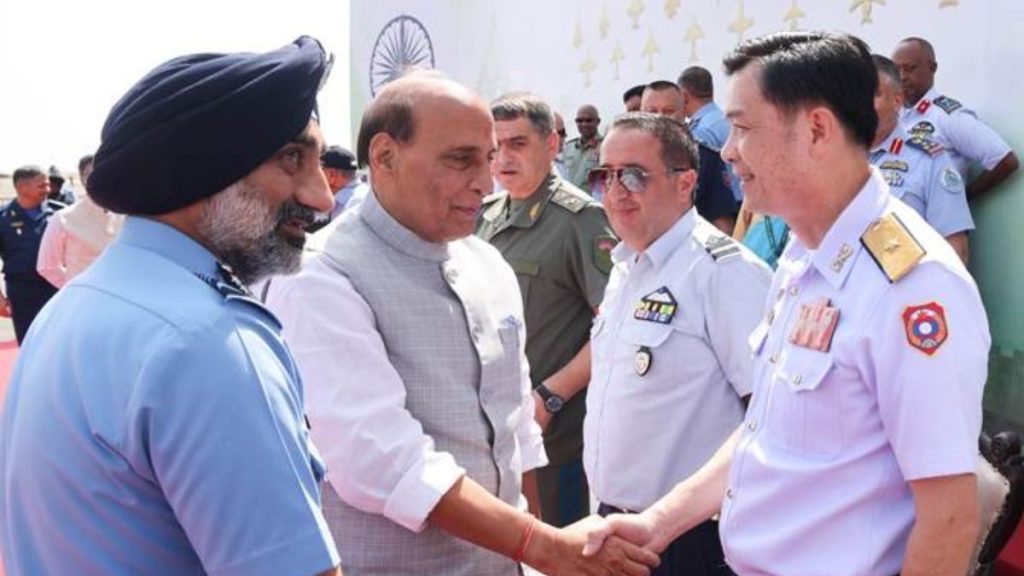
New Delhi: Future military power will increasingly depend on how quickly armed forces detect threats, process information, take decisions and act, rather than the number of military platforms they possess, the defence minister, Rajnath Singh, said on Saturday. Addressing participants of Exercise Tarang Shakti 2026 at Air Force Station Jodhpur, he linked combat readiness to technological integration, domestic defence production and cooperation with trusted international partners.
The Indian Air Force is hosting the second edition of Tarang Shakti from September 26 to October 12 under the theme “Power in Partnership”. Seven foreign air forces, from Australia, Bangladesh, France, Germany, Sri Lanka, the United Arab Emirates and the US, are participating, while 32 other countries are attending as observers.
“It will be determined by the speed of sensing, understanding, deciding, and acting,” Singh said of future military power. He argued that information, precision and the ability to integrate different capabilities would become more important as military operations expanded beyond traditional battlefields.
Technology reshaping modern warfare
Singh said warfare now extended into space, cyberspace, the electromagnetic spectrum and the information domain, alongside land, sea and air. Unmanned aircraft and drones were changing the pace of operations, artificial intelligence was influencing decision making and electronic warfare had increased the importance of controlling frequencies used by communications and radar systems.
Long-range precision weapons were also expanding the areas in which forces could engage targets, he said. Against an increasingly uncertain international security environment, these developments demanded faster assessments and closer coordination between pilots, command centres and supporting systems.
At Jodhpur, the exercise has brought together combat aircraft, transport planes and aerial refuelling platforms, including American F-35 fighters, French Rafales, F-16s, A400M transports and C-130 variants. The US contingent includes four F-35A fighters from Misawa Air Base in Japan and a KC-135R refuelling aircraft from Kadena, according to US Pacific Air Forces.
The drills have included air defence, drone operations, dynamic targeting and combat search and rescue, The Tribune reported. Such exercises allow aircrews and mission planners to compare procedures, coordinate with unfamiliar formations and identify areas for improvement through joint operational experience.
Defence self-reliance alongside global partnerships
Singh said prolonged conflicts could expose countries to shortages of imported weapons, spare parts and critical technologies. India’s response, he argued, must be the ability to design, develop, manufacture, maintain and upgrade its own defence equipment rather than depend primarily on assembly or overseas supply.
He cited the Tejas fighter, Dhruv, Rudra and Prachand helicopters, the light utility helicopter, the Akash air-defence system, active electronically scanned array radars and emerging unmanned technologies. The indigenous Tejas and Prachand are participating at Jodhpur, although the programmes he listed are at different stages of development, production and operational use.
The Advanced Medium Combat Aircraft (AMCA) remains a development programme intended to build India’s fifth-generation stealth fighter capability. In May 2025, the government approved an execution model allowing Indian public and private companies to compete to develop its prototype, while Singh separately identified advanced aero-engine technology as an area requiring investment and potential international co-production.
“The defence relationships of the future will be about technology and trust, not just about platforms,” Singh said. He outlined research, co-development, co-production, maintenance, training and innovation as possible areas for cooperation, without announcing any new agreement.
Singh stressed that self-reliance should allow India to act independently when necessary while working effectively with partners when interests converge. Multinational exercises, he argued, offered opportunities to examine assumptions, improve operating procedures and strengthen coordination among air forces employing different aircraft and technologies.
The defence ministry also drew a connection with Operation Sindoor, citing the importance of preparedness, integrated planning and precision air power, without detailing any new operational outcomes. Singh called on the IAF to incorporate lessons from multinational flying and mission planning into its training, tactics, technology and doctrine, with Tarang Shakti scheduled by the ministry to conclude on October 12.