


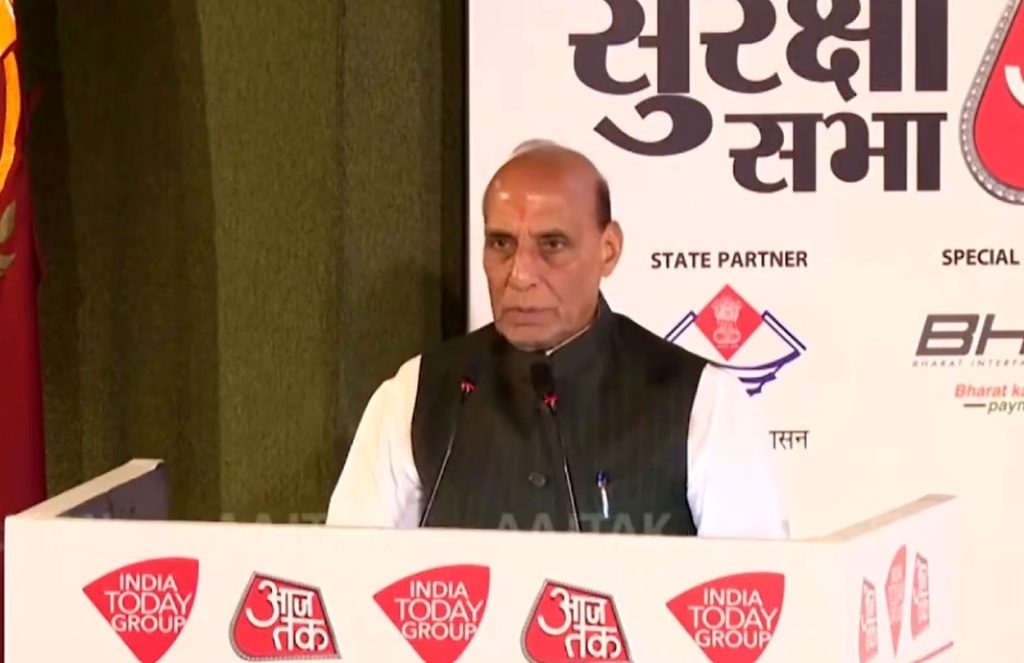
New Delhi: The Indian armed forces have been given the operational freedom and resources required to respond decisively to security threats, including the authority to strike hostile targets inside an adversary’s territory, the defence minister, Rajnath Singh, said on Monday. He framed the policy as part of India’s transition from a traditionally reactive posture to one designed to deter aggression through credible military capability and political resolve.
Addressing the Aaj Tak Suraksha Sabha here in the national capital, Singh said India remained committed to peace and had no territorial ambitions against another country. However, he argued that restraint should not be mistaken for weakness and warned that states supporting terrorism against India could expect a military response instead of dialogue.
The defence minister said the government had provided the armed forces with sufficient resources and greater latitude to determine an appropriate response to a threat. His remarks indicated that New Delhi intended to preserve the option of cross-border action when it assessed that terrorism or other hostile activities posed a direct danger to national security.
Singh cited the surgical strikes, the Balakot airstrike and Operation Sindoor as examples of what he described as India’s increasingly proactive approach to counterterrorism. These operations, although conducted under different circumstances, have become central to the government’s argument that military force may be employed against terrorist infrastructure beyond India’s borders.
He also referred to India’s suspension of the Indus Waters Treaty, saying the decision had conveyed that terrorism and normal bilateral engagement could not continue simultaneously. India announced that measure as part of a wider set of actions against Pakistan following the Pahalgam terrorist attack.
The defence minister accused India’s adversaries of trying to destabilize Jammu & Kashmir by financing anti-India activities, encouraging violence, misleading young people and exploiting social divisions. He said the government had combined security operations with rehabilitation, de-radicalization, employment programmes and efforts to bring vulnerable young people into the mainstream.
Singh further claimed that Jammu & Kashmir had experienced substantial development and expanded economic opportunities since the abrogation of Article 370. The constitutional changes made in August 2019 ended the erstwhile state’s special status and led to its reorganization into the Union territories of Jammu & Kashmir and Ladakh.
Placing military policy within a broader strategic framework, Singh said India was maintaining its independent agency and strategic autonomy at a time when conflicts and geopolitical rivalries were pressuring countries to align with competing blocs. Economic strength, resilient supply chains and domestic technological capacity, he added, were essential to sustaining that autonomy during a crisis.
The minister said warfare was increasingly extending beyond the conventional domains of land, sea and air into space and cyberspace. Artificial intelligence, autonomous platforms, drones, counter-drone systems and precision-guided weapons were transforming military operations, requiring India’s security architecture to anticipate technological change rather than merely respond to it.
Singh linked that objective to the government’s drive for indigenous defence production, saying India should develop critical technologies domestically instead of remaining dependent on imports. He listed the Akashteer air-defence control system, Akash missile, Pinaka rocket system, Astra air-to-air missile, Prachand and Dhruv helicopters, Tejas fighter, Arjun tank and INS Vikrant among the major platforms produced in India.
He also credited India’s entry into the Missile Technology Control Regime in 2016 with facilitating work to extend the BrahMos cruise missile’s range. Singh said the missile had played an important role during Operation Sindoor, presenting it as an example of how diplomacy, technology and military preparedness could reinforce one another.
According to figures presented by Singh, India’s annual defence production has increased from about ₹40,000 crore before 2014 to approximately ₹1.8 lakh crore, while defence exports have risen to around ₹38,500 crore. He said Indian military equipment was now being exported to more than 100 countries and set a target of raising annual exports to ₹50,000 crore by 2029.
More than 16,000 micro, small and medium enterprises are now involved in defence manufacturing, while the number of defence start-ups has crossed 2,000, Singh said. He added that the defence industrial corridors in Uttar Pradesh and Tamil Nadu had attracted investment proposals worth approximately ₹70,000 crore, of which nearly ₹10,000 crore had materialized.
The government’s stated objective, Singh said, was to build a defence ecosystem capable of strengthening national security, supporting economic growth and enlarging India’s role in the global security architecture. He projected that by 2047, when the country marks 100 years of independence, India could emerge as a leader in technology, economic capacity and defence manufacturing.