


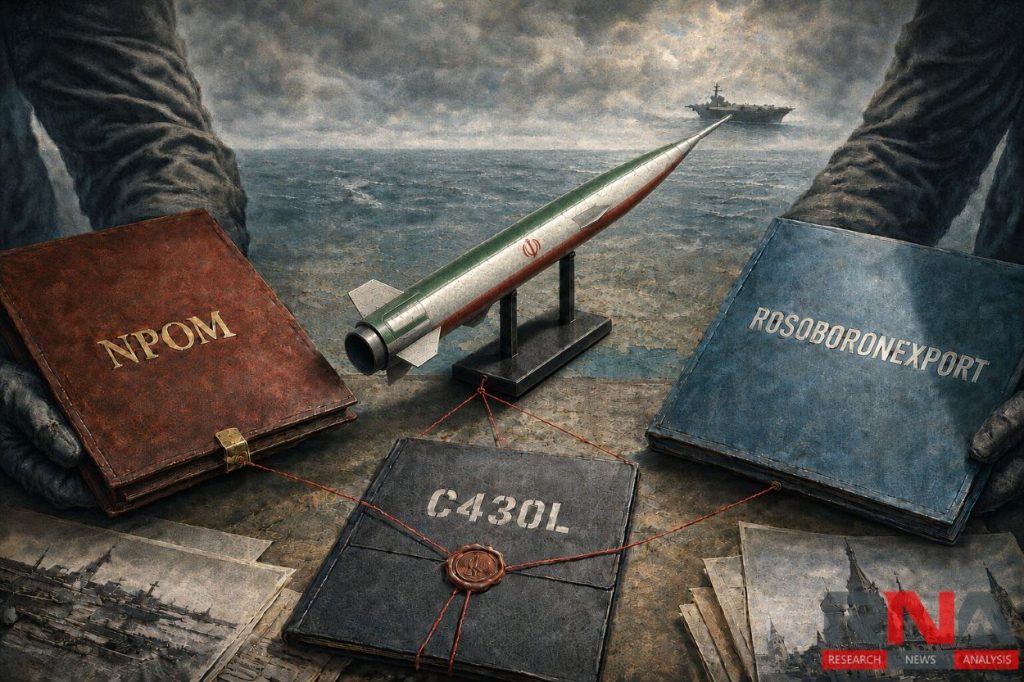
New Delhi: Russia has reportedly been helping Iran develop an advanced ramjet-powered cruise missile that could sharply strengthen Tehran’s ability to threaten US warships and military installations across the Middle East. The covert initiative, reportedly code-named Project C430L, began in 2023 and continued during the current US-Israeli war with Iran, according to a Financial Times investigation published on Wednesday.
The investigation was based on leaked Russian correspondence, travel records and an examination of military patents linked to the programme. The documents reportedly show that experienced Russian missile specialists provided technical assistance intended to help Iran master ramjet propulsion – a critical technology for cruise missiles designed to sustain supersonic speeds.
Russia’s state arms-export agency, Rosoboronexport, allegedly arranged the programme and coordinated it with NPO Mashinostroyenia (NPOM), one of the country’s leading missile and space-engineering organizations. A contract was formally signed with Iran’s defence ministry and armed forces logistics in November 2023, although Russian officials and engineers had reportedly visited Iran several times before the agreement was concluded.
The FT investigation says that by 2025, NPOM had received extensive Iranian technical material relating to a ramjet engine that Tehran had already built and flight-tested. Russian engineers subsequently examined telemetry from the trial and sought further information about the engine’s fuel system, combustion stability, air intake and exhaust nozzle.
The engineers also questioned whether the engine had continued operating after the telemetry supplied by Iran ended less than a minute into the test. Their detailed enquiries suggest that the work went beyond general consultations and involved an effort to diagnose problems and improve a propulsion system already under development.
Rosoboronexport proposed sending about two dozen Russian specialists to Iran for technical consultations in April 2025, according to the leaked correspondence. A letter dated June this year indicated that Russian technical reports were still being discussed and that the two sides were negotiating another phase of the project, although it remains unclear whether that stage has begun.
Why ramjet technology matters
Unlike a conventional jet engine, a ramjet has no mechanical compressor and instead uses the missile’s forward motion to compress incoming air before combustion. It therefore requires an initial boost to reach an effective operating speed but can subsequently sustain high-speed flight with a relatively compact propulsion system.
A supersonic cruise missile travels faster than Mach 1, while a weapon is generally classified as hypersonic only when it exceeds Mach 5 and retains effective manoeuvrability. The available material describes C430L as a supersonic programme and does not establish that the proposed Iranian weapon has achieved hypersonic performance.
For Iran, a fast, low-flying cruise missile would have particular value in the confined waters of the Gulf, where the US Navy maintains a substantial presence. Speed, sea-skimming flight and manoeuvrability could compress the detection and engagement time available to existing American naval air-defence systems, although such characteristics would not make the missile impossible to intercept.
Fabian Hinz, a senior analyst with the thinktank Conflict Armament Research, assessed the alleged assistance as a transfer of strategically sensitive technology that Iran had sought for decades. Jim Lamson, a former CIA analyst specializing in Iran, said such a weapon would give Tehran a qualitatively new capability against US naval vessels.
Iran is reported to have constructed and flight-tested the propulsion system, but there is no evidence that a complete Russian-assisted missile has entered service. Nor has the investigation established its intended range, warhead, guidance system, launch platform or production schedule.
The India connection
NPOM’s reported involvement is particularly noteworthy from an Indian perspective because the Russian organization is the partner of the Defence Research and Development Organisation in BrahMos Aerospace. The joint venture’s official account credits NPOM with expertise in ramjet engines, cruise missiles, launch vehicles and space systems that contributed to developing the BrahMos supersonic cruise missile.
That institutional connection does not establish any relationship between BrahMos and Project C430L, which the investigation portrays as a separate Russia-Iran arrangement. No publicly available evidence indicates that Indian technology, BrahMos intellectual property or information belonging to the Indo-Russian joint venture was involved in the alleged Iranian programme.
The US treasury sanctioned NPOM in 2014, describing it as a major Russian rocketry company responsible for cruise-missile systems launched from surface, underwater and land platforms. Washington also said the organization supported Russia’s strategic nuclear forces and worked on intercontinental ballistic missiles and space systems.
A growing military relationship
The reported missile collaboration fits a broader expansion of defence and intelligence ties between Moscow and Tehran following Russia’s invasion of Ukraine in February 2022. Ukraine and Western governments have accused Iran of supplying Shahed attack drones subsequently used by Russia, although Tehran has disputed allegations that it provided weapons for attacks on Ukraine.
The president of Russia, Vladimir Putin, and the president of Iran, Masoud Pezeshkian, signed a comprehensive strategic partnership treaty on January 17, 2025. Its published text provides for greater defence cooperation, exchanges between military experts and closer coordination between the two countries’ intelligence and security services.
A separate Reuters investigation reported in April that Russian satellite imagery and cyber assistance had helped Iran refine attacks on US and regional targets, citing a Ukrainian intelligence assessment and Western and regional security sources. Russia and Iran did not comment on those claims, while Washington maintained that outside assistance had not materially affected US operations.
The Kremlin, Rosoboronexport, NPOM and the Iranian government did not respond to the FT’s requests for comment on Project C430L. Because the leaked documents have not been released in full, the programme’s precise status cannot be independently verified through publicly available material.
If C430L eventually produces an operational missile, it could complicate naval deployments and missile-defence planning around the Gulf and the Strait of Hormuz. For now, however, the evidence points to a technically significant development effort rather than a fielded weapon – an important distinction in assessing both the immediate threat and its longer-term strategic consequences.