


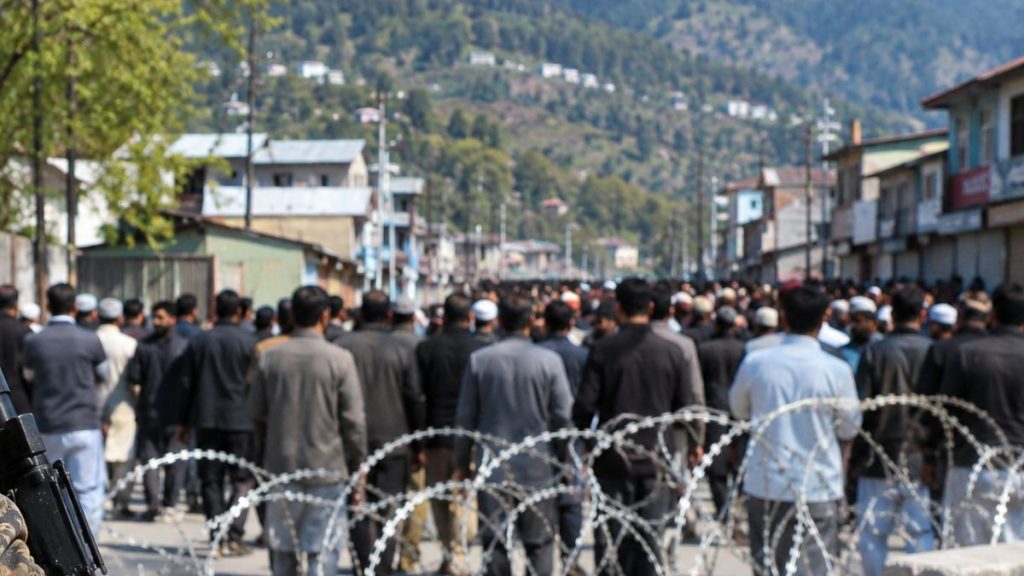
New Delhi: Efforts to resolve prolonged unrest in Pakistan-occupied Kashmir (POK) have encountered fresh obstacles after the Jammu & Kashmir Joint Awami Action Committee (JAAC) rejected a political conference declaration, amid reports of intensified restrictions in Rawalakot. However, the protest organization’s advisory council subsequently indicated conditional willingness to negotiate, as concerns mounted over additional anti-terrorism listings, reported civilian displacement threats and disputed deaths during security operations.
The POK publication Kashmir Times reported on Wednesday reported that a conference of political leaders and prominent figures from Poonch, held in Islamabad on November 23, constituted a six-member mediation committee headed by former POK president, Sardar Masood Khan. The panel was tasked with preparing a framework for negotiations within five days, although the initial declaration failed to secure the support of the JAAC’s Poonch chapter.
JAAC sets conditions
The conference, organized by the Jammu & Kashmir peoples’ party, called for a peaceful resolution of the Rawalakot sit-in, implementation of the October 2025 agreement between Pakistan’s government and the JAAC, compensation for families affected by violence and reopening of blocked roads.
Masood Khan proposed simultaneously ending the protests and security operations to create conditions for negotiations. He also advocated a legal mechanism to remove the JAAC from the list of proscribed organizations and sought a government white paper detailing progress on the movement’s 38 demands.
However, the JAAC’s Poonch chapter rejected the declaration, accusing conference participants of reinforcing the government’s narrative while failing to condemn civilian deaths and security forces’ actions. It questioned how political leaders could demand implementation of the October 2025 agreement without opposing the continued ban on the organization that negotiated it.
In a subsequent development, the POK legislative assembly adopted a resolution on Wednesday offering conditional negotiations, while demanding the disbandment of armed groups and action against individuals accused of serious crimes. The assembly blamed the JAAC leadership for the breakdown of earlier talks, allegations disputed by the protest movement.
The JAAC’s advisory council responded on Thursday by expressing willingness to participate in meaningful negotiations, The Azadi Times reported. It called for an empowered negotiating committee within 48 hours and a formal meeting in Rawalakot within five days, alongside independently verifiable safeguards, restoration of communications and an end to coercive security measures.
Anti-terror listings fuel tensions
Kashmir Times reported that authorities had placed another 75 people, including Rawalakot Municipal Corporation Mayor Abdul Naeem Khan, on the fourth schedule under anti-terrorism provisions. Such listings can subject individuals to enhanced surveillance and restrictions on travel, financial transactions and other civil liberties.
The publication cited the UK based Jammu & Kashmir human rights observatory, which documented at least 445 fourth schedule entries in a briefing updated on November 11. The figures remain attributed to the monitoring organization and have not been independently verified.
Residents of Naseem Town, Model Town and Djibouti Town in Rawalakot were reportedly instructed to vacate their homes ahead of a possible security operation, Kashmir Times reported. A delegation approached the deputy commissioner seeking clarification and alternative accommodation, although no official confirmation of a planned evacuation or detailed public explanation was available in the report.
The publication also described conflicting accounts of violence near the Matiyal Mara bus terminal on November 17, when Pakistan Rangers deputy superintendent, Barkat, was reportedly fatally shot. Police claimed four armed individuals were subsequently killed in retaliatory action, but Kashmir Times said their identities and reported deaths could not be independently verified.
The JAAC disputed the police account, alleging that security personnel had targeted civilians. The movement, which has continued for nearly six months, is demanding affordable electricity, subsidized flour, economic relief, political accountability and greater control over local resources.
The latest developments suggest that negotiations remain possible despite the rejection of the original conference declaration and continuing security tensions. Progress will depend on whether the administration and protest organizers can agree on credible safeguards, the JAAC’s legal status and implementation of earlier commitments.