


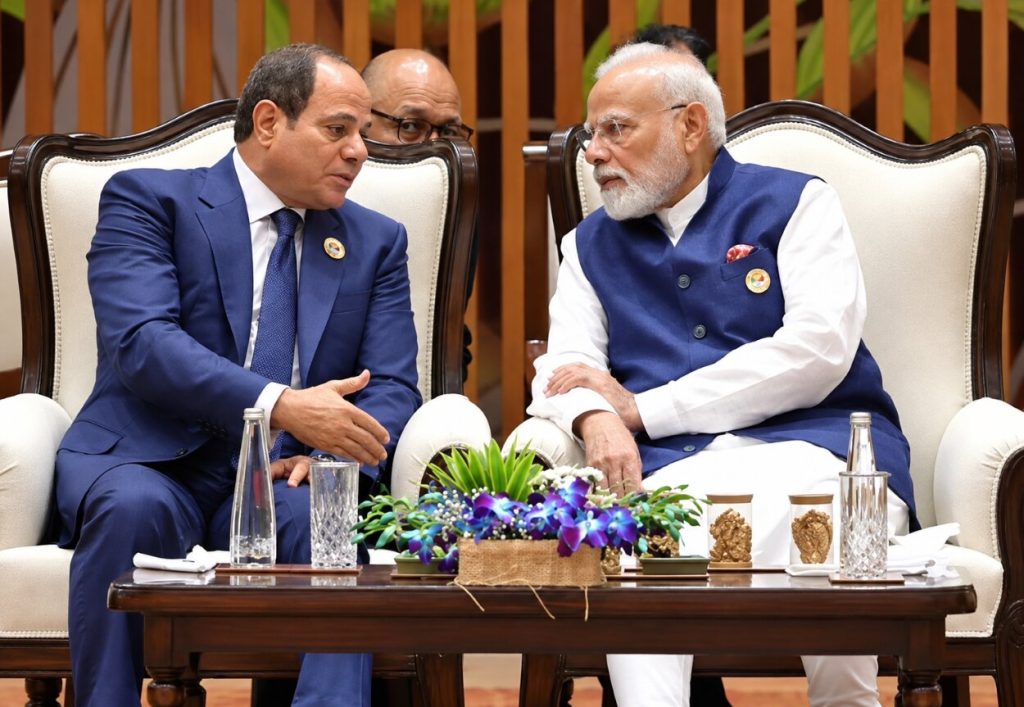
New Delhi: The prime minister, Narendra Modi, held a bilateral meeting with the Egyptian president, Abdel Fattah el-Sisi, in New Delhi on Sunday, as the two countries looked to build further momentum in their strategic partnership. The talks took place on the sidelines of the 18th BRICS Summit, where India’s engagement with Egypt also carries wider significance for its outreach to the Arab world and Africa.
The meeting was part of a packed schedule of bilateral engagements for Modi on the second day of the summit, with the prime minister also due to meet the leaders of Kazakhstan, the Philippines, South Africa and Burundi, as well as senior representatives from Nigeria and Uganda. El-Sisi arrived in New Delhi on September 11 to participate in the BRICS gathering, which is being hosted by India under its 2026 chairship.
The Modi-El-Sisi talks come against the backdrop of a relationship that was formally elevated to a strategic partnership in 2023. Modi’s state visit to Egypt in June that year produced an agreement to upgrade bilateral ties, while El-Sisi had earlier visited New Delhi as chief guest for India’s Republic Day celebrations in January 2023.
The relationship has since acquired a broader economic and geopolitical dimension. India regards Egypt as one of its important partners in Africa, while Cairo sees New Delhi as a major Asian power with which it can expand cooperation in trade, investment, technology, pharmaceuticals, energy, agriculture and other sectors.
Economic ties are an increasingly important component of that strategic partnership. According to the Indian embassy in Cairo, bilateral trade reached about $6.5 billion in the financial year 2025-26, while more than 700 Indian companies are registered in Egypt and Indian investments there exceed $5.5 billion.
Egypt’s geographical position adds another layer to the partnership. Its control of the Suez Canal gives it a pivotal role in the movement of goods between the Indian Ocean, the Red Sea and the Mediterranean, making Cairo an important interlocutor for India as New Delhi seeks more resilient trade and supply-chain routes.
The two sides have also been developing institutional mechanisms to give the relationship greater economic substance. Egypt has previously expressed an ambition to raise bilateral trade to $12 billion over five years, while discussions have covered areas ranging from information technology and pharmaceuticals to renewable energy, green hydrogen, tourism and connectivity.
There is also a significant strategic overlap in the political sphere. India and Egypt have traditionally maintained close positions on issues affecting the developing world, while their cooperation has expanded to include counterterrorism, regional stability and consultations on conflicts involving West Asia and Africa.
That convergence assumes greater importance as BRICS itself becomes more geographically diverse. Egypt joined the grouping as part of its 2023 expansion, and the bloc now has 11 full members, representing roughly half of the world’s population and around 40 per cent of global GDP, according to figures cited in the run-up to the New Delhi summit.
For India, the presence of Egypt at the summit therefore serves a purpose beyond the bilateral relationship. Cairo gives New Delhi an additional channel into the Arab and African strategic space at a time when the Middle East is being reshaped by conflict, energy disruptions and competition over regional influence.
The broader BRICS discussions are taking place against a particularly unsettled international backdrop, including the conflict involving Iran, the war in Ukraine, disruption around the Strait of Hormuz and continuing tensions over trade and global economic governance. India has used its chairship to emphasize resilience, innovation, cooperation and sustainability, while pushing for a greater role for the global south in shaping international institutions.
The Modi-El-Sisi meeting thus fits into a larger Indian strategy of using BRICS not merely as a multilateral forum but also as a platform for strengthening individual relationships with key countries across Asia, Africa and the Middle East. For Egypt, closer engagement with India offers access to one of the world’s largest markets and an increasingly important partner in technology, manufacturing and development, while for New Delhi, Cairo’s location and diplomatic reach make the relationship strategically valuable well beyond bilateral trade.