


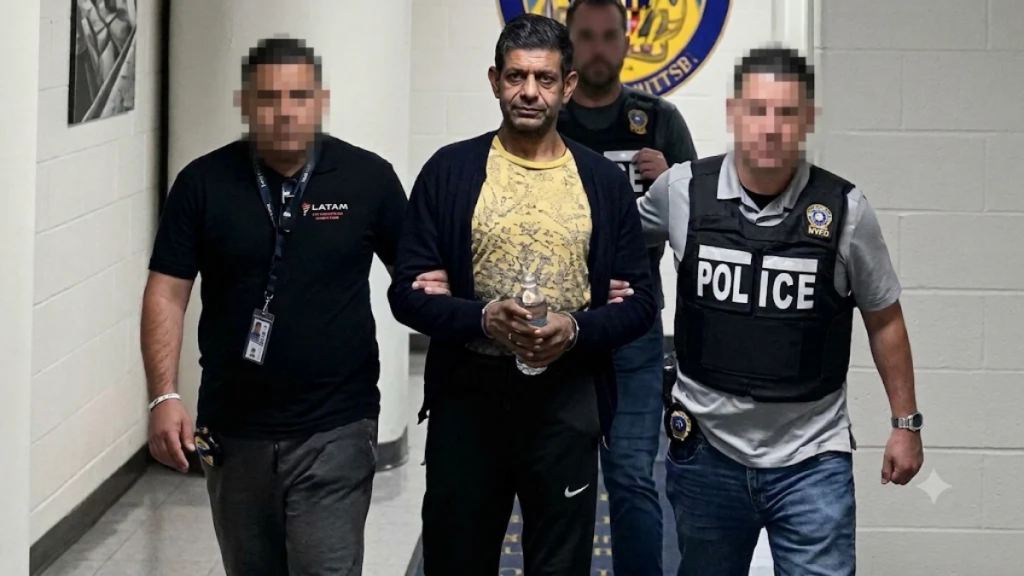
New Delhi: US federal prosecutors have demanded a prison sentence of more than 24 years for Indian national Nikhil Gupta over his involvement in a foiled conspiracy to assassinate Khalistani separatist Gurpatwant Singh Pannun in New York in 2023. With sentencing scheduled for November 20, Gupta’s lawyers are seeking a substantially shorter 12-year term, setting up a consequential legal decision in a case that has also raised sensitive questions about alleged Indian intelligence involvement in an overseas assassination attempt.
In a sentencing submission filed on Friday, prosecutors asked the US district court for the southern district of New York to impose 293 months of imprisonment – approximately 24 years and five months. The proposed punishment represents the upper limit of the applicable federal sentencing-guidelines range of 235 to 293 months, although the final decision rests with US district judge Victor Marrero.
The prosecution maintains that Gupta was a central participant in a carefully organized conspiracy to kill an American citizen because of his political activities, making the offence particularly serious. In its submission, the government described his conduct as both brutal and brazen, arguing that a lengthy sentence was necessary to deter similar attempts to carry out politically motivated killings on American territory.
Gupta, however, has appealed for leniency, expressing remorse and asking the court to consider his personal circumstances, absence of previous convictions and acceptance of responsibility. His lawyers have supported the federal Probation Department’s recommendation of 144 months in prison, followed by three years of supervised release, arguing that the lower sentence would adequately reflect the gravity of the offence without being disproportionately severe.
Gupta’s remorse and the prosecution’s response
In a personal letter to Marrero, Gupta said he regretted the decisions that led to his arrest and wished he could reverse his actions in 2023. He described struggling with excessive alcohol consumption and psychological distress during that period, arguing that his deteriorating personal circumstances had contributed to his poor judgement.
His defence has also suggested that he acted under pressure from Vikash Yadav, a co-accused whom American investigators identified as an Indian government employee during the period covered by the conspiracy. According to the defence, Gupta believed Yadav possessed considerable official influence, a circumstance his lawyers want the court to consider when assessing his culpability.
Federal prosecutors have rejected the suggestion that alcohol dependence or external pressure adequately explains Gupta’s involvement, pointing to the extended period over which the assassination was planned. They have argued that his repeated communications, logistical arrangements and coordination across international borders demonstrated deliberate participation rather than a temporary lapse in judgement.
The prosecution has also challenged Gupta’s suggestion that he lacked financial motivation, alleging that he expected to benefit from opportunities involving weapons and narcotics transactions after the operation. Meanwhile, Pannun has urged the court to impose a severe punishment, saying the assassination conspiracy forced him to alter his personal and professional life and remain under security protection.
How the assassination conspiracy unfolded
The case originated in May 2023, when Gupta allegedly began coordinating with Yadav to arrange Pannun’s killing in New York, according to the American investigation. Gupta approached an individual whom he believed had criminal connections and could arrange a contract killing, unaware that the person was a confidential source working with the US Drug Enforcement Administration (DEA).
The confidential source subsequently introduced Gupta to a supposed professional assassin, who was actually an undercover DEA officer, enabling American investigators to monitor the unfolding conspiracy. According to the US justice department, the agreed payment for the killing was $100,000, of which $15,000 was delivered as an advance on June 9, 2023.
Investigators said Gupta also passed along information about Pannun’s movements, contact details and residence, while communicating regularly with the people he believed were arranging the assassination. American court documents further alleged that the conspirators discussed delaying the operation around the Indian prime minister, Narendra Modi’s, official visit to the United States in June 2023.
Gupta was arrested in the Czech Republic on June 30, 2023, following a request from American authorities and was subsequently extradited to the United States in June 2024. He initially denied the allegations but pleaded guilty on February 13 this year to murder-for-hire, conspiracy to commit murder-for-hire and conspiracy to commit money laundering.
The three offences carry a combined statutory maximum sentence of 40 years, although the advisory sentencing range is considerably lower. His guilty plea establishes his criminal responsibility for the offences, but the separate allegations concerning Yadav and any wider institutional involvement have not been judicially established against the other accused.
Diplomatic implications for India and the US
Yadav was formally charged by American prosecutors in October 2024, with investigators identifying him as an employee of India’s Cabinet Secretariat, which houses the Research and Analysis Wing (R&AW). US authorities have alleged that he directed Gupta’s activities, although Yadav has not been convicted in the case and was described by the justice department in February as not having been arrested on those charges.
India has consistently denied authorizing any assassination conspiracy, maintaining that such activities would be contrary to government policy. New Delhi nevertheless constituted a high-level enquiry committee following information supplied by Washington, and in January 2025 announced that the committee had recommended legal action against an individual whose previous criminal links had emerged during the investigation.
The controversy has also intersected with the June 2023 killing of Khalistani separatist Hardeep Singh Nijjar in Canada, with American investigators alleging that Gupta referred to Nijjar’s death during conversations about the proposed New York assassination. However, that allegation does not establish who was responsible for Nijjar’s killing, and India has separately rejected allegations of government involvement in the Canadian case.
For Washington, the proceedings concern the protection of American citizens from foreign-directed violence regardless of their political beliefs, whereas New Delhi views Khalistani separatist activities through the prism of national security and territorial integrity. Pannun, who advocates the creation of an independent Khalistan, was designated an individual terrorist by India in 2020, but that designation does not diminish the protections available to him under American law.
The November 20 hearing will determine Gupta’s punishment rather than settle every outstanding question about the alleged network behind the operation. Nevertheless, the court’s findings and the prosecution’s account of his relationship with Yadav could carry implications beyond the sentence itself, particularly for continuing scrutiny of the case in India-US diplomatic and security relations.