


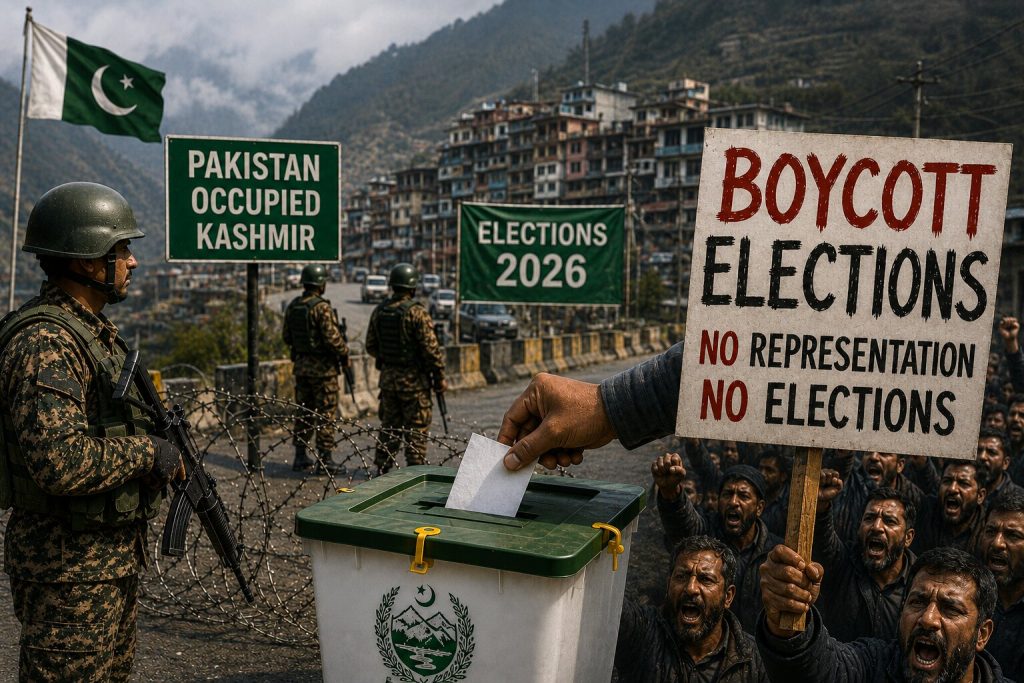
New Delhi: Polling opened on Monday for the first phase of assembly elections in Pakistan-occupied Kashmir (POK). The exercise – held under one of the heaviest security deployments the territory has seen in years – unfolding against a backdrop of a boycott call by the region’s principal protest movement and fresh allegations of rigging even as votes were being cast.
Voting in the 13 constituencies of the Mirpur division – covering Mirpur, Bhimber and Kotli – ran from 8am to 5pm local time (7.30am to 4.30pm IST), the first of three phases that will conclude on August 10. The second phase, on August 2, covers nine constituencies in the Muzaffarabad division along with all 12 seats reserved for refugees settled elsewhere in Pakistan; the third, on August 10, covers 11 constituencies of the Poonch division.
Islamabad’s election authorities said more than 3.4 million voters, including over 500,000 enrolled for the first time, were eligible to cast ballots across the territory, which Pakistan administers as Azad Jammu & Kashmir.
To manage the exercise, Pakistan deployed a three-tier security apparatus of roughly 18,560 personnel, including about 2,100 army troops backing up police, the Punjab and Sindh Rangers and the Federal Constabulary, with the country’s Quick Response Force units held in reserve. The scale of the deployment reflected official anxiety over a repeat of the violence of October 2025, when protests led by the Joint Awami Action Committee (JAAC) turned deadly.
That anxiety appeared well founded within hours of polling starting. The JAAC, whose activities were subsequently proscribed by Islamabad under anti-terrorism law after it boycotted the election outright, alleged on social media that signs of manipulation had surfaced in Mirpur division even before voting began.
The group also said Kotli town remained effectively shut, with several polling stations neither drawing voters nor formally opening well past their scheduled start time. Separately, the country’s election commission suspended and detained two presiding officers in Kotli after they were allegedly found away from their designated stations with official polling material in their possession.
That episode has added to questions over the process’s integrity. The Pakistan Tehreek-e-Insaf’s PoK unit went further, dismissing the election as a sham that voters had already rejected. At the centre of the discontent lies the structure of the 53-seat assembly itself.
Of 45 general seats, 12 are reserved for refugees and migrants living across Pakistan rather than for residents of the territory – a mechanism that JAAC and other critics say has allowed whichever party controls Islamabad to effectively engineer the outcome in PoK, as happened with the Pakistan People’s Party in 2011, the Pakistan Muslim League-Nawaz in 2016 and Imran Khan’s Pakistan Tehreek-e-Insaf in 2021. Abolishing this quota is the first item on the 38-point charter of demands the JAAC issued in June, which also seeks an end to what protesters call economic extraction: hydroelectric dams in the territory generate power far in excess of local needs of around 400MW, yet residents face daily outages of up to 15 to 20 hours while paying tariffs several times the cost of generation.
The crackdown that followed the JAAC’s agitation has left, by differing accounts, anywhere between 20 and 150 dead. Pakistani news outlets reported the lower figure, while Indian security sources cited in domestic reportage placed the toll considerably higher; more than 600 activists and local leaders are reported to have been detained.
Watchdog group Amnesty International has condemned the ban on the JAAC as a disproportionate attack on freedom of association. The United Nations human rights chief, Volker Turk, called on July 17 for prompt, thorough and impartial investigations into the deaths, having earlier also criticized internet restrictions imposed across the territory as a disproportionate curb on the right to seek and share information.
New Delhi has used the moment to press its case internationally. At the UN security council last week, India’s permanent representative, Harish Parvathaneni, said the developments in the territory exposed what he called a decades-long pattern of suppressing basic rights and freedoms of Kashmiris under Pakistani control.
Earlier, the external affairs ministry spokesperson, Randhir Jaiswal, said the unrest was a direct consequence of systemic exploitation and administrative repression, and accused Pakistani authorities of responding to legitimate grievances with excessive police brutality, including against women and children. India has reiterated its long-standing position that the territory is an integral part of Jammu & Kashmir under illegal occupation.
Adding to the grievances is the question of resource control. Pakistan’s army chief, Field Marshal Asim Munir, has been championing a mineral-extraction drive in neighbouring Gilgit-Baltistan projected to be worth as much as $6 trillion, after an army-linked firm was found in 2025 to have extracted ore there without local consent – a episode that protesters cite as symptomatic of a broader pattern in which the territory’s resources are exploited with little local benefit.
With two more phases of voting still to come and the JAAC’s grievances unresolved, the coming fortnight is likely to test whether Islamabad can complete the exercise without further bloodshed, and whether the outcome carries any real legitimacy with a population that, by its own protest movement’s account, wants no part of it.