


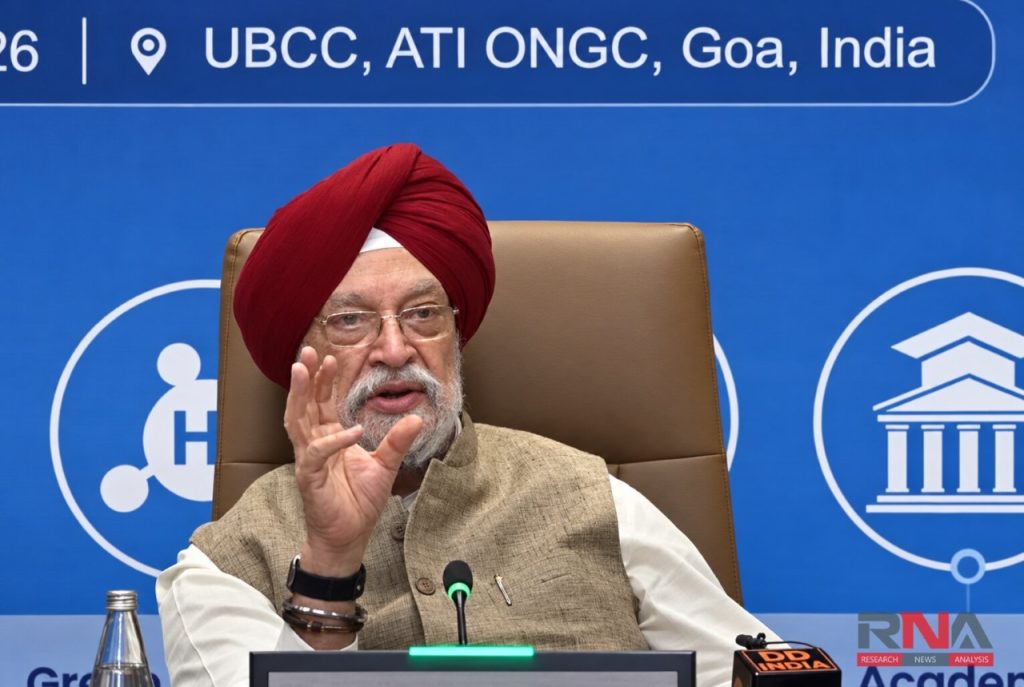
New Delhi: India has faced no pressure from the United States to reduce its purchases of Russian crude, the petroleum and natural gas minister, Hardeep Singh Puri, said on Tuesday. Speaking at an industry event in Goa, he attributed the recent decline in Russian supplies to more attractive offers from Gulf producers and refiners’ commercial decisions.
Puri said the relative prices of competing crude grades determined India’s purchases, with refiners increasing their intake of discounted Gulf oil. “Whatever people say or do, ultimately it is anchored in their self-interest,” he said, according to a Reuters report.
His comments come as India’s oil import mix shifts again following months of disruption to West Asian supplies. Shipping data show that Russian deliveries have fallen while purchases from traditional Gulf suppliers have recovered, reflecting changes in availability, freight costs and the price of crude delivered to Indian ports.
Gulf oil regains ground
India imported about 1.8 million barrels per day of Russian crude in September, down approximately 14 per cent from August, according to ship-tracking data. Russia’s share of Indian crude imports consequently fell to 33.5 per cent from 46.6 per cent a month earlier.
Over the same period, purchases from the Middle East rose to roughly 2.8 million barrels per day, their highest level since February, accounting for about 54 per cent of total imports. Russia nevertheless remained India’s largest individual supplier, followed by the United Arab Emirates and Iraq.
India had initially increased Russian purchases to compensate for the loss of West Asian supplies after the Iran war disrupted regional trade. As producers and traders increased shipments through the Strait of Hormuz, Indian refiners bought additional Gulf cargoes, reversing part of that earlier adjustment.
Refiners weigh the delivered cost
The changing economics are also evident in the procurement plans of Bharat Petroleum Corporation Limited (BPCL), India’s second-largest public sector refiner. Its director of finance, Vetsa Ramakrishna Gupta, told an investor call that Russian crude purchases would decline significantly in November because competing Persian Gulf grades were more commercially attractive.
Russian grades accounted for approximately 37 per cent of BPCL’s crude procurement during July–September, but their volumes eased in October. Gupta said the company was restoring purchases from West Asia as supplies improved, while retaining flexibility in its choice of suppliers.
There are signs that Russian offers could become more competitive again, although transportation remains a constraint. Supplier premiums for December cargoes have narrowed to about $1–$2 a barrel from $12–$13 under October contracts, but elevated freight costs could continue to favour West Asian supplies.
These premiums are additions to a reference price, rather than the full cost of the crude. The reporting indicates that refiners’ decisions depend on the complete delivered price – including transportation – so a reduction in a supplier’s premium may not, by itself, make a Russian cargo the cheapest option.
US tariff threat remains part of the backdrop
Puri’s statement follows a recent easing of a US tariff threat linked to Russian energy purchases. An executive order issued by the US president, Donald Trump, on October 16 waived key Russia-related sanctions and tariffs that had been due to take effect under legislation known as the Lindsey Graham Act, as RNA Media had reported.
The legislation could have exposed Indian goods to additional duties of up to 100 per cent because India was among the five largest buyers of Russian oil. New Delhi had warned in September that the proposed measures could damage bilateral relations, adding energy procurement to the difficulties surrounding negotiations on a trade agreement.
The US secretary of state, Marco Rubio, subsequently said the trade negotiations were a consideration in Trump’s waiver decision. He also acknowledged that some countries faced difficulties obtaining energy from alternative sources, underlining the supply constraints confronting major importers.
Beyond the choice of supplier, Indian oil executives are drawing attention to the cost of moving crude. The Indian Oil Corporation chairman, A. S. Sahney, said at an industry event in Goa on October 27 that India needed a larger shipping fleet and more storage infrastructure to capture the benefits of cheaper supplies.
Sahney said high freight charges were eroding savings from discounted crude, while additional oil and liquefied petroleum gas storage would strengthen protection against supply disruptions. His remarks point to a wider challenge for India’s energy strategy: securing an attractively priced cargo also requires affordable transport and sufficient capacity to receive and store it.