


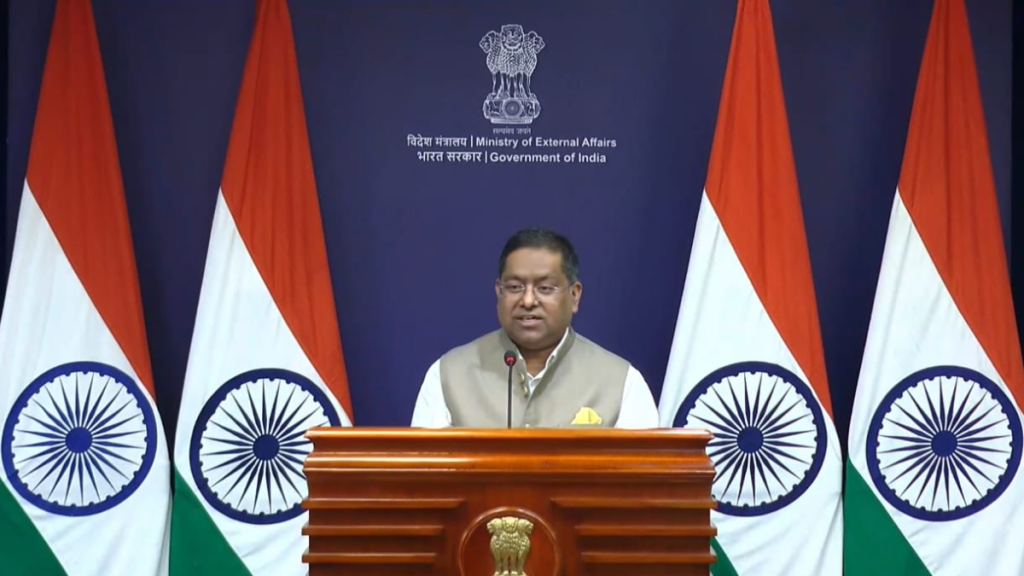
New Delhi: India on Friday firmly rejected Pakistan’s objections over Kashmir, asserting that Jammu & Kashmir and Ladakh “are, were and will remain” integral parts of India. The spokesperson also blamed “one country” for the lack of progress in the South Asian Association for Regional Cooperation (Saarc), as the strain between India and Pakistan continued to feature prominently in the ministry’s weekly briefing.
Responding to Pakistan’s decision to summon the US envoy over remarks describing Kashmir as part of India, Ministry of External Affairs (MEA) spokesperson Randhir Jaiswal said India had nothing to say about Pakistan’s frustration.
MEA blames “one country” for Saarc stalemate
The ministry said Saarc is currently not making progress, attributing the impasse to “one country.” Saarc is a regional organization comprising India, Pakistan, Bangladesh, Nepal, Bhutan, Sri Lanka, Maldives and Afghanistan. Established in 1985, the grouping seeks to promote regional cooperation in areas such as economic development, trade, social progress and connectivity.
The remarks come amid renewed calls for Saarc’s revival, with Maldives President Mohamed Muizzu recently offering to facilitate dialogue among member states to break the regional deadlock.
However, India-Pakistan tensions have significantly affected the grouping’s functioning. The last Saarc summit was held in Kathmandu in 2014, while the 2016 summit scheduled to be hosted by Pakistan was postponed after India and several other member states pulled out following the Uri terror attack.
The MEA also addressed Pakistan’s removal of structures in front of the Indian high commission, saying Islamabad had proceeded with the removal despite India’s request not to do so. Following Pakistan’s action, India removed temporary structures in the lane of the Pakistani high commission in New Delhi, describing the move as a proportionate response. The developments mark another point of friction in already strained India-Pakistan ties.
22 Indian sailors aboard hijacked vessels
The MEA also clarified the status of the Indian sailors aboard the hijacked vessels, saying the ships are not Indian-flagged and are flying the flags of other countries. As reported by RNA, the two vessels – MT Sibu 1, hijacked off Yemen, and MV Lutuf, hijacked off Somalia – have a combined 22 Indian sailors onboard, with 16 aboard one vessel and six on the other.
The ministry stressed that the welfare of the seafaring community remains a high priority for the government.
India-Nepal ties remain strong
On the Indian Army chief’s visit to Nepal, the MEA described the trip as a positive reflection of the close and longstanding relationship between the two countries. India and Nepal share strong historical, cultural and people-to-people ties, with defence cooperation forming an important component of the bilateral relationship.
Nathu La reopened for trade
On border trade, the MEA said Nathu La, the Himalayan pass used for trade with China, has been reopened, while trade activities through two other designated points will be activated accordingly.
On the Ganga Water Treaty with Bangladesh, the ministry said the agreement was signed for a period of 30 years. The issue will be discussed with Bangladesh as part of the agenda for the upcoming Joint Rivers Commission meeting, which will be held at the technical level.
India steps up engagement with Palestine
The MEA said secretary for Consular, Passport, Visa and Overseas Indian Affairs (CPV & OIA) Sripriya Ranganathan concluded a three-day visit to Palestine, during which she held high-level meetings with Palestinian prime minister Mohammad Mustafa and senior ministers, reviewing the full range of India-Palestine ties and discussing ways to deepen bilateral cooperation.
A key outcome of the visit was the groundbreaking ceremony for the Indian Super Speciality Hospital in Arrabeh, Jenin, a Government of India-funded project that will include multiple specialities and a trauma centre, aimed at improving access to advanced healthcare in Jenin and the northern West Bank. India and Palestine also signed two memoranda of understanding (MoUs) covering the construction of the hospital and support for vocational training in the printing sector.
Ranganathan also handed over a consignment of life-saving medicines and announced plans for a prosthetic limb camp in Palestine and the donation of a Bhishm Cube, a portable mobile health unit, for use in Gaza. Her engagements also covered education, skills development, women’s empowerment and technology cooperation, underlining the broader scope of India’s development partnership with Palestine.