


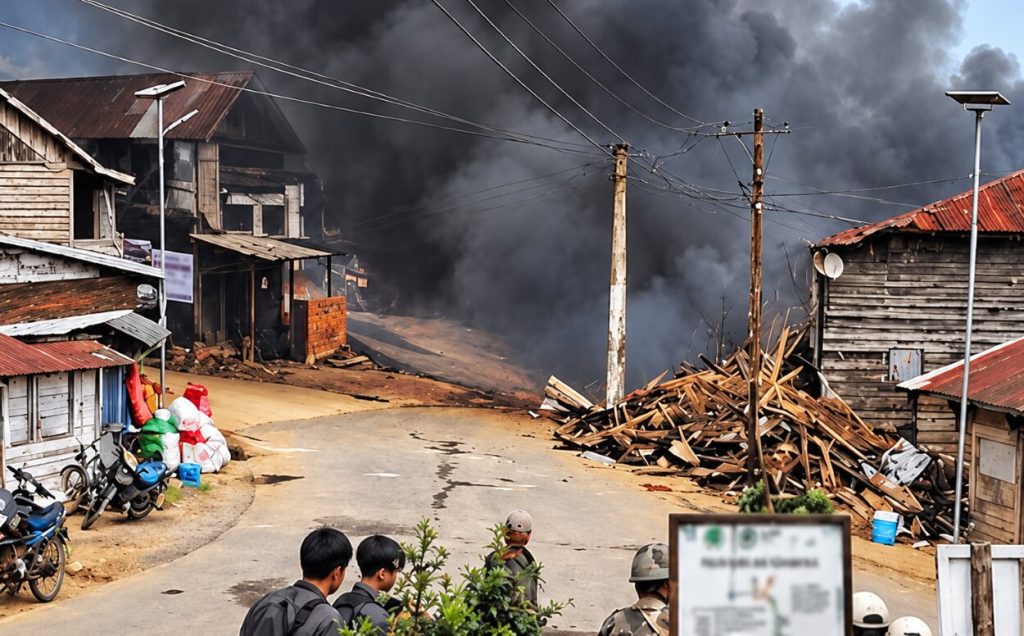
New Delhi: At least nine people were reported killed in shootings and armed clashes across three hill districts of Manipur between Friday and Saturday as renewed Naga-Kuki violence brought arson, highway shutdowns and restrictions on public gatherings. The victims included a Kuki woman with five children, Naga villagers and village guards, and a Gorkha farmer, with attacks reported in Kamjong, Kangpokpi and Ukhrul.
The latest outbreak followed the fatal shooting of Domkhonei Touthang, 42, at Chassad village in Kamjong on Saturday, after which gunfire and attacks on settlements continued into the following morning. Although major reports converged on a toll of nine, accounts differed over the timing and circumstances of some killings, while responsibility for several attacks remained unconfirmed.
Personnel from the Manipur Police, India Reserve Battalion and Border Security Force had gone to Chassad to dismantle alleged illegal bunkers. Media quoting the police reported local women attempted to obstruct the operation and unidentified assailants fired at the security team, which retaliated.
Kuki organizations disputed that account, alleging that security personnel opened fire on women protesting against the removal of village guards and their alleged arrest and detention. The Kuki Students’ Organisation demanded a criminal investigation, compensation for Touthang’s family and an independent inquiry into the conduct of the personnel involved, according to media reports.
A young Kuki man, Michael Ngamminlen Haokip, was also reported killed at Chassad in the early hours of October 10. Kuki civil society organizations blamed the National Socialist Council of Nagalim (Isak-Muivah), or NSCN (IM), for attacks on the village, but the reports reviewed did not establish that allegation independently.
Two Naga residents of Ningchou village in Kamjong were killed in another attack at around 9.30am on October 10. Naga organizations alleged the involvement of Kuki armed groups, including militants operating from Myanmar, while reports citing official sources said possible cross-border involvement had not been confirmed.
In Kangpokpi, four Naga village guards or volunteers were reported killed in violence around Makui and the adjoining road corridor. Accounts differed on whether all four died during an assault on Makui Asang village or whether three were killed there and a fourth in a separate ambush nearby.
A Hindusthan Samachar report described an early-morning attack on Makui followed by an ambush on volunteers travelling towards the village along the Imphal–Tamenglong road. It reported that two wounded volunteers were evacuated to Senapati for treatment, while The Indian Express said continuing gunfire had prevented security personnel from reaching one attack site at the time of reporting.
In Ukhrul, unidentified gunmen killed Sandeep Rai while he was travelling by car on October 10 morning. India Today NE reported that Rai had leased farmland near Chepu Yaolen and was heading towards it when he was attacked; the identities and motive of the assailants remained unclear.
Around 14 houses belonging to members of the Naga and Kuki communities were reported set ablaze, alongside damage to shops near Chassad police station. The Kamjong administration imposed restrictions on gatherings within a 400-metre radius of the police station following the violence.
The unrest also brought fresh restrictions on road movement, with Kuki civil society organizations announcing an indefinite shutdown along National Highway 202, connecting Imphal and Ukhrul, from 11am on October 10. Separately, the Committee on Tribal Unity called a 24-hour shutdown along National Highway 2 through Kangpokpi, from 6pm that day until 6pm on October 11, according to local media reports.
The deputy chief minister, Nemcha Kipgen, condemned the civilian killings and called for thorough, impartial investigations. She also appealed for restraint and warned against retaliatory violence, stressing the need to protect civilians.
The attacks occurred as the chief minister, Yumnam Khemchand Singh, met the prime minister, Narendra Modi, in New Delhi. According to the state government’s account, Modi assured Manipur of assistance in restoring peace, while Singh highlighted efforts to resume passenger services and goods movement on major highways.
The latest killings form part of a Naga-Kuki confrontation that has added another dimension to Manipur’s crisis, which initially centred on violence between Meiteis and Kuki-Zo communities from May 2023. Human Rights Watch reported in September that the earlier conflict had caused more than 260 deaths and displaced more than 60,000 people, while renewed clashes in the hills had brought further killings, hostage-taking and destruction of homes.
The current Naga-Kuki violence began around the mixed-population Litan-Sareikhong area of Ukhrul in February 2026 and subsequently spread to other districts. It has revived longstanding territorial tensions, with attacks and retaliatory abductions drawing armed groups into disputes between neighbouring settlements.
The geography presents a particular challenge for security forces: Naga and Kuki settlements are interspersed across the hills, making it difficult to protect every village or establish a clear separation between opposing armed groups. Violence along roads and highways also disrupts supplies and movement, extending its effects beyond the immediate sites of attacks.
Previous blockades have already affected access to food, fuel and medical treatment, according to Human Rights Watch. The fresh shutdowns therefore add to the pressure on communities facing both armed violence and repeated disruption of essential services.