


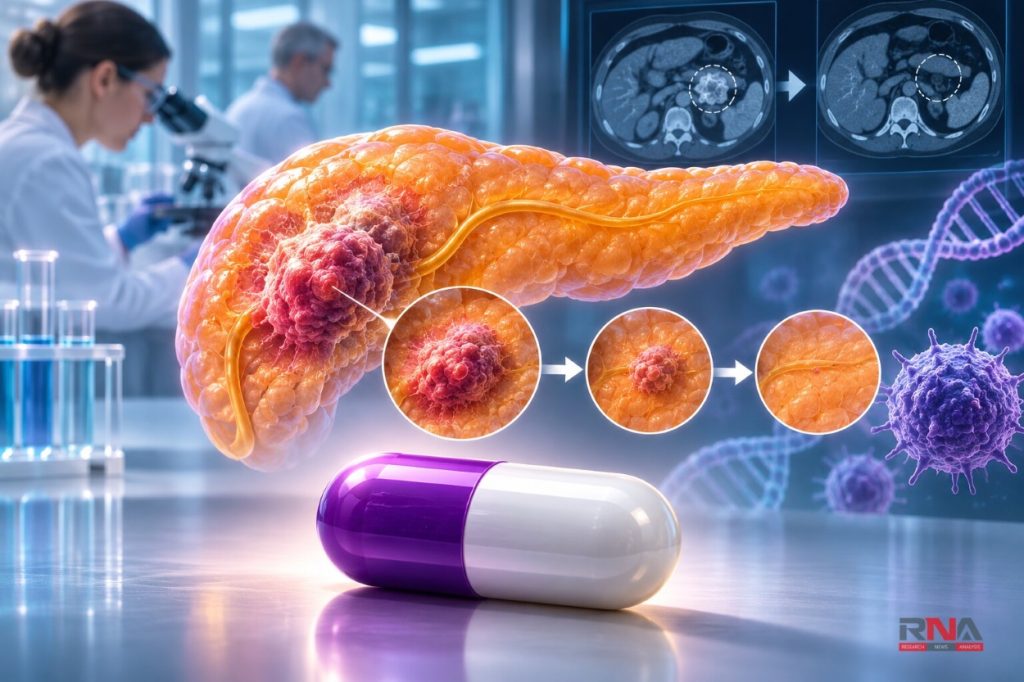
New Delhi: A new oral cancer drug has delivered striking results in an early clinical trial, causing pancreatic tumours to disappear from medical scans in some patients and substantially slowing the disease in many others. The findings have raised hopes of a significant advance against one of the deadliest forms of cancer, although researchers caution that larger studies must establish whether the treatment can reliably extend patients’ lives.
The drug, called daraxonrasib and marketed as Rasonque, was administered alongside conventional chemotherapy to 61 patients whose pancreatic cancer had already spread to other organs. According to findings presented on Friday at an international cancer research conference in Barcelona, Spain, tumours shrank or became undetectable in approximately 61 per cent of participants, with complete responses recorded in 8.2 per cent.
The results are particularly encouraging because metastatic pancreatic cancer has historically proved extremely difficult to control, with existing chemotherapy treatments offering limited survival benefits. In the latest study, researchers reported that the disease stopped progressing in approximately 90 per cent of patients, suggesting the experimental combination could provide more sustained tumour control than conventional treatment alone.
The findings emerged from the phase 1/2 RMC-GI-102 trial conducted by the American biotechnology company Revolution Medicines, with updated results presented at the 38th EORTC-NCI-AACR Symposium on Molecular Targets and Cancer Therapeutics. The research involved patients receiving daraxonrasib as their first treatment for metastatic pancreatic adenocarcinoma, the most common form of pancreatic cancer.
What the clinical trial revealed
The study recorded a confirmed tumour response rate of 60.7 per cent, including five patients whose cancers became undetectable on scans. Another important finding was a median progression-free survival of 12.8 months, meaning half the patients remained alive without their disease worsening for at least that period.
The researchers also reported that 76.6 per cent of participants were alive one year after beginning treatment, although the median overall survival had not yet been established. Conventional chemotherapy generally produces tumour responses in approximately 23–42 per cent of comparable patients, with disease progression commonly occurring within five to six months, according to figures presented at the conference.
The study’s principal investigator, Dr Wungki Park, a medical oncologist at Memorial Sloan Kettering Cancer Center in New York, described the results as potentially transformative for patients with advanced pancreatic cancer. He nevertheless acknowledged that the findings required confirmation through a larger randomized trial comparing the new combination directly with standard chemotherapy.
Importantly, a complete response does not necessarily mean cancer has been eliminated permanently, because microscopic malignant cells may remain undetected and later cause recurrence. Researchers must therefore establish whether the responses persist and whether patients receiving the treatment ultimately survive longer.
How new drug attacks pancreatic cancer
Daraxonrasib works by interfering with RAS proteins, molecular switches that regulate cell growth and division and are frequently altered in cancerous cells. More than 90 per cent of pancreatic cancers carry mutations affecting this signalling system, making it an important target for treatments designed to disrupt tumour growth.
The drug inhibits the active form of RAS, potentially blocking signals that allow malignant cells to multiply and survive. By combining it with gemcitabine and nab-paclitaxel, two established chemotherapy medicines, researchers hope to attack cancer through complementary mechanisms and delay the development of resistance.
Patients in the latest trial received 200mg of daraxonrasib orally each day alongside scheduled intravenous chemotherapy. Reported adverse effects included rashes, diarrhoea, fatigue and reductions in blood-cell counts, although investigators said most were manageable with established medical interventions.
Already approved in US, but not for this combination
Unlike many experimental cancer drugs, daraxonrasib has already secured regulatory approval for a different treatment setting. The US Food and Drug Administration approved it on August 26 this year for certain patients with metastatic pancreatic cancer who had previously received systemic treatment or could not undergo intensive combination chemotherapy.
That decision followed a separate randomized trial involving 500 patients, which demonstrated median overall survival of 13.2 months among those receiving daraxonrasib, compared with 6.7 months for patients given standard chemotherapy. The European Commission also approved the medicine in November for previously treated metastatic pancreatic cancer, but its use alongside chemotherapy as an initial treatment remains under investigation.
The distinction matters because regulatory approval for one patient population does not automatically establish that a medicine is effective or safe when administered earlier in the disease or combined with additional drugs. The ongoing phase 3 RASolute 303 trial is designed to determine whether daraxonrasib, administered independently or alongside chemotherapy, produces superior outcomes compared with chemotherapy alone.
Why scientists remain cautiously optimistic
The new results have attracted considerable attention from cancer specialists, although independent researchers have emphasized the limitations of a relatively small study without a randomized comparison group. Professor Shivan Sivakumar, a translational oncology specialist at the University of Birmingham, told the Science Media Centre that the findings compared favourably with historical chemotherapy outcomes but could not yet establish a definitive survival advantage.
The implications extend beyond pancreatic cancer because mutations involving RAS proteins also contribute to several lung, colorectal and other malignancies. However, each application would require separate clinical evidence, and the drug’s effectiveness against one cancer cannot be assumed to extend automatically to another.
For India, where late diagnosis, treatment costs and unequal access to specialist oncology services remain substantial challenges, advances against difficult-to-treat cancers could eventually have considerable public-health significance. An earlier RNA Media analysis of emerging cancer treatments examined how scientific breakthroughs, including those assisted by artificial intelligence, must overcome clinical, regulatory and affordability barriers before delivering widespread benefits.
Daraxonrasib is not yet approved in India, and there has been no verified separate Chinese government response to the latest findings, which concern clinical research rather than a geopolitical development. For now, the important question is whether the encouraging tumour responses translate into sustained survival gains – a result that could fundamentally improve the treatment outlook for patients facing advanced pancreatic cancer.